Xinjiang Lamb Kebabs (Kawap): The Complete Guide to the Silk Road’s Most Iconic Street Food
Xinjiang Lamb Kebabs (Kawap): The Complete Guide to the Silk Road’s Most Iconic Street Food
Last updated: July 15, 2026 · Written by Karl Huang, a Xinjiang travel specialist who has spent time across the region. Practical details are cross-checked against official tourism, transport, and border-regulation sources.
If Xinjiang had an official smell, it would be the aroma of lamb fat dripping onto glowing charcoal, cumin and chilli rising in fragrant smoke over a busy night market. The Xinjiang lamb kebab — known locally as kawap in Uyghur and yang rou chuan (羊肉串) in Chinese — is the single most iconic street food of the region and one of the great grilled-meat traditions of the world. Cubes of well-marbled lamb, threaded onto flat metal or reddish willow skewers, dusted with cumin, salt and chilli, and grilled fast over open coals until the edges char and the fat turns golden: it sounds simple, and that simplicity is exactly the point. Done right, a Xinjiang kebab is smoky, juicy, faintly sweet from the lamb’s own fat, and deeply savoury from the cumin. This guide covers where the dish comes from, what makes the Xinjiang version distinct, how to order and eat it like a local, and where to find the best skewers across the region.
Why Xinjiang Kebabs Are Different
Grilled meat on a stick exists all over the world, from Turkish şiş to Japanese yakitori, and the shared Central Asian and Middle Eastern roots of the kebab run deep. But the Xinjiang version has a character all its own. First, the lamb: Xinjiang’s sheep graze on the salty, herb-rich pastures of the Tianshan and the desert fringes, giving the meat a clean, mild flavour with none of the muttony heaviness many travellers fear. Second, the fat: a proper skewer alternates lean meat with cubes of tail fat, which melts during grilling and bastes the lean pieces from within. Third, the spice: the trinity of ground cumin, salt, and dried red chilli is applied generously but never used to mask the meat — it amplifies it. Fourth, the fire: real Xinjiang kebabs are cooked over charcoal, fanned by hand or by a simple blower, so the surface caramelises fast while the centre stays tender. The result is a kebab that tastes of the grassland, the desert, and the Silk Road all at once.
History & Cultural Background
The kebab is one of humanity’s oldest cooked foods — meat over fire predates almost every other culinary technique — and Central Asia, with its nomadic herding cultures, has grilled skewered meat for millennia. In Xinjiang, the dish is inseparable from the Uyghur people and the wider community of Turkic and Central Asian cultures who have lived along the Silk Road for centuries. As a halal food, lamb has always been central to the local diet, and grilling skewers became a natural way to cook it quickly and communally, whether at a family gathering, a bazaar, or a wedding feast.
What began as regional home and market cooking became, over the last few decades, one of China’s most beloved street foods. Uyghur vendors carried the kebab to cities across the country, and today you can find “Xinjiang chuan’r” grills from Beijing to Guangzhou. Yet nothing compares to eating them at the source. In Xinjiang, the kebab is woven into daily life: it is the smell of the evening bazaar, the centrepiece of the night market, the reliable snack after a long day’s travel. Around it has grown a whole culture of communal eating — friends gathered around a low table, a mountain of skewers, flat naan bread, cold beer or salty milk tea, and easy conversation stretching late into the night.
The Many Forms of the Xinjiang Kebab
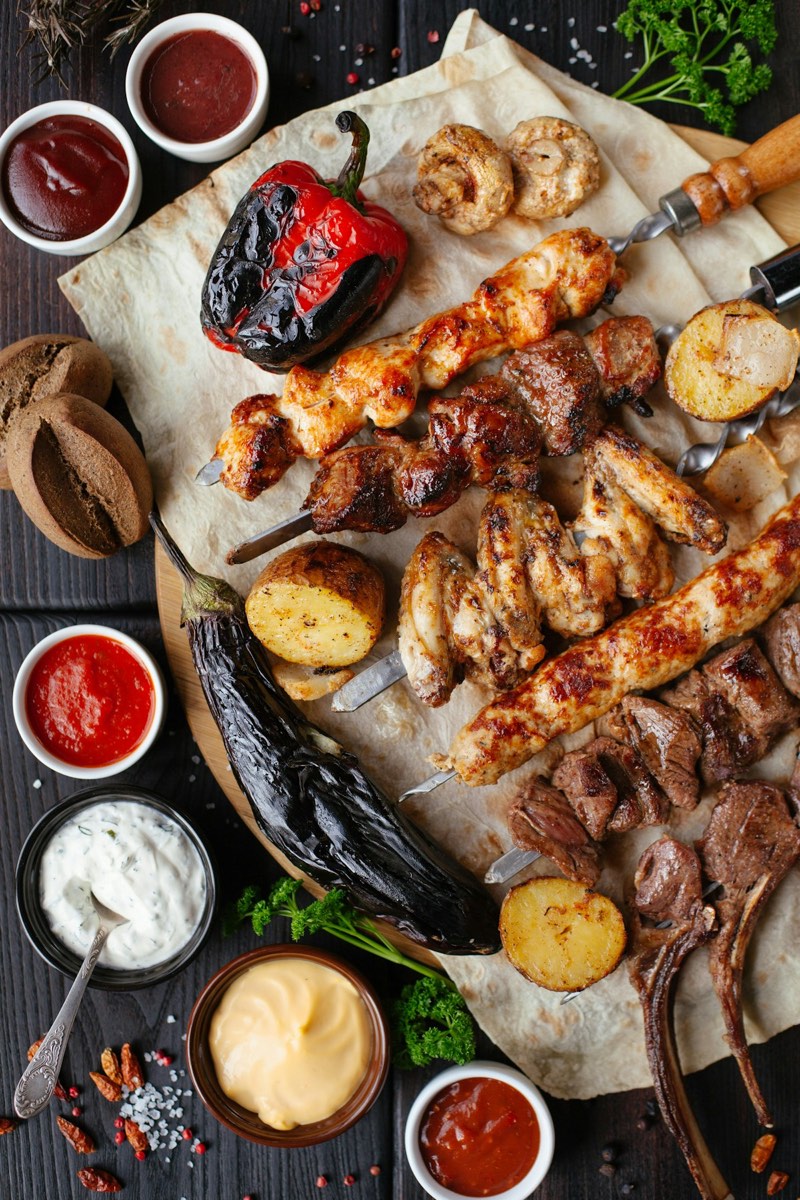
While the classic small lamb skewer is the icon, the family of Xinjiang grilled meats is surprisingly large. Knowing the varieties helps you order well:
- Classic lamb skewers (羊肉串): Small cubes of lamb and tail fat on thin skewers, sold by the stick. The everyday standard, eaten by the dozen.
- Big skewers / red willow skewers (红柳烤肉): Large chunks of lamb grilled on thick, freshly cut red willow branches. The willow imparts a subtle sap-sweet aroma, and the bigger cubes stay especially juicy. A must-try if you see them.
- Roast lamb ribs and lamb chops (烤羊排): Whole ribs or chops grilled slowly, crispy outside and tender within.
- Roast lamb leg (烤羊腿): A whole leg, spit-roasted and carved at the table — a feast dish for groups.
- Grilled fish (烤鱼) and grilled chicken wings: Common at night markets, seasoned with the same cumin-chilli blend.
- Grilled offal and kidneys (烤腰子): For the adventurous, these are a night-market favourite.
- Grilled naan and grilled vegetables: Naan brushed with oil and warmed on the grill, plus peppers, eggplant, and mushrooms for balance.
How to Order & Eat Kebabs Like a Local
Where to find them: The best kebabs come from three kinds of places — busy night markets, dedicated kebab restaurants, and humble street stalls with a single charcoal trough. As a rule, follow the crowds and the smoke: a stall with a queue of locals and a fast turnover is grilling fresh, and freshness is everything.
How to order: Skewers are usually sold per stick, and they are cheap — often just a few RMB each. Order generously; a hungry traveller can easily put away ten or more small skewers. It is normal to order a stack at once. Pair them with naan bread to soak up the juices, a plate of cold noodles or a fresh tomato-and-onion salad (a classic accompaniment that cuts the richness), and a drink.
What to drink: Locals pair kebabs with salty milk tea, fresh yogurt, or in many settings, cold beer. In summer, a glass of freshly pressed pomegranate or apricot juice is a wonderful match.
How to eat: Slide the meat off the skewer with your teeth, or push it off onto your naan. Do not be shy about the fat cubes — that rendered fat is where much of the flavour lives. Eat the skewers hot, straight off the grill; they lose their magic as they cool.
Etiquette and cost: Kebab eating is casual and communal. Expect plastic stools, shared tables, and a lively atmosphere. A generous kebab dinner for one rarely costs more than 30–50 RMB, making it one of the best-value meals in China.
Where to Find the Best Kebabs in Xinjiang
Urumqi: The regional capital is a kebab paradise. The area around the International Grand Bazaar has famous grill houses, and the city’s night markets fire up thousands of skewers every evening. Look for the big red-willow skewer specialists.
Kashgar: In the old city and around the night market near the Id Kah Mosque, kebabs are grilled in the open air in a setting that has barely changed in generations. Kashgar is also excellent for whole roast lamb and lamb ribs.
Turpan: Eating grilled lamb under the grape trellises of Turpan on a warm evening, with the region’s famous grapes and melons for dessert, is a quintessential Xinjiang experience.
Hotan and the southern oases: The Sunday markets and evening bazaars of the southern Silk Road towns serve some of the most traditional, unfussy kebabs you will find anywhere.
Wherever you are, the golden rule holds: eat where the locals eat, choose stalls with fast turnover, and go at night when the markets are alive.
The Anatomy of a Perfect Skewer
Once you have eaten a few dozen skewers, you start to appreciate the craft behind what looks like a casual snack. A great Xinjiang kebab comes down to four things. First is the cut: the best vendors use fresh, never-frozen lamb from the shoulder or leg, cut into bite-sized cubes big enough to stay juicy but small enough to cook through quickly. Second is the ratio: a proper skewer threads lean meat and cubes of tail fat in deliberate alternation, so the melting fat bastes the lean pieces as they cook. Third is the fire: real charcoal, not gas, built to a bed of even, glowing coals with no flames licking the meat — the grill master constantly fans the coals and turns the skewers so the surface caramelises without burning. Fourth is the timing of the spice: cumin, salt, and chilli are added in stages, with a final generous dusting in the last moments over the fire so the aromatics bloom in the heat rather than scorching. Watch a skilled vendor and you will see a rhythm — lay, turn, dust, turn, lift — honed over thousands of nights at the grill.
Recreating Xinjiang Kebabs at Home
Part of the appeal of travelling for food is bringing a little of it home. Xinjiang kebabs are surprisingly achievable in your own kitchen or backyard. Start with good lamb shoulder, cut into 2–3 cm cubes, and include some fat. Marinate lightly — many purists use only a little salt, oil, and a splash of onion juice, letting the spices do their work on the grill rather than in a heavy marinade. Thread the meat onto flat metal skewers, alternating lean and fat. Grill over a hot bed of real charcoal, turning frequently, and dust generously with a mix of ground cumin, salt, and dried red chilli flakes (and a pinch of Sichuan pepper if you like) during the final minutes. The keys are high, even heat and not overcooking — pull the skewers while the centre is still juicy. Serve immediately with warm flatbread and a sharp tomato-onion salad. It will not be identical to a Kashgar night market, but it will carry you straight back.
Practical Tips for Travellers
- Freshness is safety: Choose stalls grilling to order over a hot fire. Meat that sits pre-grilled loses quality and safety. Piping-hot skewers straight off the coals are your best bet.
- Pace your spice: The chilli can be assertive. If you are sensitive, ask for “少辣” (less spicy) — most vendors will oblige. The cumin, however, is essential; do not skip it.
- Mind the fat: The tail-fat cubes are prized locally but very rich. If they are not for you, you can order leaner skewers, but try at least one traditional skewer for the full experience.
- Balance your plate: Order the tomato-onion salad or some grilled vegetables and naan alongside. The acidity and bread balance the richness of the lamb.
- Carry small cash: Street stalls prefer cash or mobile pay; skewers are inexpensive, so small denominations help.
- Halal context: Kebabs are a halal food central to local Muslim culture. Approach the food and the vendors with the same respect you would anywhere.
- Pair with the region’s fruit: Finish a kebab feast with Xinjiang’s legendary melons and grapes — the sweetness is the perfect counterpoint to smoky, salty meat.
Before you go
The Xinjiang lamb kebab is proof that the world’s greatest dishes are often the simplest: good meat, real fire, and a handful of well-chosen spices. To eat kawap at a Xinjiang night market — surrounded by smoke and chatter, a stack of skewers in front of you, warm naan in hand, the desert night cooling around you — is to taste the Silk Road itself. No trip to the region is complete without it, and few culinary memories from anywhere in China will stay with you longer. Follow the smoke, pull up a plastic stool, and order more than you think you can eat. You will finish every last skewer.