Turpan Practical Guide: Tickets, How Many Days, Where to Stay, and Getting Around
{ “@context”: “https://schema.org”, “@type”: “Article”, “headline”: “Turpan Practical Guide: Tickets, How Many Days, Where to Stay, and Getting Around”, “description”: “If there is one place in Xinjiang that makes you feel like you have traveled back to the ancient Silk Road, it is Turpan (吐鲁番). This is one”, “url”: “https://www.xinjiangtraveltips.com/turpan-xinjiang-travel-guide/”, “datePublished”: “2026-06-09”, “dateModified”: “2026-06-09”, “mainEntityOfPage”: { “@type”: “WebPage”, “@id”: “https://www.xinjiangtraveltips.com/turpan-xinjiang-travel-guide/” }, “publisher”: { “@type”: “Organization”, “name”: “Xinjiang Travel Tips”, “url”: “https://www.xinjiangtraveltips.com” }
}
Turpan (吐鲁番) is Xinjiang’s furnace — one of the hottest, lowest, and most historically layered spots in the region — and it is an easy add-on from Urumqi. This is the logistics version: how many days, what it costs to see, where to stay, and how to move around. The main Turpan guide covers the “why.”
How many days?
- 1 day: a rushed loop of the Grape Valley, Jiaohe, and the bazaar. Possible from Urumqi but thin.
- 2 days: comfortable — day one the oasis sights (Grape Valley, Karez wells, bazaar), day two the desert ruins (Jiaohe, Bezeklik, Flaming Mountains).
- 3 days: relaxed, with Aydingkol (the lowest point in China) and a vineyard/wine stop.
Getting there and around
- From Urumqi: high-speed train (~1 hour) or car (~2.5–3h). The train makes a day-trip realistic.
- Inside Turpan: the sights are scattered and far apart. A car or driver is the practical choice; public buses exist but eat your time.
Tickets
Each major site (Grape Valley, Jiaohe, Bezeklik, Karez) is a separate paid ticket. There is sometimes a combined pass — confirm at the station. Budget the tickets as your main cost after transport.
Reaching {P} on buses, taxis and shared rides
We came twice. The first time we chartered a car for the round trip and it was worth every yuan. The trick is finding the vehicle rather than the timetable. The second a driver on a return leg dropped us at the entrance and waited in the car park, which is the cheap way to do it if you do not mind setting your own clock.
In Turpan the drivers wait where drivers always wait, in the little offices a few hundred metres off the main terminal, and they will put together a half-day for a price the meter would never quote. The last vehicles back leave in the early evening, and after dark on a mountain road the local buses stop running entirely. Leave two hours of slack on the return. Turpan Xinjiang sits an hour or two from the nearest town, which sounds close until you work out there is no reliable public bus to the gate.
What does exist is an intercity coach leaving the Turpan long-distance station early, a taxi share at the stand that costs a few tens of yuan a head if you are patient, and the tour vans that pick up at hotels.
The hour I go back for
By ten the coaches are here, and by one it is an hour of people shuffling past. I have come to like the last forty minutes before the gate shuts, when the groups have gone and the staff are sweeping, because that is when you can look up properly instead of squeezing a shoulder past strangers. Whatever the guidebook says about golden hour, go on a weekday. The light is only free of company on a Tuesday. Midday is the hour to avoid, not the hour to schedule.
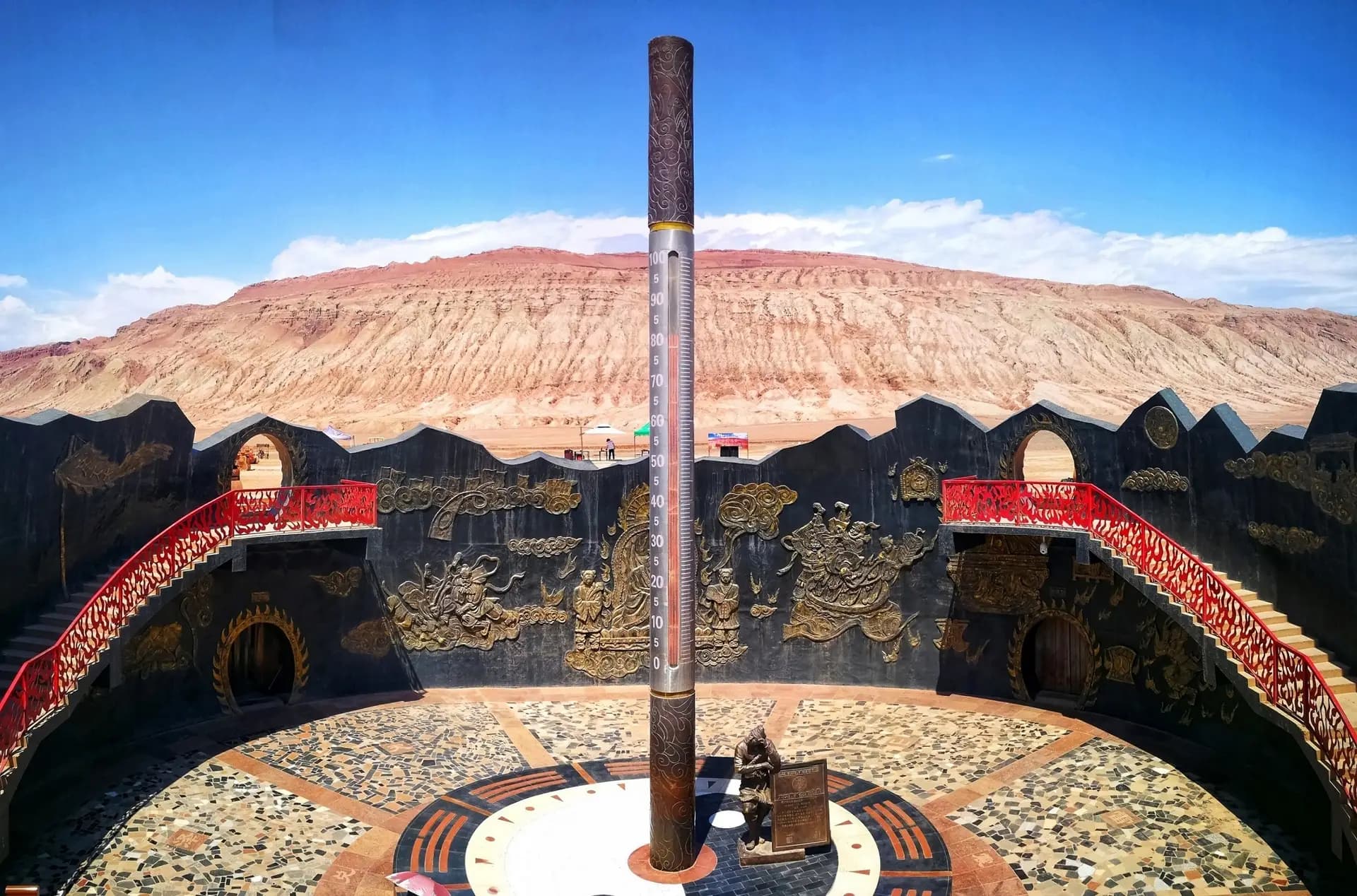
Go early or go late and the same ground gives you two different subjects. Everything goes flat, the shade disappears, and the temperature on an open plateau rises in a way that stops you caring about photographs. Between the two I would pick the later one, mostly because the early version costs you the rest of the day. Sunrise is the one worth an alarm for. The whole face of Turpan Xinjiang turns a colour that does not exist at any other time, and the site is empty enough that you can stand still and hear nothing.
More on the other end of that day is in our [[turpan-travel-guide-2026-xinjiang|Turpan Travel Guide 2026, Xinjiang]].
A second look on day two
I did, and the second visit was better, because the first had been spent working out where to stand. The second time you can skip the obligatory viewpoint and walk along the base of the ridge where the light comes in sideways, and that is the photograph you keep. If your itinerary has a spare morning, spend it here again rather than at the bigger name on the far side of town. Almost nobody does Turpan Xinjiang twice.
What goes in the day pack
Sunscreen and a brim. The light here is serious and the shade is intermittent, so the sunscreen goes on before you leave the hotel, not at the gate. A wind shell. The temperature drops fast once you stop moving and the drop is not hypothetical on an exposed pass.
Water, more than you think, a power bank and some cash. A fleece covers most of the year, a real jacket covers shoulder season. Cards work at the gate and in the shops, but the stalls on the approach road and the drivers waiting at the turnoff want cash, and coming up short at the moment you want a lift is the classic way to lose an hour. That stretch of the trip is described in our [[xinjiang-travel-guide-2026-2|Xinjiang Travel Guide 2026]] too.
A place to crash
- In Turpan city: the normal base — hotels, food, and the night bazaar within walking distance.
- Near the Grape Valley: family courtyard stays in summer; atmospheric but limited.
Beat the heat
Summer daytime regularly tops 40°C. Do outdoor ruins in the early morning or late afternoon, hydrate hard, and treat midday as indoor/rest time. The Karez wells and the Grape Valley both offer shade. For the full sightseeing list, the vineyard and wine guide and the Bezeklik cave art round out a two-day plan.