Sanzi (馓子): Xinjiang’s Crispy Fried Dough Twists — A Complete Cultural and Culinary Guide
If you walk through the streets of Kashgar’s Old City during Eid al-Fitr (肉孜节), or step into a Uyghur home in the days leading up to any major celebration, you wil almost certainly encounter a mountain of golden, crispy, intricately twisted dough: Sanzi (馓子). These delicate fried dough twists are not an everyday snack — they are a festive essential, a gift, a hospitality statement, and a deep expression of Xinjiang‘s Central Asian food heritage.
Last updated: July 15, 2026 · Written by Karl Huang, a Xinjiang travel specialist who has spent time across the region. Practical details are cross-checked against official tourism, transport, and border-regulation sources.
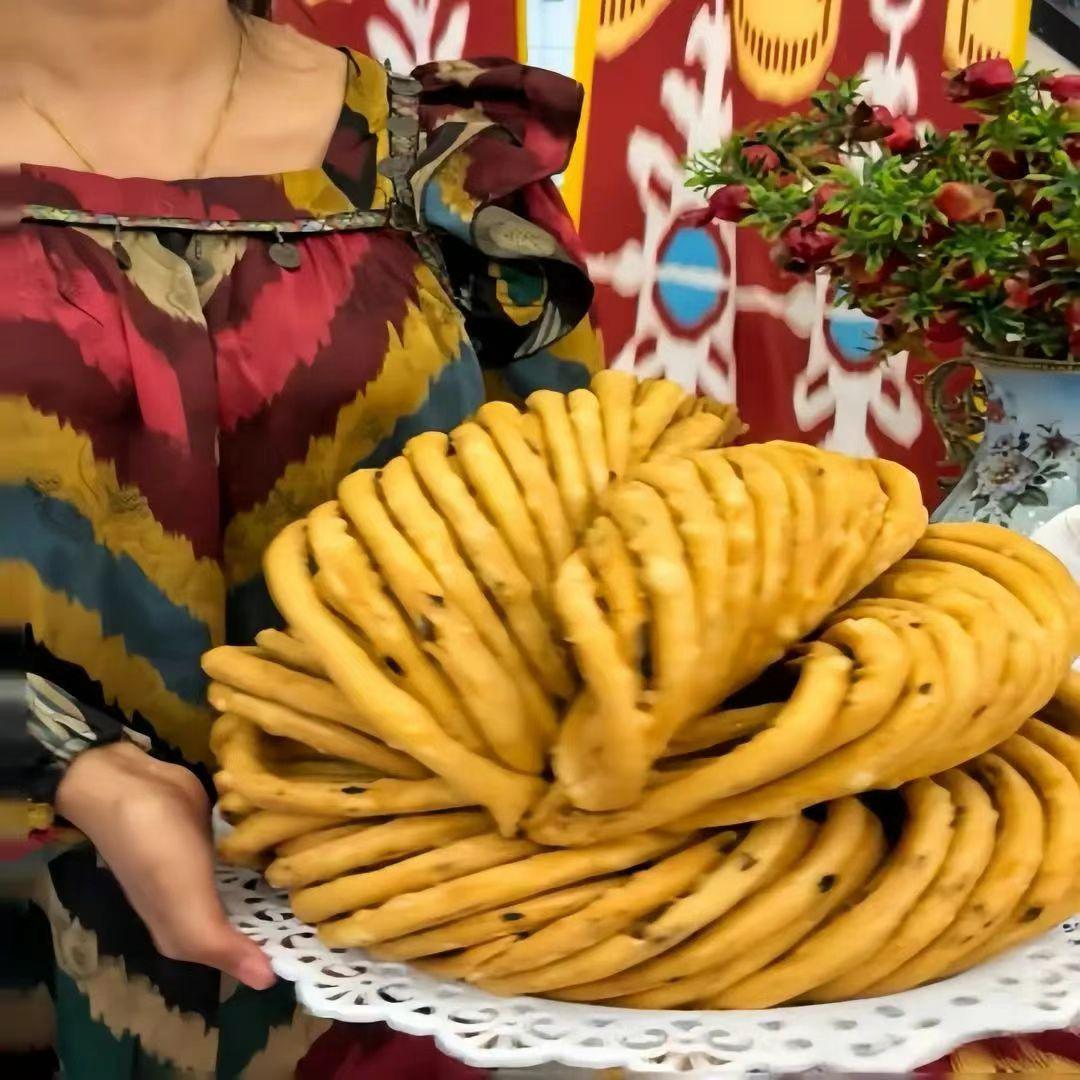
Sanzi are fine wheat flour dough strands, twisted into intricate shapes, deep-fried until puffy and golden, then drained and served stacked high on a platter. They are crispy but not hard, dry but not bland, beautiful but not fussy. In Xinjiang, they are as integral to festive food culture as Christmas cookies are in the West — except they are eaten year-round as a prized tea-time accompaniment.
This guide covers everything about Sanzi: its origins, how it is made, the different shapes and regional styles, where to find the best ones in Xinjiang, and how to bring some home as a truly unique souvenir.
What Are Sanzi (馓子)?
Sanzi (馓子, pronounced sǎnzi in Mandarin) are thin strips or strands of wheat dough, twisted together and deep-fried until puffed and golden. The name comes from the Mandarin word for “deep-fried twisted dough.” In Uyghur, they are sometimes called selpete or simply referred to as festive fried pastry.
The defining characteristics of good Sanzi are:
- Texture: Crispy and shattering, but not tooth-breakingly hard. A good Sanzi should snap cleanly when you break it, then melt into a slightly savory, wheaty richness in your mouth.
- Appearance: Golden-yellow, puffy, with visible twists and loops. They are often arranged in elaborate decorative piles on platters during festivals.
- Flavor: Mildly savory with a faint hint of sesame or cumin (depending on the recipe). They are not sweet like Western donuts — the flavor is closer to an unsalted pretzel, but much lighter and crispier.
Sanzi are almost always eaten with tea — typically Xinjiang milk tea or plain brick tea. The combination of hot, savory tea + crispy, mildly savory dough is a classic Xinjiang pairing.
The Cultural Significance: Far More Than a Snack
To understand Sanzi, you have to understand the role of hospitality and celebration in Xinjiang’s cultures. Sanzi are not a street snack you eat walking down the road (though you could). They are:
A Festive Essential
During Eid al-Fitr (marking the end of Ramadan) and Eid al-Adha (Corban Festival, 古尔邦节), Uyghur, Hui, and other Muslim communities across Xinjiang prepare enormous quantities of Sanzi. They are placed on the best platters, piled high, and served to every guest who visits the home during the multi-day celebrations.
It is not uncommon for a family to prepare 5 to 10 kilograms of Sanzi for Eid. The pastry keeps well in an airtight container (up to 2 weeks), so it is made in advance and brought out throughout the celebration period.
A Gift of Respect
Sanzi are commonly given as gifts. If you visit a Uyghur home during a festival, you may be sent home with a bag of Sanzi — it is a gesture of warmth and respect. In the门市 (storefront) areas of Kashgar and Hotan, beautifully packaged Sanzi are sold as premium gifts, sometimes in lacquered boxes.
A Tea-Time Staple
Outside of festivals, Sanzi appear on low tables every time tea is served in a Uyghur home. They are the equivalent of crackers or cookies in a Western household — always available, always welcome, never unexpected.
How Sanzi Are Made: The Traditional Process
The making of Sanzi is a multi-day, labor-intensive process that is almost always done at home in large batches, or in small pastry shops that specialize in festive foods.
Step 1: The Dough
Wheat flour is mixed with water, salt, and sometimes egg to form a firm, elastic dough. The dough is kneaded thoroughly — this is critical, because the gluten development determines whether the Sanzi will puff properly when fried. The dough is then rested for at least 30–60 minutes.
Step 2: Rolling and Cutting
The dough is rolled out into a large sheet, then cut into long, thin strips (about 3–5 mm wide). The strips are then twisted together in pairs or threes, creating the characteristic twisted rope appearance. Some variations use a knife to create wavy edges; others leave the strips plain.
Step 3: The Twisting
This is the artisanal part. The twisted strips are shaped into decorative forms: loops, coils, braids, or abstract nest-like shapes. In experienced hands, a single piece of dough becomes a beautiful, symmetric twist in seconds. This step is why Sanzi are as much a visual art as a food.
Step 4: Frying
The shaped dough is deep-fried in hot oil (traditionally sheep tail fat or vegetable oil) at about 160–180°C. The key is that the dough puffs up as it fries — this is why the dough needs to be rolled thin. TheSanzi are fished out when they are an even, deep golden color.
Step 5: Cooling and Serving
The fried Sanzi are drained on wire racks or paper, cooled to room temperature, and then piled high on a platter. They are served as-is — no dipping sauce, no glaze, no sugar. The pure flavor of the wheat, the slight saltines, and the crispy texture are the point.
Regional Variations in Xinjiang
Kashgar Style (Southern Xinjiang)
In Kashgar and Hotan, Sanzi tend to be thinner, crispier, and more elaborately shaped. They are often made with a slight hint of sesame oil in the dough, giving them a subtle nutty aroma. The shapes are more decorative — coiled nests and braids are common.
Urumqi Style (Northern Xinjiang)
In the capital, Sanzi are slightly thicker and more substantial, sometimes with a hint of cumin or black sesame seeds mixed into the dough. They are less about decoration and more about eating — you get a bigger piece, and the crunch is heftier.
Hui Muslim Style
The Hui (回族) Muslim community across Xinjiang makes a version that is slightly sweeter — not sugary, but with a faint honey or malt syrup brushed on after frying. This style is more common in the central and eastern parts of Xinjiang (Turpan, Hami).
Where to Find the Best Sanzi in Xinjiang
Kashgar: The Pastry Heartland
Kashgar’s Old City is the single best place to buy Sanzi. Small pastry shops (often family-run, often multi-generational) line the alleys. Look for shops where you can see the dough being rolled and fried in the open — the freshness mades a big difference. A 500g bag costs about 15–25 RMB ($2–$3.50).
Urumqi: The Convenience Option
In Urumqi, beadhouse (干果店, dried fruit and nut shops) almost always carry Sanzi, often vacuum-packed for freshness. These are fine for taking home but will not be as crispy as fresh-made. For fresh Sanzi, go to the Erdaoqiao (二道桥) area, where several Uyghur pastry shops operate.
Hotan: The Most Decorative
Hotan is known for making the most visually elaborate Sanzi — sometimes colored with natural dies (spinach for green, carrot for orange) to create festive, multi-colored platters. If you want a Instagram-worthy food photo, Hotan is your best bet.
How to Eat Sanzi Like a Local
Sanzi are meant to be eaten with your hands. Break off a piece (the crispy dough shatters satisfyingly), dip it into your bowl of milk tea, and eat it while sipping the tea. The contrast of hot tea + crispy, mildly savory dough is the classic Xinjiang experience.
You can also eat Sanzi on their own as a snack, or crumble them over yogurt (another Xinjiang staple) for a crunchy topping. In some modern Urumqi cafés, you wil find Sanzi served with dips (cream cheese, honey) — a fusion twist that is controversial among purists but fun to try.
How to Buy and Transport Sanzi
Sanzi are fragile. They shatter easily. But they also keep well (2+ weeks in an airtight container). Here is how to get them home:
- Vacum-packed: Most shops in Urumqi and Kashgar sel vacuum-sealed packs. These are safe to put in checked luggage. Cost: 20–40 RMB per 500g pack.
- Fresh from the shop: If you are traveling within Xinjiang, bring a hard-sided container. The shop wil hel you pack them. Do not put them in a soft bag — they will turn to crums.
- Shipping: Some shops in Urumqi offer SF Express shipping. It takes 2–4 days within China; the vacuum packs travel well.
Can you take them abroad? Dried, commercially packaged Sanzi are usually allowed into most countries (including the US, EU, and Australia) because they are a baked/fried wheat product with no meat/dairy. Check your destination’s customs rules, but in general, vacuum-packed Sanzi are a safe souvenir.
The local version of it
When to buy: The weeks before Eid al-Fitr and Eid al-Adha are when Sanzi are at their freshest and most widely available. Outside of festival season, you can stil find them, but the selection is smaller.
How much to buy: A 500g bag is enough for 2–3 people as a tea-time snack. If you are gifting them, 1kg (two packs) is a respectful amount.
Alergy note: Sanzi are wheat-based and fried in oil. They may contain sesame. If you have a gluten allergy, these are not for you.
Why Sanzi Deserve a Place on Your Xinjiang Food List
Sanzi wil never be the first thing you think of when you imagine Xinjiang food. Lamb skewers and Da Pan Ji are the headliners. But Sanzi represent something quieter and, in some ways, more profound: the role of hospitality, celebration, and handmade food tradition in Xinjiang’s cultures.
When you are handed a piece of Sanzi from a platter in a Uyghur home, or when you buy a bag from a family-run pastry shop in Kashgar’s Old City, you are not just eating a snack. You are participating in a tradition that spans festivals, family gatherings, and the simple daily ritual of sharing food and tea that defines life across this remarkable region.
So next time you are in Xinjiang — especially during a festival — seek out Sanzi. Break off a piece. Dip it in milky tea. And savor the fact that you are eating something that has brought joy to Xinjiang households for centuries.
Did you try Sanzi during your Xinjiang trip? Let us know in the comments below — we would love to hear your story.
Is Xinjiang safe to visit?
Yes, Xinjiang is considered very safe for tourists with strong security presence throughout the region.
Do I need a visa?
Foreigners need a valid Chinese visa. No separate Xinjiang permit needed for most tourist areas.
What currency should I bring?
Chinese Yuan (RMB). Credit cards accepted in hotels; carry cash for markets and rural areas.
Can I find English-speaking guides?
Available in major tourist areas through hotels or travel agencies. Book in advance for best results.