Xinjiang Kebab Culture: Beyond the Basic Lamb Skewer
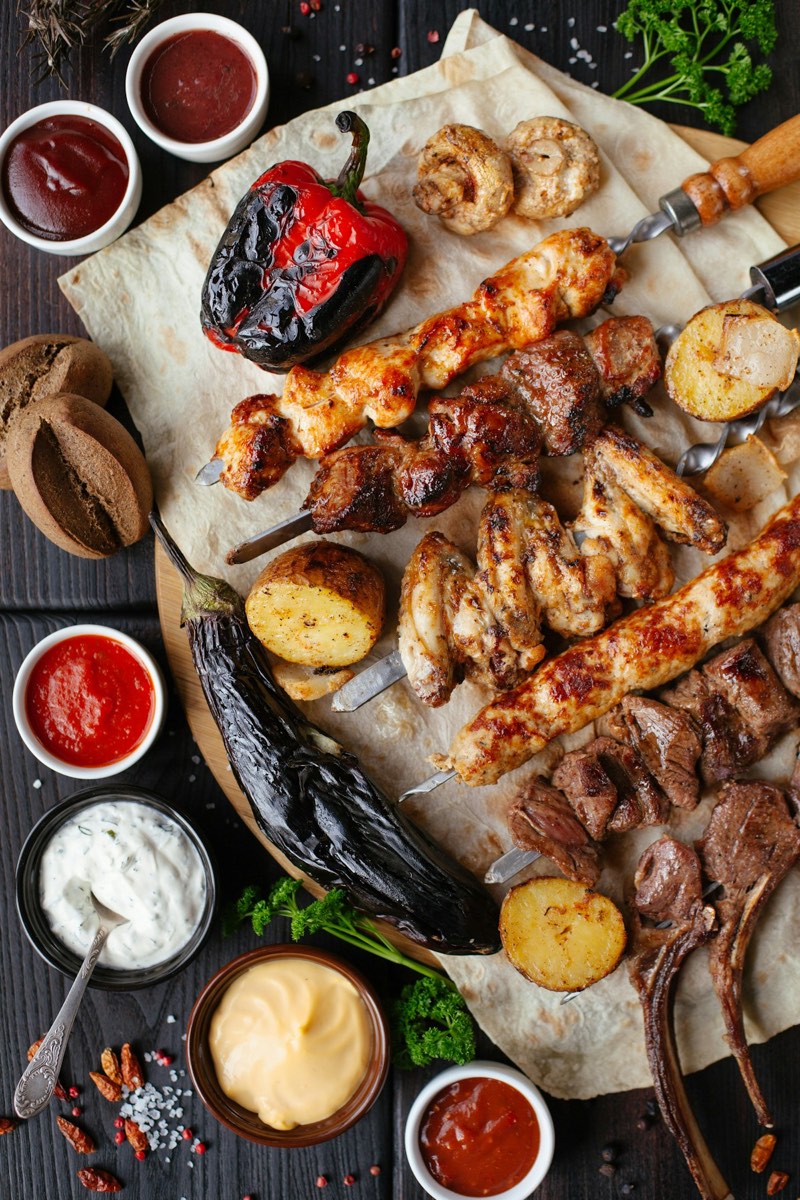
The small lamb skewer (kawap) is the gateway, but Xinjiang’s grill goes much further. Walk a night market and you’ll see ribs, liver, heart, fish from the northern rivers, and the showstopper — a whole leg or sheep roasted on a vertical spit. The region’s BBQ culture is a meal, a show, and a social ritual at once. Knowing the cuts turns you from tourist-sampler to regular.
Here’s the grill beyond the basic stick.
The Cuts
Kawap (小串). The everyday skewer — lamb alternated with tail fat, cumin and chili. Order by the dozen.
Lamb ribs (排骨). Bigger, meatier, often a half-rack on a flat skewer. More work, more reward.
Liver and heart (羊肝/羊心). Grilled firm and dusty with spice; a local favorite, richer than the muscle meat.
Fish (鱼). In the north (Burqin, Kanas), river fish grilled whole — a break from lamb.
The Big Format
The headliner is the whole leg or sheep on a vertical rotisserie (tunkawap / 烤全羊 style), cooked slowly so the outside crisps and the inside stays juicy. It’s a communal order — a feast for a table, often with a仪式 where the host carves and toasts. You’ll see it at celebrations and at the bigger night-market joints; point and ask the price, which is by the leg, not the stick.
What travels home and what does not
Buy the dried fruit in the market rather than at the airport and ask for it packed at the stall. What does not work is anything fried or saucy, which turns in transit, and anything you cannot repeat at home. It is cheaper, the staff wrap it properly, and it spends a week in your bag as the best thing about the trip. Nuts, dried grapes, an uncut flatbread and vacuum-packed lamb all survive a long-haul flight.
The one thing I order every time
In Xinjiang Kebab Culture Beyond that is the tea, and the reason is not the flavour. Ask for it plain the first time. The sweet version is the one for the market, not for a morning. It is the rhythm of it: someone puts a glass in your hand, another arrives, you sit for ten minutes, and suddenly the rest of the day is sorted. The evening version of that plan is in our [[xinjiang-tea-house-culture-2|Xinjiang Tea Houses: Where the Silk Road…]].
The stall, the teahouse and the restaurant
The street stall is fastest, cheapest and eaten standing up. The teahouse is where you sit an hour and get refilled. The restaurant is where you take someone you want to impress. The food is the same and the price gap is not small.
What you lose at the stall is a seat and some shade. I eat at the first two most days and take people to the third when they ask for somewhere proper. Everything else is right there. Three kinds of place sell the same dish in Xinjiang Kebab Culture Beyond, and they are not competing so much as serving different occasions.
I wrote the driving side up in our [[xinjiang-tea-house-culture|Xinjiang’s Tea Houses: Where the Day…]] as well.
How it is actually eaten
Bread goes down first, tea arrives without being asked for, and the main dish comes when the people eating together are already sitting properly. Eating alone here is a quiet business and the kitchen knows it. If you are travelling solo and the thought of a room full of families bothers you, the counter seats at the small places are exactly the right answer. In Xinjiang Kebab Culture Beyond the meal is a long one, not a fast one. More on the other end of that day is in our [[xinjiang-tea-culture-beyond-milk-tea-a-guide-to-the-regions-diverse-tea-traditio|Xinjiang Tea Culture: Beyond Milk Tea — A…]].
Regional Styles
The south (Kashgar, Hotan) grills heavier on cumin and chili, the meat a touch gamier. The north is milder, with more variety (fish, the occasional beef). Every region claims the best kawap; the honest answer is they’re all good and slightly different. Ask for ‘la’ (spicy) or ‘bu la’ (not) and you’re ordering like a local.
How to Order
Point at what looks good, hold up fingers for the count, and let the cook load your plate. Pay by QR or cash. Sit where the smoke is thickest and the turnover fastest — that’s where the meat is freshest. The grill is the social center of every Xinjiang evening; pull up a stool and you’re in.