Halva in Xinjiang: The Sesame Sweet That Travels Well
I used to think halva was the pale, crumbly stuff in health-food stores. The halva I met in Xinjiang corrected me. It is dense, dark, and made mostly of sesame, and a small square of it will sit in your cheek for a long time while you keep driving.
What it is here
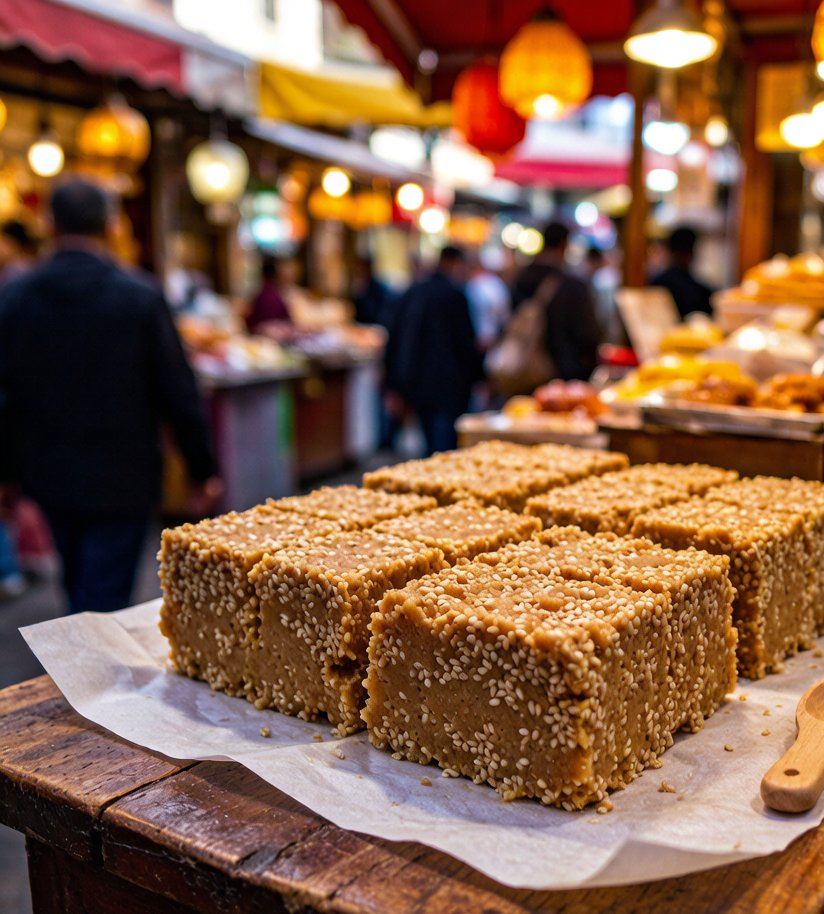
Xinjiang halva is built from ground sesame and sugar, sometimes with a little wheat flour or nuts, pressed into a block. The texture is somewhere between fudge and wet sand, in the best way. It is intensely nutty, only moderately sweet, and nothing like the airy version sold in jars elsewhere. The first block I bought came from a counter in a southern bazaar and I ate it over three days of driving.
Where it sits among the sweets
It shares the shelf with maran tang, the pressed nut candy, and both are better travel companions than fresh pastry. Unlike kumiss or the dairy sweets, halva keeps without refrigeration, which is the whole point on a long route. I have packed it in a glove box through desert heat and it was fine.
Buying it without getting rinsed
Buy from the nut and sweet stalls by weight, not the gift-wrapped boxes aimed at tour buses. The boxed stuff is the same halva at three times the price. Watch the vendor cut a slab, weigh it, and wrap it in paper. That is the version worth carrying home.
Why I keep coming back to it
Most souvenirs are a burden by the time you lug them through an airport. Halva is small, sturdy, and actually good. I bring blocks back for friends who have no idea what Xinjiang is, and the sesame sweetness does more to explain the place than a postcard. It is the rare souvenir that earns its weight.
If you want the savory side of the pantry, my samsa guide covers the bready stuff. But for something sweet that survives the trip, halva is the safe bet.
The hour I go back for
By ten the coaches are here, and by one it is an hour of people shuffling past. I have come to like the last forty minutes before the gate shuts, when the groups have gone and the staff are sweeping, because that is when you can look up properly instead of squeezing a shoulder past strangers. Whatever the guidebook says about golden hour, go on a weekday. The light is only free of company on a Tuesday. Everything goes flat, the shade disappears, and the temperature on an open plateau rises in a way that stops you caring about photographs.
Midday is the hour to avoid, not the hour to schedule. Go early or go late and the same ground gives you two different subjects. Between the two I would pick the later one, mostly because the early version costs you the rest of the day. The whole face of Xinjiang Halva Sweet turns a colour that does not exist at any other time, and the site is empty enough that you can stand still and hear nothing. Sunrise is the one worth an alarm for.
The evening version of that plan is in our [[how-to-go-to-xinjiang|How to Get to Xinjiang: Entry Requirements…]].
A few minutes of background change the visit
Locals in Xinjiang will give you the short version in about a minute if you ask, and it is usually better than the panel at the gate. Knowing what you are standing on turns a pleasant walk into something you actually remember. The history here is layered in a way the official signage compresses into names and dates. The place only makes sense once you know its shape. Xinjiang Halva Sweet was cut rather than built, which is why the walls are solid and the streets are the empty space between them, and why centuries of dust ended up acting as a roof. Read that the morning before rather than at the entrance, where the boards stand too far from the object to help. More on the other end of that day is in our [[xinjiang-fruits-melons-the-sweet-edge-of-the-desert|Xinjiang Fruits & Melons: The Sweet Edge of…]].
Judging a good block
Not all halva is equal. The best I have had was dense and a little gritty, with a strong sesame hit and no waxy aftertaste; the tourist-tin version is often too smooth and too sweet, padded with filler. Color matters less than texture. I now taste before I buy when a vendor offers a broken edge, and I have walked away from pretty boxes more than once. As a gift it travels better than fresh pastry and keeps longer than dried fruit in a hot car, which makes it my default souvenir. Wrap it tight, because it picks up other smells in a backpack faster than you would think.
Two kinds worth knowing
Beyond the sesame block there is a walnut version, denser and a little bitter in a good way, and a softer one with flour that crumbles faster. I prefer the walnut for travel and the plain sesame for eating on the spot with tea. Pair a small piece with brick tea and the bitterness of the tea and the sweetness of the halva balance in a way that explains a lot about the local palate. As a gift, the wrapped brick travels best and survives a backpack better than the soft kind. I have mailed it home in a padded envelope and it arrived intact, which is more than I can say for most sweets. Buy it where it is cut fresh, not pre-packed, and you taste the difference immediately.