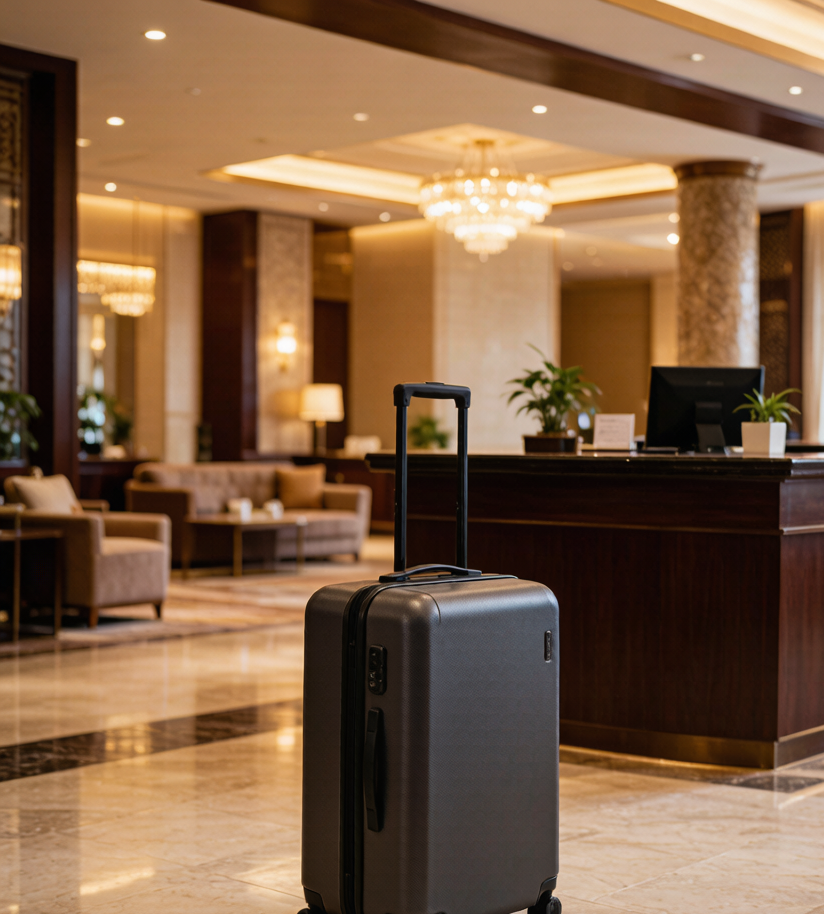
Luggage Storage in Xinjiang: Travelling Light Between Legs
There is a moment on many trips when you want the bag gone but not yet gone home: before a desert drive, after a flight, or between a train and a rental car. Solving storage turns a heavy day into a light one, and Xinjiang handles it better than visitors expect.
Hotels are the first port of call. Even after checkout, the hotel you booked will usually hold a bag for the day, and I use that constantly when I fly in, store the big case, and grab a small bag for a few days on the road. It dovetails with the overland arrival habit, where you shed weight before the empty quarter.
Stations and airports are the backup. Larger terminals often have a staffed counter, and I confirm the location when I arrive rather than assume. On a tight connection it saves a back-and-forth, and it feeds the budget logic of not paying for a room you will not sleep in.
The habit that helps most is packing a true day bag, so the stored case can hold everything else. I learned this the hard way on a loop where I dragged a suitcase up a mountain pass for no reason, and now the big bag stays put while I move.
Store smart and the trip bends to you: fly in light, drive light, return for the case. It is one of the quieter efficiencies, and on a long itinerary the quiet efficiencies add up to a much easier month.
The airports are the easy win. At the big terminals I have stored a case for a day without fuss, and it let me fly in, grab a daypack, and hit the road within an hour of landing. The trick is to confirm the desk location on arrival, because signs are not always where you expect.
For train travellers, the station cloakroom is the move, and it pairs with the railway: arrive, store, rent, drive, return, retrieve. The bag waits; the trip moves. That rhythm has saved me more than one heavy day.
The hotel hold is the move I use most. On a fly-in, drive-out plan I book the first night, store the big case at that desk, and take a small bag for the loop, then collect on return; the desk rarely charges and never blinks. For a side trip without a hotel, the station or airport cloakroom is the backup, and I confirm it is staffed before I commit, because a closed desk at the wrong hour is a problem. A tip that saved me once: photograph the claim ticket, because a lost paper at a language-barrier counter is a slow fix. With storage solved, I have flown into Urumqi, driven the south for a week on a daypack, and flown out of Kashgar with the big case retrieved from the first hotel, all without dragging it once on the road.
The only real risk is the claim ticket, so I photograph it and keep the photo until I have the bag back in hand. Beyond that the system is forgiving, and every desk I used understood the traveller who arrives with a plan and a smile. Store the weight, carry the light, and the region opens up in a way a laden suitcase never allows.
What goes in the day pack
The light here is serious and the shade is intermittent, so the sunscreen goes on before you leave the hotel, not at the gate. A wind shell. The temperature drops fast once you stop moving and the drop is not hypothetical on an exposed pass. A fleece covers most of the year, a real jacket covers shoulder season.
Water, more than you think, a power bank and some cash. Cards work at the gate and in the shops, but the stalls on the approach road and the drivers waiting at the turnoff want cash, and coming up short at the moment you want a lift is the classic way to lose an hour. Sunscreen and a brim. The short version, with the numbers, is in our [[xinjiang-luggage-storage-left-luggage-guide|Xinjiang Luggage Storage: Where to Stash…]].
Getting there without a car of your own
Luggage Storage In Xinjiang sits an hour or two from the nearest town, which sounds close until you work out there is no reliable public bus to the gate. What does exist is an intercity coach leaving the Xinjiang long-distance station early, a taxi share at the stand that costs a few tens of yuan a head if you are patient, and the tour vans that pick up at hotels. We came twice. The first time we chartered a car for the round trip and it was worth every yuan. The second a driver on a return leg dropped us at the entrance and waited in the car park, which is the cheap way to do it if you do not mind setting your own clock.
The trick is finding the vehicle rather than the timetable. Leave two hours of slack on the return. In Xinjiang the drivers wait where drivers always wait, in the little offices a few hundred metres off the main terminal, and they will put together a half-day for a price the meter would never quote. The last vehicles back leave in the early evening, and after dark on a mountain road the local buses stop running entirely. The evening version of that plan is in our [[xinjiang-landscape-photography-light-guide|Xinjiang Landscape Photography: Light,…]].