Getting to Xinjiang Overland: The Gansu–Dunhuang Gateway Route
The fast way into Xinjiang is a direct flight to Urumqi. The memorable way is to let the landscape build: start in Lanzhou, crawl west along the Hexi Corridor, and cross into Xinjiang with the desert already in your bones. I have done both, and for a first visit the overland approach is worth the extra days.
The corridor that fed the Silk Road
For two thousand years everyone who reached Xinjiang came this way. The railway west from Lanzhou threads Jiayuguan — its fortress a rusted rectangle against the Gobi — and arrives at Dunhuang, where the Mogao caves hold the art that once flowed east and west. Arriving here first is like reading chapter one before the climax.
Why enter through Dunhuang
- You acclimatise to the dryness and the distances before the real vastness begins.
- Dunhuang’s crescent lake and singing sands are a gentle overture to Xinjiang’s dunes.
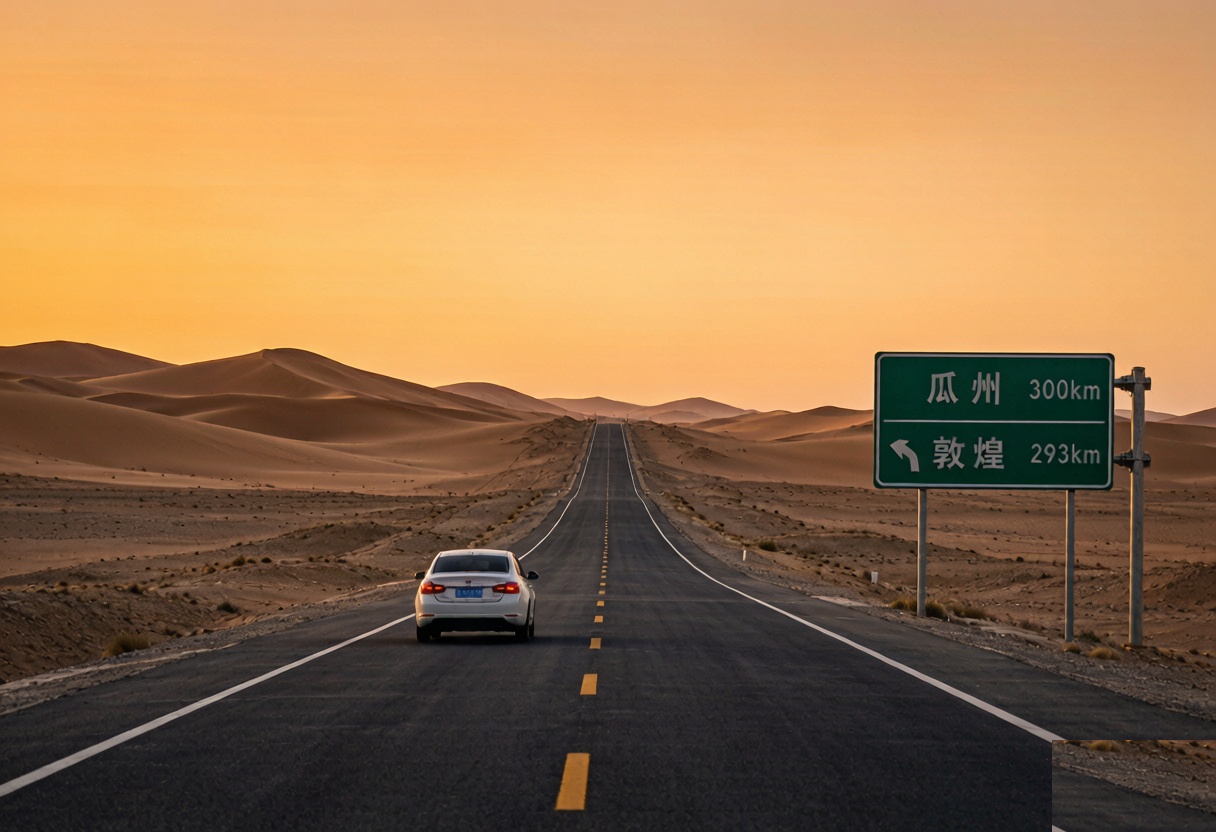
- From Dunhuang you can take the train or a long drive to Hami, the first Xinjiang city, and feel the border of the region under your wheels.
By rail or by road?
The train from Lanzhou to Dunhuang is comfortable and scenic; the drive via the G30 expressway lets you stop at lonely watchtowers and desert services. I favour the train west and a rental car from Hami onward. Our 30 tips cover the paperwork you will need at each step.
What changes at the border of Xinjiang
Past Hami the green of Gansu thins to scrub, then to nothing, then to the Taklamakan’s edge. That is the moment Xinjiang announces itself — not at a sign, but in the sudden, total absence of shade. Entering overland, you earn that feeling rather than landing into it.
Connecting to the loops
If you plan to drive the northern loops afterward, starting from the east means you meet the Tianshan fresh, before fatigue sets in, and you can hand the car back in Urumqi at the end. It is a cleaner logistics story than flying in cold.
The overland gateway is slower. It is also the difference between visiting Xinjiang and understanding how it fits the continent.
The Lanzhou stop
If you have an extra day, break the journey in Lanzhou itself — the Yellow River cable car, the museums, and a proper hand-pulled noodle lunch are a gentle on-ramp to the region. From there the train to Dunhuang is an easy afternoon, and you arrive with legs un-cramped and camera ready for the dunes.
Paperwork for the corridor
No special permit is needed to enter Xinjiang from Gansu; your passport is enough, and the checks begin once you are inside the region, not at the provincial line. Keep your documents handy from Hami onward, where the first real checkpoint rhythm starts. Our 30 tips cover the documents to have ready.
Not everyone should build a trip around this
The honest version: take half a day if that is all the arithmetic allows, and save the full day for the thing that is genuinely once in a lifetime. It does not suit a family with a small child who needs a shade stop every forty minutes, and it does not suit anyone in week two of a high-altitude trip still feeling it. I am not going to pretend this is gentle. There is a lot of unshaded ground, the altitude is real if you came from a low-altitude city, and the swing between the car and the viewpoints is enough to give you a headache on an empty stomach. Who it does suit: someone wanting one strong memory, someone driving the Xinjiang loop anyway, someone willing to be out before breakfast.
Who it does not: anyone whose main goal is a relaxed few days, and anyone who has already done this same thing twice here. If you are short on days, this is the thing to cut, and no guidebook will tell you that. Getting To Xinjiang Overland is superb, but it is also an hour or more in each direction from everything else you planned, and the drives are what eat the schedule. It suits people who like landscape and can walk a few kilometres at their own pace. It suits a traveller with a car and a flexible morning. The short version, with the numbers, is in our [[xinjiang-local-transport-getting-around|Getting Around Xinjiang: Buses, Didi,…]].
A second look on day two
If your itinerary has a spare morning, spend it here again rather than at the bigger name on the far side of town. I did, and the second visit was better, because the first had been spent working out where to stand. The second time you can skip the obligatory viewpoint and walk along the base of the ridge where the light comes in sideways, and that is the photograph you keep. Almost nobody does Getting To Xinjiang Overland twice. For the part people underestimate, see our [[xinjiang-food-safety-for-travelers-how-to-eat-well-without-getting-sic|Xinjiang Food Safety for Travelers: How to…]].
Spend a night in Dunhuang itself
The gateway deserves more than a transfer. Dunhuang is where the corridor opens onto the desert, and the Mogao Caves (莫高窟) are the single best place in the region to understand why the Silk Road mattered — a thousand years of cave temples cut into a cliff face. The Crescent Lake (月牙泉) at sunset, with the singing sands behind it, is the postcard everyone expects and it still delivers. I treat Dunhuang as a half-reset: shower, proper meal, and a look at the caves before the final push west.
The Liuyuan transfer
Trains to the area stop at Liuyuan (柳园), not Dunhuang. From there it’s roughly two hours by road to Dunhuang town, and about four more to the Xinjiang border beyond Hami. Build that transfer time into your day; don’t plan to cross into Xinjiang the same evening you arrive. The overland route is slower than flying, but the desert-and-oasis rhythm you feel rolling in is exactly the context the rest of the trip pays off against.