Emin Minaret (Sugong Ta): Turpan’s 18th-Century Brick Masterpiece
The Emin Minaret Turpan is one of the most unusual Islamic monuments in China, a tapering mud brick tower on the eastern edge of Turpan city that travelers and heritage listings alike describe as the tallest ancient minaret in the country. Built in the late 1770s, it pairs a slender 44 metre tower with a working mosque and a walled courtyard, and it is celebrated above all for the dozens of geometric brick patterns that wrap its surface. This article gathers what official heritage records, published scholarship and traveler reports say about the site, and lays out practical logistics for fitting it into a Turpan visit.
How This Guide Was Researched, and Where Its Limits Are
Before any details, a plain note on sourcing. This guide to the Emin Minaret Turpan is compiled from official heritage listings, published scholarship and traveler reports, and it is not the author’s personal visit. No first person claims about climbing, standing inside or walking the courtyard appear here because they would be fabricated. The historical core that follows is documented: the construction date, the patron, the height and the protected status are recorded in multiple public sources and are treated as fact. Where visitor experience is described, the language is deliberately indirect, using phrases such as travelers report, official sources state and heritage listings record. Ticket prices and opening hours shift from year to year and between booking platforms, so every figure here is given as a range with a year and the standing advice to confirm locally. Readers planning a trip should treat the practical numbers as a planning baseline rather than a guarantee.
Overview and Key Facts About the Emin Minaret Turpan
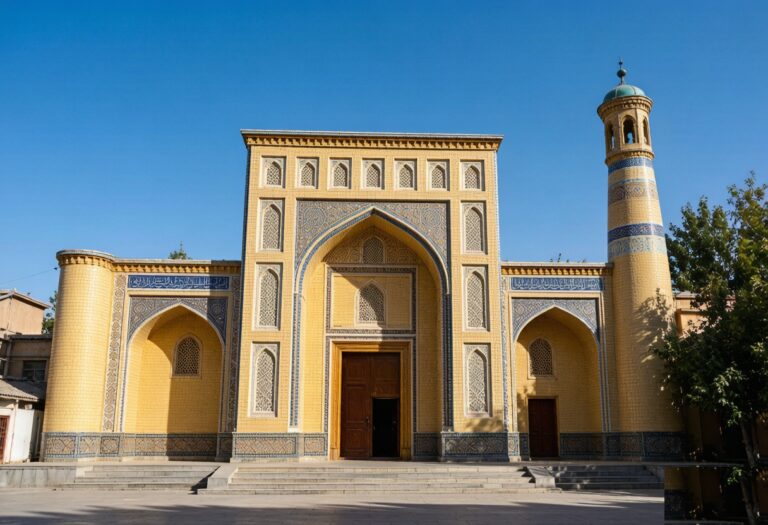
The Emin Minaret, also called Sugong Ta or Imin Minaret, sits about two kilometres east of central Turpan. Heritage listings record that it was built between 1777 and 1778, during the Qing Qianlong reign, under the direction of Suleiman, who commissioned it in honour of his father Emin Khoja. Emin Khoja, also rendered as Emin Hoja, was a local Turpan ruler of the Khoja family who allied with the Qing court, and the monument is widely understood as both a pious foundation and a gesture of loyalty to the emperor.
Official sources state the tower reaches roughly 44 metres, making it the tallest ancient minaret in China. It is built almost entirely of sun dried mud brick and a lime based mortar, on a circular plan that narrows from a wide base toward a small finial. The adjoining mosque and the surrounding walls form a single walled compound. The whole complex was listed among the early batches of major national protected cultural heritage sites, which is why conservation rules today restrict interior access.
The feature travelers most often describe is the brickwork. Rather than plain courses, the surface is laid in dozens of distinct geometric motifs: grids, diamonds, crosses, interlocking bands and vine like scrolls. These are achieved by rotating and stacking the mud bricks themselves, so the pattern is structural rather than applied decoration. Published accounts describe the effect as a textile wrapped around the tower, and the play of raking light across the relief is one reason photographers time their visits carefully.

The mosque beside the tower is a rectangular hall with a flat timber roof supported on columns, built in a local Uyghur architectural idiom. Heritage listings record that it can hold several hundred worshippers, and travelers report that it remains an active place of worship on Friday and during festivals, with the minaret standing as its call to prayer tower. The courtyard between them is open ground, partly shaded by a few trees, and framed by the enclosing wall that gives the site its quiet, contained feel.
At a glance
| Fact | What the record says |
|---|---|
| Location | Eastern edge of Turpan city, Xinjiang |
| Built | 1777 to 1778, Qing Qianlong period |
| Patron | Suleiman, son of Emin Khoja |
| Height | About 44 metres, tallest ancient minaret in China |
| Material | Sun dried mud brick and lime mortar |
| Status | Major national protected cultural heritage site |
| Interior access | Generally not open to climb, per visitor reports |
Getting There: Reaching the Minaret from Turpan City
Turpan is reached by high speed rail from Urumqi in a couple of hours and by road on the G30 corridor, and the minaret is close enough to town that it is an easy half day add on. From Turpan city centre, traveler reports describe a short taxi or rideshare ride of roughly ten to fifteen minutes to the site gate. The local bus network also serves the eastern district, though service frequency varies and published accounts suggest confirming the route with the hotel before setting out. For visitors based in Turpan and moving between several sites, hiring a car or joining a day tour is the common choice, since the ruins of Jiaohe and Gaochang, the Karez system and the Flaming Mountains all sit at different points around the basin.
Those arriving by the Turpan North high speed rail station should note the station is some distance from the old town, so budget extra transfer time. A useful reference for the wider region is our transportation in Xinjiang guide, which covers rail, road and local movement. The minaret pairs naturally with the rest of a Turpan day, and the hour by hour plan below shows one workable sequence.
Tickets, Hours and Costs
Ticket prices for the Emin Minaret Turpan are commonly listed at roughly 40 to 60 RMB as of 2025, and some combined Turpan passes bundle it with nearby sites. Confirm before travel, because posted rates change and platform prices differ. Opening hours are typically daytime only, often around 08:30 to 20:00 in summer, but heritage listings and traveler reports both recommend checking the current schedule, since seasonal adjustments are frequent.
An honest point that several visitor reports stress: interior climbing of the minaret is generally not permitted for conservation reasons, so readers should not expect to ascend the tower. The experience is the exterior brickwork, the courtyard and the mosque, not a climb to the top. There may be a small separate charge or free access to the prayer hall outside service times, but this is not consistent, so ask at the gate.
Students and seniors sometimes receive discounted admission at Chinese heritage sites, and travelers report carrying an ID helps, though the discount is not guaranteed here. Budget a modest amount for water and shade, because the site has limited cover and Turpan summer heat is severe.
Best Time to Visit the Emin Minaret Turpan
Turpan is one of the hottest and driest places in China, and that shapes timing more than any other factor. The best window for the Emin Minaret Turpan is spring, from roughly April to early June, and autumn, from September to October, when daytime temperatures are tolerable and the light is good for photographing the brick relief. Our best time to visit Xinjiang guide gives the regional picture, and the same logic applies locally: avoid the mid summer peak if heat is a concern.
Within a day, the early morning and late afternoon are the comfortable and photogenic slots. Travelers report that the low sun rakes across the carved brick and makes the geometric patterns pop, while midday flattens them and bakes the open courtyard. If you are in Turpan in July or August, plan the minaret for the cool edges of the day and reserve the hot middle for indoor or shaded stops such as the Karez system.
A Turpan Heritage Day, Hour by Hour
The plan below builds a Turpan day around the basin’s extreme summer heat: an early start, a long midday break, and a late finish. It chains the Emin Minaret with Jiaohe, the Karez wells and the Flaming Mountains, with the minaret placed at a cool, low light moment.
| Time | Stop | Why this slot |
|---|---|---|
| 07:00: | Leave hotel, drive east to the Emin Minaret Turpan | Cool air, soft light on the brickwork |
| 07:30: | Emin Minaret and mosque courtyard | Photograph relief before sun climbs |
| 09:00: | Travel to Jiaohe ruins | Still bearable before peak heat |
| 09:30: | Walk Jiaohe upper town | Open air but early enough to manage |
| 11:30: | Return to town for lunch and rest | Avoid the 40 plus degree midday |
| 14:00: | Karez wells underground channel tour | Cool shade below ground at peak heat |
| 16:00: | Drive to Flaming Mountains viewpoint | Heat easing, red slopes glow |
| 18:30: | Back to Turpan for dinner | Long daylight, relaxed finish |
This sequence keeps the two open air ruins in the morning and evening and puts the underground Karez at the worst of the heat. Travelers report that the rhythm works because Turpan’s summer afternoons are genuinely hazardous for prolonged exposure. For the desert ruins context, see our Turpan’s desert ruins, Jiaohe and Gaochang guide, and for the water system that makes this day possible, our Karez wells in Turpan article.

Where to Stay in Turpan
Turpan city offers a spread of accommodation from budget hostels to mid range hotels, concentrated around the train station area and the old town. Traveler reports describe the centre as a practical base because it puts the minaret, the bazaar and the bus station within easy reach. In summer, air conditioning is not optional, so check that listings mention it before booking. For a first visit, staying in or near the old town lets you reach the Emin Minaret Turpan at first light without a long transfer.
Some visitors split a stay between Turpan and the hotter outlying counties to be closer to the Flaming Mountains or the Grape Valley, but for a single heritage day the city itself is the efficient choice. Book ahead in the July and August peak, when published accounts note rooms tighten and prices rise. A broader Turpan planning resource is our Turpan Xinjiang travel guide.
What and Where to Eat Nearby
Turpan’s food scene centres on Uyghur staples: naan flatbread, hand pulled laghman noodles, pilaf known as polo, kebabs and the region’s famous grapes and raisins. Our Xinjiang naan guide explains the bread you will see stacked at every corner. Near the minaret, traveler reports point to small restaurants and tea houses in the old town rather than at the site gate, so plan to eat in town before or after the visit.
A practical habit travelers describe is carrying water and a few naan for the day, because the heritage sites themselves have limited food. In summer the grapes are at their best, and a stop at a local market for raisins makes an easy souvenir. Keep meals light in the heat, and use the midday break from the hour by hour plan for a proper sit down lunch in air conditioning.
Practical Tips for Visiting
Several concrete points help a visit go smoothly. First, set expectations: the minaret is not climbed, so enjoy it from the courtyard and exterior. Second, dress for heat and sun, with a hat, sunglasses and high SPF, since the compound has little shade. Third, respect the mosque as an active religious site: cover shoulders and knees, speak quietly, and step aside during prayer. Fourth, carry cash as well as a payment app, because small gates and vendors do not always take cards.
Fifth, photograph in early or late light, when the brick relief reads clearly. Sixth, confirm ticket price and hours the day before, because both shift. Seventh, if you arrive in peak summer, follow the hour by hour plan and treat the midday as rest time rather than sightseeing time. Travelers report that following this rhythm is the difference between an enjoyable day and a miserable one in Turpan.

Emin Minaret FAQ
Can you climb inside the Emin Minaret Turpan?
Visitor reports state that interior climbing is generally not permitted for conservation reasons, because the mud brick structure is fragile and the internal staircase is not open to the public. Travelers should expect to experience the tower from the courtyard and exterior rather than from the top.
Is the mosque active and can non Muslims enter?
Second, dress for heat and sun, with a hat, sunglasses and high SPF, since the compound has little shade. Third, respect the mosque as an active religious site: cover shoulders and knees, speak quietly, and step aside during prayer. Fourth, carry cash as well as a payment app, because small gates and vendors do not always take cards.
Is there a dress code for the Emin Minaret and mosque?
Yes, as for any active religious site. Cover shoulders and knees, avoid low cut or sheer clothing, and remove hats inside the prayer hall if you enter. Travelers report that modest dress is appreciated and sometimes expected at the gate.
How long should I allow for a visit?
Most traveler reports suggest allowing 45 to 90 minutes: time to walk the courtyard, study the brick patterns, and view the mosque. Photographers who wait for good light may stay longer, but the site is compact and does not demand a full morning.
Is the Emin Minaret worth visiting in 45 degree heat?
It can be, if timed for early morning or late afternoon. The courtyard is open and exposed, so midday in peak summer is unpleasant. Place the visit at the cool edges of the day, as the hour by hour plan suggests, and it remains worthwhile even in extreme heat.
What is the best light for photographing the brickwork?
Low sun, early morning or late afternoon, rakes across the relief and makes the geometric motifs stand out. Travelers report that midday flat light weakens the patterns, so aim for the first hour after opening or the last before closing.
Are there combined tickets with other Turpan sites?
Some published accounts mention combined or regional passes that bundle several Turpan attractions, but availability changes year to year. Confirm at the gate or through the official booking channel, and compare a combined pass against single tickets for your planned route.
Is the site accessible for wheelchairs or those with limited mobility?
The courtyard and mosque approach are on relatively level ground, but the tower interior is not open and some thresholds and uneven paths exist. Traveler reports suggest that wheelchair users can reach the exterior and courtyard, though smooth access is not guaranteed throughout the compound.
About the author
Karl Huang writes Xinjiang travel research guides for xinjiangtraveltips.com. He has traveled the region extensively, including the Duku Highway, Kashgar and the Pamir plateau. This particular guide to the Emin Minaret Turpan is compiled research from official heritage listings, published scholarship and traveler reports, rather than a personal visit.