Ebinur Lake (Aibi Lake): Xinjiang’s Vanishing Salt Lake and the Winds That Shape It
The information below draws on official park and prefecture materials, published geography and hydrology reports, and traveler accounts shared on forums and travel platforms. Where figures differ between sources, ranges are given and readers are advised to confirm locally. This is a research-disclosure guide, not a first-person travelogue, and no individual testimonials have been invented.
Ebinur Lake sits in a remote corner of northwest Xinjiang where China meets Kazakhstan. Because access, pricing, and even the lake’s surface area change from year to year, travelers should treat the details here as a planning baseline. Geographers note that the lake is one of the most studied shrinking water bodies in the region, which makes it a useful case for understanding how wind, evaporation, and human water use interact on the arid frontier.
The shape of it
Ebinur Lake, also known as Aibi Lake, is an endorheic salt lake in Bortala Mongol Autonomous Prefecture, close to the Kazakhstan border in northwest Xinjiang. The name “Ebinur” derives from a Mongolian term meaning “marshy lake” or “a lake that never freezes”, while “Aibi” carries a similar sense of a still or quiet body of water. Official sources state the lake lies in a closed basin with no outlet to the sea, so whatever water arrives must either evaporate or sink into the salt crust.
The lake is best known for two things: its shrinking surface area and the relentless wind that sweeps across it. Geographers note that Ebinur sits in a natural wind corridor, and the nearby border port of Alashankou is often called one of China’s windiest places, earning the nickname “windy city”. Wind speeds here routinely exceed levels that make standing difficult, and the exposed lakebed contributes to seasonal dust storms that reach as far as central Asia.
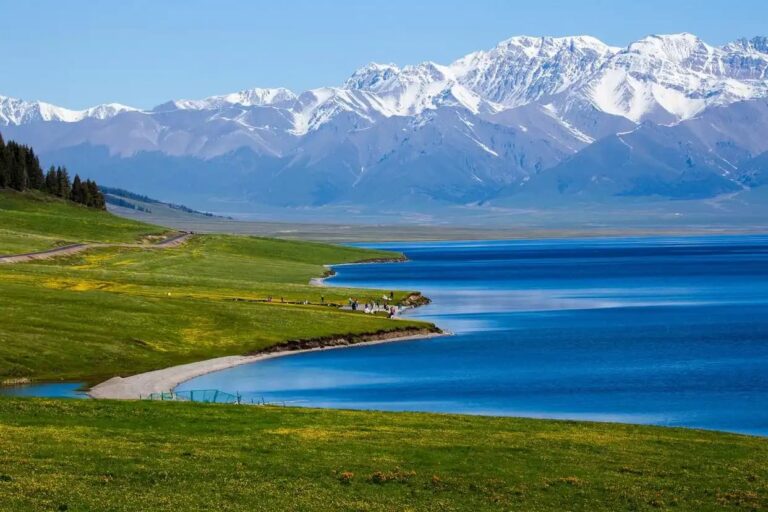
What makes Ebinur notable among Xinjiang’s lakes is precisely its fragility. Unlike the alpine freshwater of Sayram Lake, Ebinur is shallow, saline, and highly sensitive to runoff changes from the Bortala and Jing rivers. Satellite observations cited in hydrology reports show the lake surface has contracted significantly over recent decades as irrigation upstream reduced inflow. The exposed playa then becomes a source of salt and dust carried by the wind.

The table below summarizes the basic physical profile as reported across official and academic sources.
| Attribute | Reported value | Source note |
|---|---|---|
| Location | Bortala Prefecture, Xinjiang, near Kazakhstan border | Prefecture gazetteer |
| Lake type | Endorheic saline lake | Geography reports |
| Elevation | Approx. 189 to 200 meters above sea level | Varies by source |
| Surface area trend | Contracting over recent decades | Satellite hydrology studies |
| Nearby wind corridor | Alashankou port, known as a windy city | Official tourism copy |
The road in, in numbers
Most travelers approach Ebinur Lake from Urumqi, Xinjiang’s capital, which is roughly 500 kilometers to the east. The standard route runs west by rail or road through the northern Xinjiang corridor toward Bortala and the Alashankou border area. The transportation in Xinjiang guide covers the broader rail and road network that connects these points.
By rail, travelers report taking a train from Urumqi to Bortala or to the Alashankou area, then arranging local transport. The journey is long and the schedules are limited, so advance planning is essential. By road, the drive follows the G30 Lianyungang to Khorgas expressway corridor and branch routes toward Bortala town, then continues north toward the lake basin and the border port. A private car or hired driver is the most flexible option because public transport does not run directly to the lakeshore.
Because the lake sits close to the Kazakhstan frontier, parts of the surrounding zone fall under border management. Travelers should review the Xinjiang border permit guide before setting out, since rules for proximity to the boundary can change and some areas require notification or permits.
For those starting their trip in the capital, the Urumqi City Guide explains where to catch trains and long-distance buses and how to arrange drivers for onward travel into Bortala.
Prices and passes
Pricing for Ebinur Lake is not standardized in the way a major ticketed scenic area might be, and travelers report that access conditions vary by season and by which gate or viewing point is open. As a planning estimate, entry costs are reported in a range of about 30 to 60 RMB as of 2025, but this should be confirmed locally because the site is less commercialized than better-known lakes. Some travelers describe simply reaching the lakeshore by local road rather than passing through a formal ticket gate, while others mention small conservation or viewing-area fees.
Budget items to consider include transport from Bortala (a hired car for the round trip may run into several hundred RMB depending on distance and waiting time), meals, and accommodation. Geographers and travel writers note that because the lake is remote and wind-exposed, guided or driver-assisted visits are common, which adds to cost but improves safety. Always carry enough cash, as card and mobile payment coverage can be patchy near the border.
A month-by-month read
Ebinur Lake is windy year-round, so the question is less about avoiding wind and more about choosing conditions that suit your interest. Spring brings bird migration, when the remaining wetlands and shallow margins attract flocks that travelers report seeing in large numbers. Autumn is another favored window, with cooler temperatures and somewhat steadier air compared with the gusty summer. The best time to visit Xinjiang breakdown gives the wider regional picture, but for Ebinur the birdlife and lower summer heat are the main draws.
Summer is hot and intensely windy, and winter is cold with the risk of icy roads and closed access points. Photographers who want the cracked salt-crust patterns and dramatic dust lighting tend to favor late autumn, though they must be prepared for sudden wind. Whatever the season, check the local forecast for Alashankou wind warnings before departing, because the corridor can close temporarily during severe gusts.

The itinerary I would follow
The plan below is a realistic two-day outline for travelers based in Bortala town. It assumes a hired car or driver, since public transport does not reach the lake directly. Times are illustrative and should be adjusted for seasonal daylight and wind conditions.
| Day | Time | Activity | Notes |
|---|---|---|---|
| Day 1 | 08:00 | Depart Bortala town by hired car | Confirm driver and border-zone rules |
| Day 1 | 09:30 | Stop at Alashankou wind corridor viewpoint | See the windy city and border port area |
| Day 1 | 11:00 | Arrive at Ebinur Lake southern viewing point | Wind protection essential |
| Day 1 | 12:30 | Lakeshore walk and salt-crust photography | Stay on firm ground, avoid thin crust |
| Day 1 | 14:00 | Lunch in a roadside stop near Bortala | Kazakh and Han options available |
| Day 1 | 16:00 | Return to Bortala, rest | Wind tends to strengthen afternoon |
| Day 1 | 19:30 | Dinner in Bortala town | Try local lamb and noodle dishes |
| Day 2 | 07:30 | Early drive to wetland margin for birdwatching | Best light and calmer wind at dawn |
| Day 2 | 09:00 | Observe spring migration flocks if in season | Bring binoculars and dust mask |
| Day 2 | 11:00 | Visit local museum or market in Bortala | Learn prefecture history and culture |
| Day 2 | 13:00 | Lunch and free time | Sample dairy snacks |
| Day 2 | 15:00 | Depart for Urumqi or onward route | Book return transport in advance |
This timetable is a framework. Travelers report that strong wind can compress or cancel lakeshore time, so build flexibility into the plan and keep the driver reachable.
Where to sleep
The practical base for visiting Ebinur Lake is Bortala town, the prefectural seat, where most standard hotels and guesthouses are found. Travelers report a range of options from basic inns to mid-range hotels, with prices modest compared with Urumqi. Booking ahead is wise during holiday periods when domestic tourists move through the corridor toward the border and the Sayram Lake area to the south.
Alashankou, the border port town, also has accommodation, but it is oriented toward trade and transit rather than tourism, so choices are fewer and the wind exposure is greater. Staying in Bortala keeps you sheltered compared with the port and gives easier access to food and services. For those linking the trip to Sayram Lake, some travelers split the nights between Bortala and a lakeside stay farther south, though that extends the driving.
Food (What & Where to Eat Nearby)
Dining around Ebinur Lake means eating in Bortala or Alashankou rather than at the shore. The local food scene blends Kazakh and Han influences, reflecting the prefecture’s mixed population. In Bortala town, travelers report finding hand-pulled noodles, lamb skewers, pilaf, and steamed buns at everyday eateries, alongside Kazakh dairy products such as dried curds and fermented drinks.
Kazakh options to look for include boiled lamb with noodles, stuffed pastries, and milk tea, often served in casual family restaurants. Han-style restaurants offer stir-fried vegetable and meat combos, noodle soups, and dumplings. For a quick meal near the lake, pack supplies from Bortala, because roadside choices close to the shore are limited and the wind makes outdoor eating unpleasant.

On-the-ground practicalities
Wind is the defining challenge at Ebinur Lake. Geographers note that the basin funnels gusts, so even a calm morning can turn rough by midday. Pack a windproof jacket, goggles or wraparound sunglasses, and a dust mask, because the salt-laden air and occasional dust storms irritate eyes and lungs. Secure loose items such as hats and camera caps, as travelers report losing them to sudden gusts.
Footwear matters on the salt crust. The lakebed can look solid but may be thin over brine or mud, so stay on established paths or firm margins and avoid wandering onto white crust without local guidance. Hydration is important in the dry climate, and sun protection is needed even on cool, windy days.
Border awareness is the other key point. Because the lake is near Kazakhstan, some zones are sensitive. Carry identification, follow posted restrictions, and consult the Xinjiang border permit guide before travel. Do not photograph restricted infrastructure, and respect any closures announced by local authorities during high wind or dust events.
A few things worth answering
Is Ebinur Lake the same as Aibi Lake? Yes. Official and academic sources use both names for the same endorheic salt lake in Bortala Prefecture; “Ebinur” and “Aibi” are different transcriptions of related local-language terms.
Why is Ebinur Lake shrinking? Geographers attribute the contraction to reduced river inflow from upstream irrigation, high evaporation in the arid basin, and the lake’s closed drainage with no outlet. Satellite studies document the surface-area decline over recent decades.
Can you swim in Ebinur Lake? It is not advisable. The water is highly saline and shallow, the lakebed is unstable in places, and there are no developed swimming or safety facilities. Travelers go to observe and photograph, not to enter the water.
How windy is Alashankou near the lake? Official tourism copy calls Alashankou a windy city, and travelers report gusts strong enough to make walking difficult for much of the year. Wind warnings are common, and the corridor can affect road and rail movement.
Do I need a border permit to visit Ebinur Lake? The lake lies near the Kazakhstan frontier, so some surrounding areas are border-managed. Review the Xinjiang border permit guide and check current rules, because requirements can change.
What birds can be seen at Ebinur Lake? Travelers report waterbirds and migratory flocks using the remaining wetlands, especially in spring. Specific species vary by season, and the lake is noted in conservation literature as a stopover in the Central Asian flyway, though exact counts shift with water levels.
Is Ebinur Lake worth visiting if I have already seen Sayram Lake? They are very different. Sayram is an alpine freshwater lake prized for scenery, while Ebinur is a stark saline basin shaped by wind and shrinkage. If you are interested in geography, birding, or frontier landscapes, Ebinur offers a contrasting experience, but manage expectations about facilities.
Similar Posts
Heavenly Lake (Tianchi): The Sacred Alpine Lake Near Urumqi
Heavenly Lake (Tianchi) is a stunning alpine lake just 70km from Urumqi. Learn how to get there, what to see and do, when to visit, and why this sacred lake is one of Xinjiang’s most popular day trips.
Karakul Lake and Muztagh Ata: Trekking and Photography on the Pamir
Karakul Lake and Muztagh Ata guide: the Pamir viewpoint, easy lakeside treks, Kyrgyz yurts, altitude tips, and how to reach it from Kashgar.
2026 Travel Guide to Wucaitan (Colorful Beach), Xinjiang
Last updated: July 15, 2026 · Written by Karl Huang, a Xinjiang travel specialist who has spent time across the region. Practical details are cross-checked against official tourism, transport, and border-regulation sources. On the northern bank of the Irtysh River in Burqin County, Altay Prefecture, Xinjiang, lies a natural wonder known as “God’s Spilled Palette”…
Bezeklik Caves Near Turpan: Murals, History, and a Half-Day Loop
The Bezeklik Thousand Buddha Caves east of Turpan hold 1,000-year-old Uyghur Buddhist murals. How to visit, tickets, and what to combine.
2026 Ultimate Travel Guide to Keketohai, Xinjiang
Last updated: July 15, 2026 · Written by Karl Huang, a Xinjiang travel specialist who has spent time across the region. Practical details are cross-checked against official tourism, transport, and border-regulation sources. The core allure of traveling to Keketohai, Xinjiang in 2026 lies in its unparalleled diversity. As a national 5A-level tourist attraction and a…
North Xinjiang 5-Day Itinerary: Kanas, Sayram, and Tianchi Loop
A tight 5-day north Xinjiang loop linking Urumqi, Tianchi, Kanas, and Sayram: drive order, overnights, and how to compress the highlights without burning out.