Bezeklik’s Murals Decoded: Uyghur Donor Portraits, Manichaean Traces, and the Art That Survived the Looters
What the walls are actually telling you
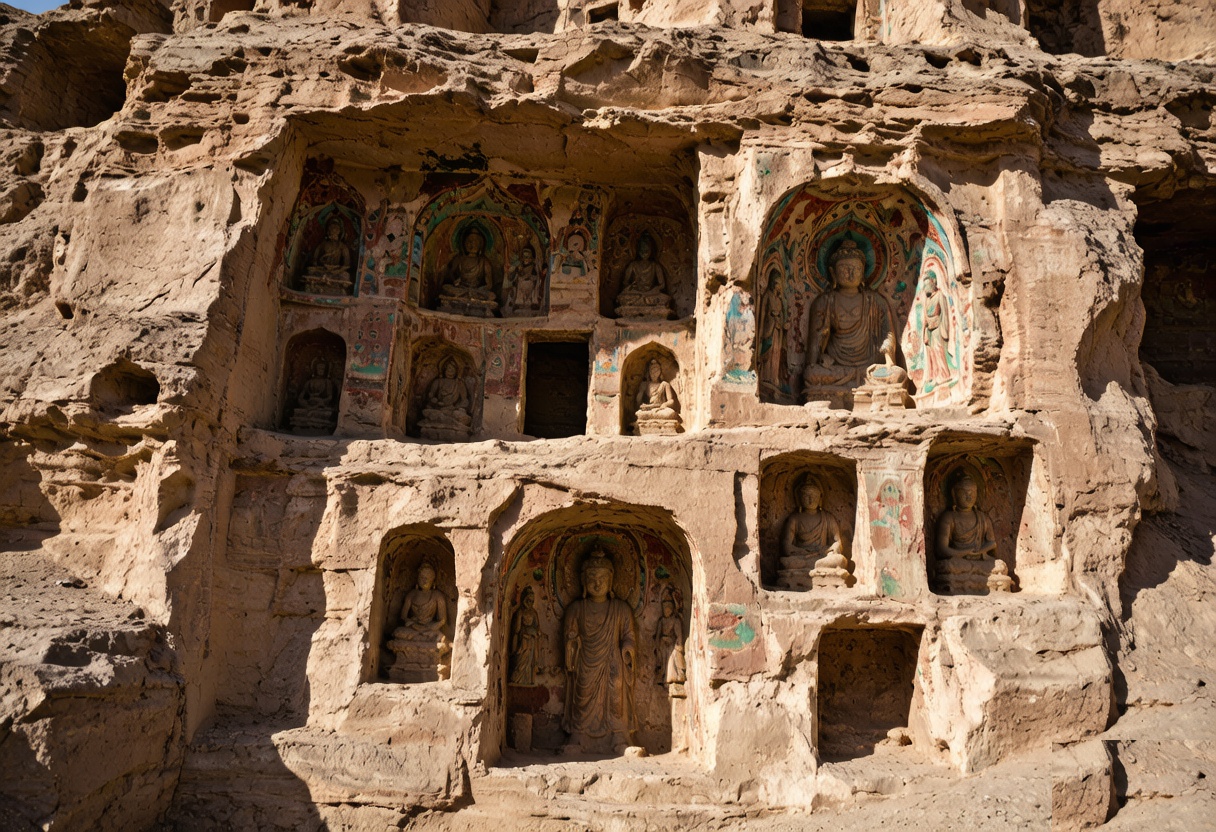
Most visitors to the Bezeklik Thousand-Buddha Caves (柏孜克里克千佛洞, “place of paintings” in Uyghur) stop at the row of cave mouths cut into the Flaming Mountains cliff and take the photograph. The more interesting part is inside, and it is not the Buddhas. It is the donors, the men and women who paid for each cave, painted at life size along the lower walls in the fashions of a kingdom that no longer exists.
On my own walks through the open grottoes, what stayed with me was not the scale but the specificity: a Uyghur noblewoman’s rounded face and high collar, a merchant’s Sogdian cap, the double braids that mark Uyghur royal donors in Turpan’s 9th to 12th century paintings. These are not decorative. They are a ledger of who held power and money along the Turpan corridor back when Buddhism, not Islam, defined the valley.
The Uyghur royal portraits
The best-preserved donor walls show rows of Uyghur princes and princesses in silk robes, hands folded, flanked by attendants. Art historians read them as the ruling family of the Gaochang Uyghur Kingdom (866 to 1209), who made Buddhism their court faith after Manichaeism lost its state status. The faces are painted with a soft modeling that mixes Indo-Iranian shading with Chinese linework, exactly the cultural blending you feel standing in the gorge where the Mutou River cuts a green line through red rock.
If you want the contrast in cave art, the Kizil Caves near Kuqa are earlier and far more international in their Hellenistic and Indian motifs. Bezeklik is later and more local. Its murals are the Uyghur Kingdom looking at itself.
Manichaean and Nestorian layers
Turpan was never singly Buddhist. Before Buddhism became the Uyghur court religion, Manichaeism was the state faith of the Uyghur steppe empire, and later small Nestorian Christian communities lived in the oasis towns. A few fragments at Bezeklik and nearby sites show figures some scholars read as Manichaean electi or Nestorian clergy, reminders that the same cliffs held several faiths within a century or two of each other.
The mistake I made the first time
I assumed two hours would be plenty. It was, in the sense that I saw everything, and it was ruined in the sense that I saw everything at the same hour with the same crowd, and I spent the drive home meaning to come back and never did. The whole point of coming this far is to have the place to yourself for a while, and that only happens if you are willing to be there when it opens or when it is nearly shut. What I would tell the version of me who planned it: put the slow hours in, not the fast ones. I did come back the following trip, at seven in the morning, and it was a different site.
The other mistake is about distance on the map. The gate is not the site. There is a shuttle, a walk, sometimes another shuttle, and the stretch everybody underestimates is between the second gate and the thing you crossed the country to see. So: work out how far it is from where the vehicle drops you to the feature, then double it. That is the number of hours the visit needs.
The evening version of that plan is in our [[xinjiang-bezeklik-caves-guide|Bezeklik Caves Near Turpan: Murals,…]].
What the ticket and the extras actually add up to
The admission is cheap, the internal transport is what adds up, and a family of four in one car turns a small ticket into a real line in the budget. Ask once at the ticket office what the full circuit costs before you commit. Staff there are used to it, and the answer takes ten seconds. The headline entrance ticket is only the first line. On top of it comes a shuttle or sightseeing bus inside the site, and if you want a far viewpoint rather than the main one that is another leg.
Parking, a printed map, and a guide are the other three places the number moves. Two of us covered the whole thing for well under what a single hotel night in Xinjiang costs, but only because we shared the car and shared the entry between us. Prices at the gate are reasonable by European standards, which is exactly why they are easy to underestimate. On your own the same afternoon comes out at maybe half again as much. I wrote the driving side up in our [[xinjiang-bezeklik-buddhist-caves-guide|Bezeklik Thousand Buddha Caves: A…]] as well.
What the looters took, and what they cut
You will notice bare rectangles and faces with scratched-out eyes. Two different acts produced them. In the early 20th century the German Turfan expeditions, Albert von Le Coq and Albert Grünwedel, cut entire mural panels from the walls and shipped them to Berlin, where the Sogdian-deity banners and the Uyghur princes fragments now sit in the Museum für Asiatische Kunst. What you see at the site is what was too heavy, too damaged, or too obscure to remove. The scratched eyes are a separate, older story, iconoclasm by later viewers who would not abide the images.
This is why the Jiaohe and Gaochang ruins matter as a pairing. Those dead cities are the political frame, Bezeklik is the spiritual one, and together they explain why Turpan looks the way it does.
How to actually look
Caves 15, 17, and 20 keep the most intact painting. Light inside is poor and flash is forbidden, so go mid-morning when the gorge sun reaches the open mouths and let your eyes adjust. Read the murals bottom-up: donors at the base, Buddhas above, apsaras and floral bands at the crown. The palette is mineral, lapis and azurite blue, malachite green, cinnabar and red lead, with gold leaf on the haloes, and the red on the Uyghur robes is the color you will remember.
Bezeklik sits an easy half-day east of Turpan, and it chains naturally with the Tuyoq village and the Flaming Mountains canyon. For tickets, hours, and the full getting-there logistics, see our main Bezeklik visiting guide. This page is the part the travel brief leaves out: what the walls are saying while you stand in front of them.