Subashi Ruins near Kuqa: The Buddhist City That Guarded the Tarim
North of Kuqa, on a bare plain where the Tianshan meets the Tarim, the wind has spent seventeen centuries turning a great Buddhist city into a field of ghosts. Subashi (苏巴什古城) is one of Xinjiang’s most atmospheric ruins — and one of the least crowded, which is exactly why it stays with you.
The history
Subashi was a twin-city monastery complex straddling a river, flourishing from the 3rd to the 10th century as a hub on the northern Silk Road. Pilgrims like Xuanzang reportedly stopped here, and the silence of the plain still feels like a held breath. The Kuqa and Kizil guide covers the kingdom it belonged to and the caves that decorated its faith.
Roads, signposts and distances
- About 25 km north of Kuqa city; a taxi or hired car takes roughly 40 minutes.
- The site is exposed — go early or late to dodge the midday heat and catch better light.
- Wear sturdy shoes; the ground is uneven, wind-eroded clay.
What remains
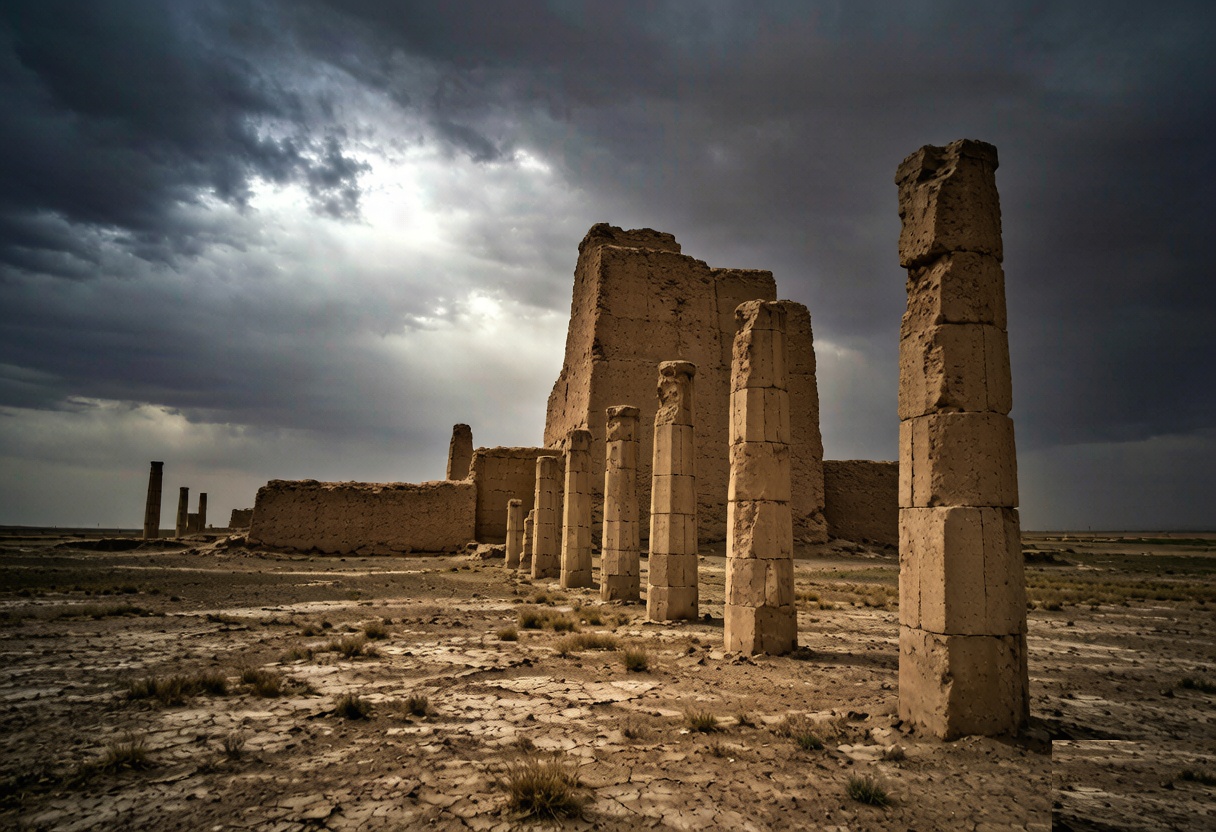
Weathered stupa bases, the outlines of monastic cells, and a few standing walls that the wind has rounded into sculpture. With no crowds and a big sky, it is easy to imagine the chanting. Pair it with Bezeklik’s caves to the east for the full Buddhist arc, from the Tarim to the Turpan depression.
Practical notes
Bring water and sun protection (see our climate guide), and keep to the marked paths so the fragile clay survives another seventeen centuries. Our 30 tips round out a Kuqa day trip, and a rented car makes the run from the city an easy half-day rather than a logistical ordeal.
With kids or older travellers
The site is flat but uneven and fully exposed, with no shade or facilities — fine for steady walkers, tiring for the very young or the less mobile. Go early, bring water and a sun hat, and keep the visit to an hour. The drama is immediate and needs no climbing, which makes it accessible in that sense; just respect the heat and the ground.
Make it a Kuqa day
Pair Subashi with the Kizil caves and the Kuqa canyon for a full northern-Silk-Road day, looping back to the city for a late lunch. A hired car makes the run smooth. Our Kuqa and Kizil guide is the backbone of that loop, and Subashi is its quiet, wind-scoured punctuation.
Who should think twice about {P}
It suits people who like landscape and can walk a few kilometres at their own pace. If you are short on days, this is the thing to cut, and no guidebook will tell you that. Subashi Ruins Kuqa is superb, but it is also an hour or more in each direction from everything else you planned, and the drives are what eat the schedule. It does not suit a family with a small child who needs a shade stop every forty minutes, and it does not suit anyone in week two of a high-altitude trip still feeling it. It suits a traveller with a car and a flexible morning. The honest version: take half a day if that is all the arithmetic allows, and save the full day for the thing that is genuinely once in a lifetime.
I am not going to pretend this is gentle. There is a lot of unshaded ground, the altitude is real if you came from a low-altitude city, and the swing between the car and the viewpoints is enough to give you a headache on an empty stomach. Who it does suit: someone wanting one strong memory, someone driving the Kuqa loop anyway, someone willing to be out before breakfast. Who it does not: anyone whose main goal is a relaxed few days, and anyone who has already done this same thing twice here. That stretch of the trip is described in our [[xinjiang-jiaohe-ruins|Jiaohe Ruins: Walking the 2,000-Year-Old…]] too.
What goes in the day pack
The light here is serious and the shade is intermittent, so the sunscreen goes on before you leave the hotel, not at the gate. A wind shell. The temperature drops fast once you stop moving and the drop is not hypothetical on an exposed pass. A fleece covers most of the year, a real jacket covers shoulder season. Sunscreen and a brim. Water, more than you think, a power bank and some cash. Cards work at the gate and in the shops, but the stalls on the approach road and the drivers waiting at the turnoff want cash, and coming up short at the moment you want a lift is the classic way to lose an hour.
What you’re looking at
The Subashi ruins (苏巴什古城) are the remains of a Qiuci (龟兹) Buddhist monastery complex split by the river that runs between its two hills — a monastic city, not a fortress. On the ground you see two large mud-brick mounds (the east and west stupa foundations), stretches of wall, and the dry riverbed that divided the community. It’s open and wind-scoured, with the Tianshan behind it, and the drama is in the scale and the emptiness more than in intact carving. I give it an hour, not fifteen.
Best light and how to pair it
Late afternoon is when the mud goes gold and the photos actually work; midday is flat and harsh. I pair Subashi with the Kizil caves (克孜尔石窟) to the west — together they tell the Qiuci Buddhist story, one a city, one a painted cave complex — and with a Kuqa old-town wander on the way back. Practical note: there’s little shade and the wind carries dust, so hat, water and a mask. It’s a stop for people who like ruins to be ruins, not for anyone expecting railings and plaques.