Tuyoq Village, Turpan: The Living Mud-Brick Village at the Mountain’s Foot
Most visitors to Turpan see the Flaming Mountains and the grape valleys and leave. A few kilometres down a side road sits Tuyoq (吐峪沟), one of the oldest Uyghur villages in Xinjiang — and one of the loveliest, because it is still simply a place where people live.
Why Tuyoq matters
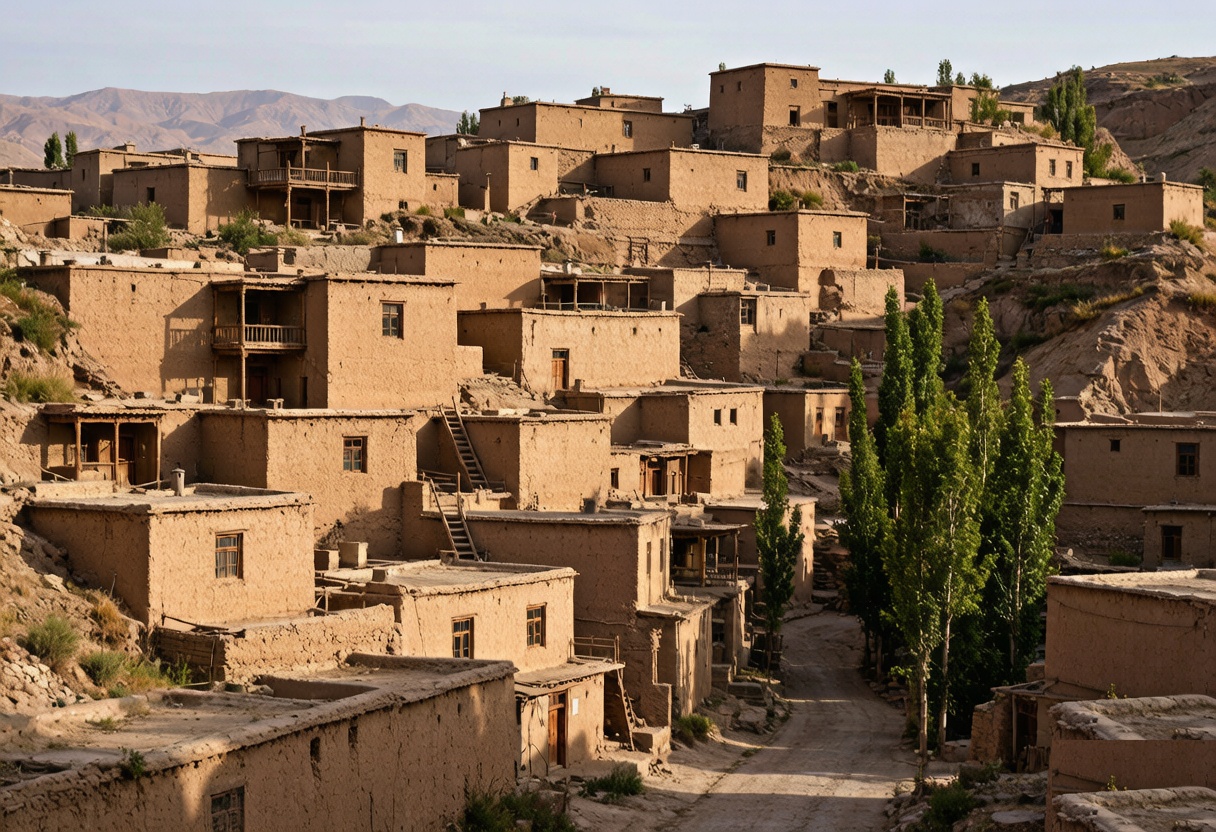
Clinging to a canyon mouth below the red mountains, Tuyoq’s mud-brick houses stack up the slope in soft, organic terraces. People have lived here for over a thousand years with barely a break. It feels less like a sight and more like a neighbour’s yard — because it is. The Turpan ruins guide covers the grander archaeological sites nearby, but Tuyoq is the living counterpart to those dead cities.
How you reach it
- From Turpan city, a taxi or hired car takes roughly an hour, mostly on good road.
- The final approach winds through the canyon, where the rock glows at sunset.
- Go early; by midday the canyon bakes and there is little shade.
What to do
Walk the lanes, peek at the old mosque, and accept that the “attraction” is the daily life around you. Buy a piece of fruit from a roadside stall; sit in the shade and watch the light move. Our cuisine guide explains the grapes this region is famous for, and Tuyoq is where you see them grown, not just sold.
Etiquette
This is a living village, not a stage set. Ask before photographing people, dress modestly, and leave the lanes cleaner than you found them. Pair it with the 30 tips for a smooth Turpan day, and you will have seen both the ruins and the continuity of the place.
Best time of day
Go at opening or late afternoon. Midday the canyon bakes and the lanes empty; early, you meet children walking to school and elders on the doorsteps, which is the whole point. Late light turns the mud walls amber and the photos need no filter. Carry water — there is little shade and no shop to rely on.
Make a morning of it
Combine Tuyoq with the nearby grape valleys and a look at the Flaming Mountains from a distance; the three together are a half-day that captures Turpan’s range — oasis, village, and desert theatre. Our 30 tips help you time it around the heat so the day stays pleasant rather than punishing.
Reaching {P} on buses, taxis and shared rides
What does exist is an intercity coach leaving the Turpan long-distance station early, a taxi share at the stand that costs a few tens of yuan a head if you are patient, and the tour vans that pick up at hotels. We came twice. The first time we chartered a car for the round trip and it was worth every yuan. The trick is finding the vehicle rather than the timetable. The second a driver on a return leg dropped us at the entrance and waited in the car park, which is the cheap way to do it if you do not mind setting your own clock.
In Turpan the drivers wait where drivers always wait, in the little offices a few hundred metres off the main terminal, and they will put together a half-day for a price the meter would never quote. Leave two hours of slack on the return. Tuyoq Village Turpan sits an hour or two from the nearest town, which sounds close until you work out there is no reliable public bus to the gate. The last vehicles back leave in the early evening, and after dark on a mountain road the local buses stop running entirely. The evening version of that plan is in our [[xinjiang-tuyoq-village-turpan|Tuyoq Village: A Living Silk Road…]].
The hour I go back for
Sunrise is the one worth an alarm for. The whole face of Tuyoq Village Turpan turns a colour that does not exist at any other time, and the site is empty enough that you can stand still and hear nothing. By ten the coaches are here, and by one it is an hour of people shuffling past. I have come to like the last forty minutes before the gate shuts, when the groups have gone and the staff are sweeping, because that is when you can look up properly instead of squeezing a shoulder past strangers. Whatever the guidebook says about golden hour, go on a weekday.
The light is only free of company on a Tuesday. Midday is the hour to avoid, not the hour to schedule. Everything goes flat, the shade disappears, and the temperature on an open plateau rises in a way that stops you caring about photographs. Go early or go late and the same ground gives you two different subjects. Between the two I would pick the later one, mostly because the early version costs you the rest of the day.
The evening version of that plan is in our [[xinjiang-village-guesthouse|Village Guesthouses in Xinjiang: Sleeping…]].
What’s in the village
Tuyoq (吐峪沟) is a living Uyghur village in a side canyon off the Turpan basin, built into the same mud as the cliffs behind it. The lane up to the hillside mazar (a local holy site) and the scattered cave-hermit cells cut above the village are the quiet draw — not a museum, just a place people still farm and pray. The houses are the colour of the earth, the grapes hang over every wall in summer, and the heat is the real Turpan heat, so I go early or late.
Getting there and when to go
It’s an easy run from Turpan town — a local bus or a short drive east — and I pair it with the nearby grape valleys and the Jiaohe ruins if I have a day. Spring and autumn are kindest; deep summer is brutally hot and I’d only do it at dawn. A homestay lunch in the village (grapes, noodles, bread) is the right way to do it — sit in the shade, let the place happen around you, and skip the urge to tick boxes. It’s small, which is exactly why it’s worth the trip.