Da Pan Ji (Big Plate Chicken): The Dish That Defines Xinjiang Cuisine
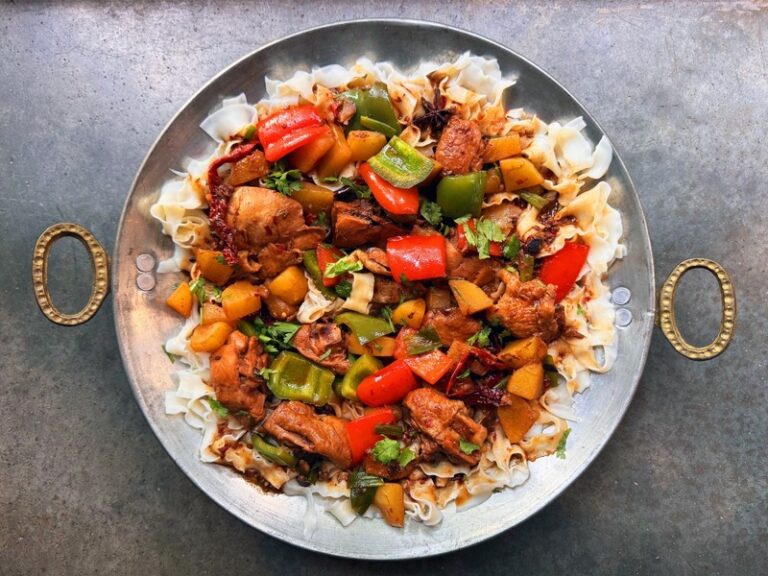
If there is one dish that captures the generous, bold spirit of Xinjiang’s food culture, it is Da Pan Ji (大盘鸡) — literally “Big Plate Chicken.” Served in a massive platter meant for sharing, this hearty stew of tender chicken, waxy potatoes, and fiery red peppers has earned its place as one of Xinjiang’s most famous and beloved dishes.
Last updated: July 15, 2026 · Written by Karl Huang, a Xinjiang travel specialist who has spent time across the region. Practical details are cross-checked against official tourism, transport, and border-regulation sources.
What makes Da Pan Ji special goes far beyond the ingredients. It is a dish born on the open road, shaped by the needs of hungry truck drivers passing through a small county town. It is a story of cultural fusion — Sichuan heat meets Xinjiang heartiness. And it is an experience: friends and family gathered around a single enormous plate, eating with chopsticks, tearing pieces of flatbread to soak up the sauce, and finishing with a layer of chewy handmade noodles.
This guide covers everything you need to know about Da Pan Ji: its surprising origin story, the essential ingredients, how it is traditionally prepared, where to find the best versions, and tips for ordering like a Xinjiang local.
What Is Da Pan Ji?
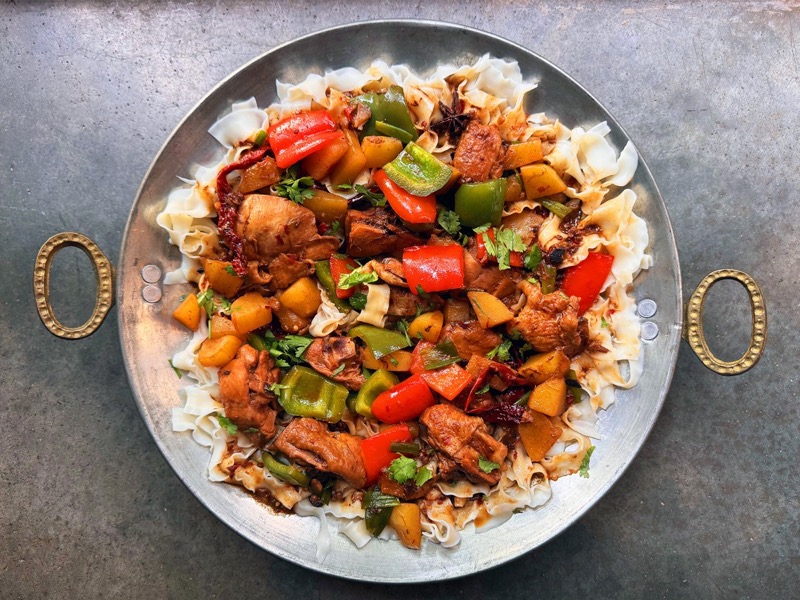
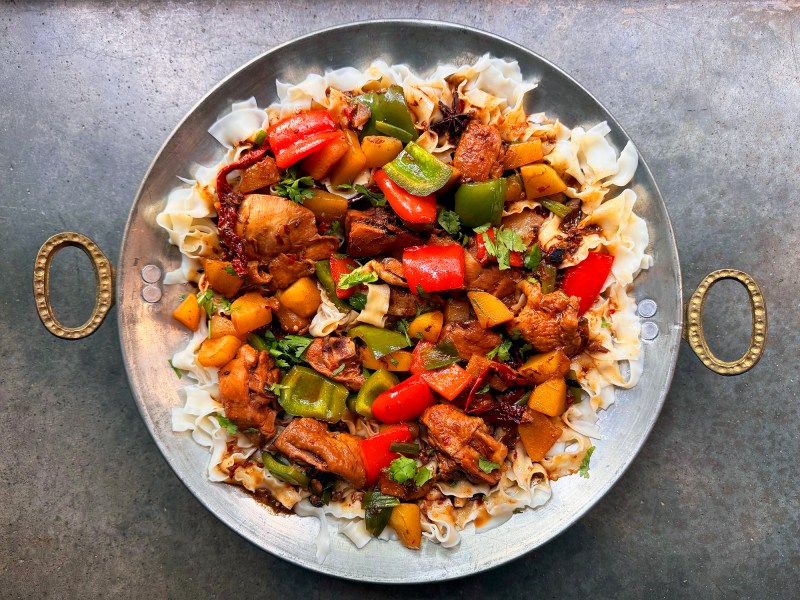
Da Pan Ji is a communal chicken stew served in an oversized round plate or aluminum tray. The dish consists of bone-in chicken pieces, potatoes, green and red bell peppers, and dried chilies, all braised together in a thick, richly colored sauce made from soy sauce, doubanjiang (fermented chili-bean paste), beer, and a blend of aromatic spices.
What distinguishes Da Pan Ji from ordinary braised chicken dishes is the scale and the combination. The portions are enormous — a full plate typically uses an entire chicken and can easily feed four to six people. The sauce is not just a cooking medium; it becomes the foundation for the dish’s celebrated finale: a layer of belt noodles (皮带面, pi dai mian) — wide, flat, hand-pulled noodles laid directly into the remaining sauce and tossed until every strand is coated.
It is, in every sense, a dish designed for sharing. You do not order Da Pan Ji for yourself. You order it for the table.
The Origin Story: From Truck Stop to National Fame
The story of Da Pan Ji begins in Shawan County (沙湾县), a small town in the Tianshan foothills of northern Xinjiang, during the 1980s.
At that time, the road from Urumqi to cities like Ili, Tacheng, and Altay passed directly through Shawan. The journey was long and rough — a full day’s drive on unpaved roads. Long-distance truck drivers would arrive in Shawan exhausted and ravenous, stopping at the cluster of small roadside restaurants that lined the highway.
According to the most widely accepted account, a restaurant owner named Li Shilin (李士林), who ran an eatery called “Man Peng Ge” (满朋阁) and was known for his la zi ji (Sichuan-style spicy chicken), received a request from a group of road construction workers: they wanted an entire chicken — not just the small portions Li typically served.
Li had no plate large enough, so he used the noodle-serving platter instead. He stir-fried the whole chopped chicken with chilies, garlic, ginger, and his signature spices, and served it on this oversized plate. The workers were thrilled. The next table demanded the same. The dish — informally called “the big-plate spicy chicken” — took off.
By the early 1990s, “Da Pan Ji” had spread from Shawan across Xinjiang and beyond. In 1992, a restaurant owner in Shawan’s Xinghua Village became the first to register “Da Pan Ji” as a brand name. Today, Shawan proudly calls itself the birthplace of Da Pan Ji, and the dish is recognized as one of the Ten Classic Dishes of Xinjiang.
The Essential Ingredients
The Chicken: Whole and Bone-In
Authentic Da Pan Ji always uses a whole chicken, chopped into bone-in pieces roughly 4 centimeters square. The bones are not optional — they contribute deep flavor to the braising liquid and help the meat stay juicy during the long cooking process. In Shawan, local free-range chickens (土鸡) are preferred for their firmer texture and more pronounced flavor compared to factory-farmed birds.
The Potatoes: The Unsung Hero
Potatoes are every bit as important as the chicken in Da Pan Ji. Large, waxy potatoes are cut into chunks and braised alongside the chicken. After simmering in the sauce for 15 to 20 minutes, they become creamy on the inside while holding their shape on the outside. For many Xinjiang locals, the potatoes are actually the best part of the dish.
The Chilies and Peppers
The heat in Da Pan Ji comes from two sources:
- Dried red chilies — These provide the slow, building warmth that infuses the entire sauce. Local Shawan-grown chilies (安集海辣椒) are considered the gold standard.
- Fresh green and red bell peppers — Added near the end of cooking, they contribute sweetness, crunch, and vibrant color.
The Spices: A Bridge Between Sichuan and Xinjiang
The spice blend reveals Da Pan Ji’s cultural DNA — a fusion of Sichuan and Xinjiang traditions:
- Sichuan peppercorns (花椒) — Their signature numbing tingle (ma la) is a hallmark of Sichuan cuisine.
- Star anise (八角), cinnamon bark (桂皮), and cardamom (草果) — These warming spices connect the dish to the broader Central Asian flavor palette common in Xinjiang.
- Ginger, garlic, and scallions — The aromatic foundation of virtually every Chinese braised dish.
The Sauce: The Soul of the Dish
The sauce that brings everything together is built from doubanjiang (豆瓣酱, Pixian fermented chili-bean paste), soy sauce, a splash of sugar to balance the heat, and — crucially — beer. The beer tenderizes the chicken and adds a subtle maltiness that rounds out the sauce. In Xinjiang, local beers like Wusu (乌苏) or Xinjiang Snow Beer are the traditional choice.
Belt Noodles (皮带面): The Grand Finale
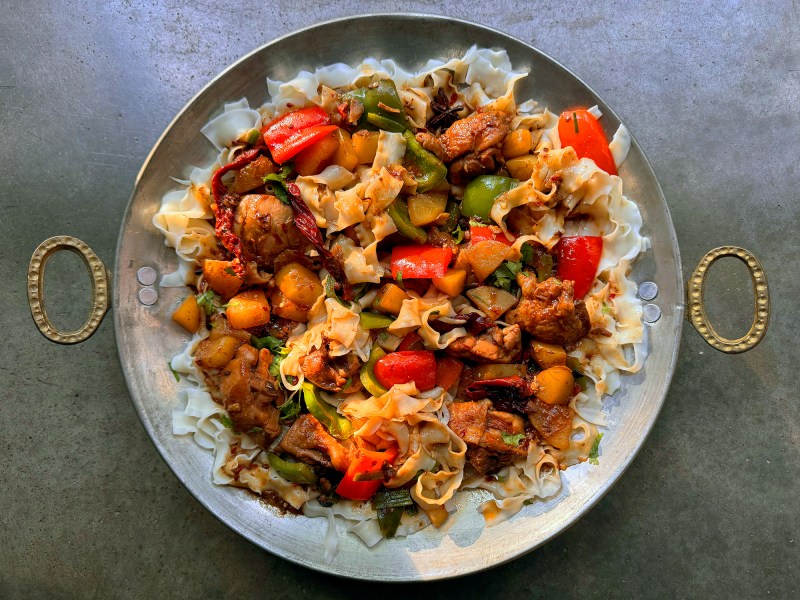
No Da Pan Ji meal is complete without belt noodles. These are wide, flat, hand-pulled noodles — each one roughly 2 centimeters wide and 30 to 50 centimeters long, resembling a leather belt (hence the name). Made from simple wheat flour, water, and salt, they are boiled separately and then laid directly into the residual sauce after most of the chicken and potatoes have been eaten.
The noodles absorb the spicy, savory, slightly sweet sauce and become the undisputed star of the meal’s final act. Many Xinjiang diners will tell you that the noodles are the real reason they order Da Pan Ji.
How Da Pan Ji Is Made: The Traditional Process
Step 1: Preparing the Chicken
A whole chicken is chopped into bone-in pieces and briefly blanched in boiling water to remove any impurities. The pieces are then drained and dried.
Step 2: Blooming the Spices
Oil is heated in a large wok. Sichuan peppercorns are added first to release their aroma, followed by sugar, which is caramelized to a deep amber. The chicken pieces go in next, searing quickly on all sides.
Step 3: Building the Sauce
Doubanjiang, dried chilies, ginger, and garlic are added and stirred until fragrant. Soy sauce is poured in, followed by enough beer to nearly cover the chicken. Star anise, cinnamon, and cardamom are dropped into the liquid.
Step 4: Braising the Chicken
The wok is brought to a boil, then reduced to a gentle simmer. The chicken braises for about 20 minutes, absorbing the flavors of the sauce.
Step 5: Adding Potatoes
Thick chunks of potato are added to the wok. Salt is adjusted, and the dish continues to simmer for another 15 minutes until the potatoes are tender but not falling apart.
Step 6: Finishing with Fresh Peppers
Diced green and red bell peppers are stirred in for the final two to three minutes, adding freshness and a burst of color. The entire dish is then transferred to a large round serving plate.
Step 7: The Noodles
Separately, belt noodles are boiled until chewy and then either laid alongside the chicken dish or — in the most authentic style — placed directly into the plate once the diners have finished most of the solid ingredients, allowing the noodles to soak up every drop of sauce.
Where to Find the Best Da Pan Ji in Xinjiang
Shawan: The Birthplace
For the most authentic Da Pan Ji experience, Shawan County is the pilgrimage destination. The town takes enormous pride in its signature dish, and dozens of restaurants compete for the title of best. Look for establishments that use local free-range chicken and Shawan-grown chilies. The difference in flavor is noticeable.
Urumqi: Widest Selection
As the capital, Urumqi offers the greatest variety of Da Pan Ji restaurants, from humble roadside eateries to upscale dining rooms. The Erdaoqiao area and the streets around Nanhu have several well-regarded options. Prices range from 80 to 150 RMB for a full plate, depending on the restaurant and chicken quality.
Everywhere Else in Xinjiang
Da Pan Ji is so deeply embedded in Xinjiang’s food culture that you will find it in virtually every town and city. It is equally popular in Uyghur-majority areas like Kashgar and Hotan, in Kazakh regions like Altay, and in northern cities like Karamay. While the core recipe stays the same, regional variations exist — some areas add more tomatoes, others use different chili varieties.
How to Order and Eat Da Pan Ji Like a Local
- Share it. Da Pan Ji is always a group dish. A full plate (大盘) feeds 4 to 6 people. A half plate (中盘) works for 2 to 3.
- Choose your spice level. You can request “bu la” (不辣, not spicy), but the mild version loses much of the dish’s character. If you can handle moderate heat, go with the standard version.
- Save room for the noodles. Many first-timers fill up on chicken and potatoes and have no appetite left when the belt noodles arrive. This is a mistake. The noodles are the best part.
- Use naan to soak up the sauce. If you run out of noodles, tear pieces of fresh naan flatbread and dip them into the remaining sauce. Locals consider this a perfectly acceptable — even encouraged — practice.
- Add a cucumber side dish. Many restaurants offer a cold cucumber salad on the side. The cool, refreshing crunch provides welcome relief from the spice.
- Pair with cold beer. A bottle of ice-cold local beer is the traditional accompaniment. Wusu Beer (乌苏啤酒), a Xinjiang icon with its distinctive green label, is the default choice.
Practical Tips for Travelers
What does it taste like? Expect bold, layered flavors: the initial hit of chili heat followed by the deep, savory richness of the braised chicken, the creamy sweetness of the potatoes, and the aromatic warmth of the spices. The sauce is complex — spicy, slightly sweet, savory, and faintly malty from the beer.
How much does it cost? A full plate at a standard restaurant costs 80 to 150 RMB ($11–21 USD). A half plate is roughly half the price. Belt noodles are typically an additional 10 to 20 RMB. At this price point, Da Pan Ji is one of the most satisfying value meals in Xinjiang.
Is it spicy? Yes, but the heat is manageable for most palates. It is a warming spice rather than an overwhelming burn. If you are sensitive to chili, you can ask for a milder version, though some of the dish’s complexity will be lost.
Can vegetarians eat it? Many restaurants offer a vegetarian version (素大盘鸡) using tofu, mushrooms, or cauliflower in place of the chicken. The potatoes, peppers, and — most importantly — the belt noodles with sauce are all vegetarian-friendly.
Why Da Pan Ji Matters in Xinjiang’s Culture
Da Pan Ji is more than a meal — it is a reflection of Xinjiang itself. The dish was born from the convergence of different culinary traditions: Sichuan’s bold spice, Xinjiang’s hearty ingredients, and the practical needs of travelers on the road. It represents the region’s multicultural character in a single plate.
The communal nature of Da Pan Ji mirrors the hospitality that defines Xinjiang. The dish is designed to bring people together — friends, family, even strangers seated at the same table in a busy restaurant. In a world of individual plates and solitary dining, Da Pan Ji is a reminder that some of the best food experiences are shared ones.
If you are planning a trip to Xinjiang, Da Pan Ji is not just a meal to try — it is an experience to seek out. Find a bustling restaurant, gather your travel companions around a big round table, and let the steaming plate of chicken, potatoes, and red sauce arrive at the center. Eat slowly. Save room for the noodles. And when you finally twist a sauce-soaked belt noodle around your chopsticks and take that first bite, you will understand why this humble truck-stop dish became one of the most celebrated foods in all of Xinjiang.
Is Xinjiang safe to visit?
Yes, Xinjiang is considered very safe for tourists with strong security presence throughout the region.
Do I need a visa?
Foreigners need a valid Chinese visa. No separate Xinjiang permit needed for most tourist areas.
What currency should I bring?
Chinese Yuan (RMB). Credit cards accepted in hotels; carry cash for markets and rural areas.
Can I find English-speaking guides?
Available in major tourist areas through hotels or travel agencies. Book in advance for best results.