Sayram Lake for First-Timers: Half-Day vs Full-Day Plans
{“@context”: “https://schema.org”, “@type”: “Article”, “headline”: “Sayram Lake for First-Timers: Half-Day vs Full-Day Plans”, “url”: “https://www.xinjiangtraveltips.com/sayram-lake-travel-guide/”, “author”: {“@type”: “Organization”, “name”: “Xinjiang Travel Tips”, “url”: “https://www.xinjiangtraveltips.com/”}, “publisher”: {“@type”: “Organization”, “name”: “Xinjiang Travel Tips”, “logo”: {“@type”: “ImageObject”, “url”: “https://www.xinjiangtraveltips.com/wp-content/uploads/2026/01/logo.png”}}, “mainEntityOfPage”: {“@type”: “WebPage”, “@id”: “https://www.xinjiangtraveltips.com/sayram-lake-travel-guide/”}}
First time at Sayram Lake (赛里木湖)? The good news: it is one of the easiest “wow” stops in Xinjiang to fit in, because it sits right on the G30 corridor between Urumqi and the Ili Valley. The question is not “can I see it” but “how much time do I give it.” Here are three realistic plans.
The 30-second orientation
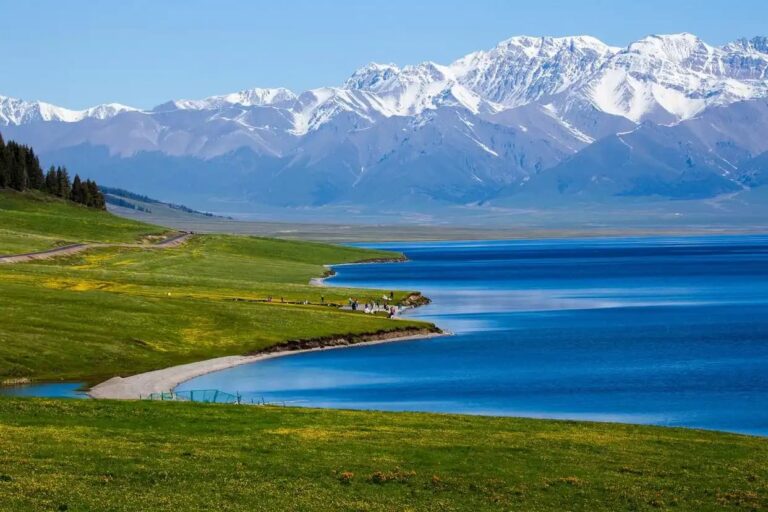
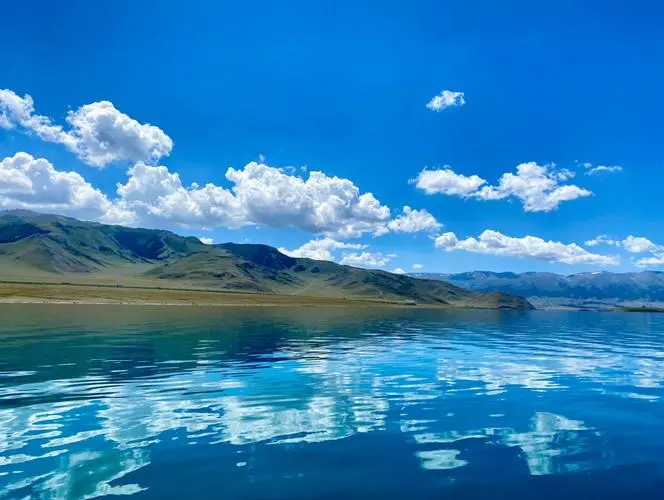
Sayram is a big alpine lake at 2,073 m, about 1.5–2 hours from Yining and 5–6 hours from Urumqi. You drive or shuttle the lakeside loop (70–90 km) and stop where the light is good. That is the whole visit. The main guide explains what you are looking at; this is about fitting it into a trip.
Plan A — Half-day from Yining (most common)
Best for: a one-night Ili stop, or a break on the Urumqi–Yining drive.
- Drive Yining → Sayram (~1.5–2h), enter mid-morning.
- Self-drive the east and south shore (2–3 hours with photo stops).
- Lunch back in Yining or at a roadside stop.
Total lake time: about 2–3 hours. Enough to feel the place without committing a night.
Plan B — Full day with Guozigou + Huocheng lavender
Best for: summer visitors who want more than a drive-by.
- Morning at Sayram (arrive for the calm light).
- Drive the Guozigou Bridge gorge on the way out.
- If it is June–July, add Huocheng’s lavender fields nearby.
- Return to Yining for the night.
The bridge and loop are detailed in the ring-road guide.
Plan C — As part of a north Xinjiang loop
Best for: first-timers doing the classic route.
- Sayram pairs naturally with Kanas and Hemu on a 7-day northern loop.
- Treat it as the southern bookend of the loop, not a standalone trip.
See the 7-day north Xinjiang itinerary for the sequencing.
The mistake I made the first time
What I would tell the version of me who planned it: put the slow hours in, not the fast ones. The whole point of coming this far is to have the place to yourself for a while, and that only happens if you are willing to be there when it opens or when it is nearly shut. I did come back the following trip, at seven in the morning, and it was a different site. The other mistake is about distance on the map. The gate is not the site.
There is a shuttle, a walk, sometimes another shuttle, and the stretch everybody underestimates is between the second gate and the thing you crossed the country to see. That is the number of hours the visit needs. So: work out how far it is from where the vehicle drops you to the feature, then double it. I assumed two hours would be plenty. It was, in the sense that I saw everything, and it was ruined in the sense that I saw everything at the same hour with the same crowd, and I spent the drive home meaning to come back and never did.
Timing your visit to {P}
Most first-timers plan two hours and then get stranded. The gates open early and the last entry tends to stop a couple of hours before closing, so the promise of coming back for sunset is not always possible. Budget the full morning. That covers the walk in, the slow look at the main feature, the side trails almost nobody does, and getting back to the car before the light goes flat. Half a day is enough to understand it.
Ninety minutes is enough to tick the box. A full day is what you want when the point of coming was Sayram Lake itself rather than a stop on the way. The first time I rushed it and spent the whole visit looking up at the same rock from one spot. The second I gave it a morning and a late-afternoon return and saw two completely different places, because the light moved across the surface and the crowds thinned to nothing. My own rule now: if I have to choose between this and an extra evening in Sayram, I keep the evening.
That stretch of the trip is described in our [[sayram-lake-travel-guide-xinjiang|Sayram Lake Practical Guide: Tickets, the…]] too.
Not everyone should build a trip around this
There is a lot of unshaded ground, the altitude is real if you came from a low-altitude city, and the swing between the car and the viewpoints is enough to give you a headache on an empty stomach. Who it does suit: someone wanting one strong memory, someone driving the Sayram loop anyway, someone willing to be out before breakfast. Who it does not: anyone whose main goal is a relaxed few days, and anyone who has already done this same thing twice here. If you are short on days, this is the thing to cut, and no guidebook will tell you that. Sayram Lake is superb, but it is also an hour or more in each direction from everything else you planned, and the drives are what eat the schedule. It suits people who like landscape and can walk a few kilometres at their own pace.
It does not suit a family with a small child who needs a shade stop every forty minutes, and it does not suit anyone in week two of a high-altitude trip still feeling it. It suits a traveller with a car and a flexible morning. I am not going to pretend this is gentle. The honest version: take half a day if that is all the arithmetic allows, and save the full day for the thing that is genuinely once in a lifetime. I wrote the driving side up in our [[kanas-lake-xinjiang-travel-guide-2|Kanas Lake in Autumn: When the Larch Turns…]] as well.
A second look on day two
Almost nobody does Sayram Lake twice. If your itinerary has a spare morning, spend it here again rather than at the bigger name on the far side of town. I did, and the second visit was better, because the first had been spent working out where to stand. The second time you can skip the obligatory viewpoint and walk along the base of the ridge where the light comes in sideways, and that is the photograph you keep. The short version, with the numbers, is in our [[kanas-lake-xinjiang-travel-guide|Kanas Lake Practical Guide: Tickets, the…]].
When to go
- Jun–Jul: wildflowers and swans — busiest, prettiest.
- Sep–Oct: golden grass, fewer crowds, calm light. My pick.
- Winter: blue ice, near-empty. Covered separately in the off-season guide.
What to pack (even in summer)
A windproof layer, sunglasses, and water. The altitude and the constant wind make it cold faster than the calendar suggests. If you are travelling with children, the family plan has the altitude notes.