Lop Nur (Lop Nor): Xinjiang’s Vanishing Salt Lake and the Lost Kingdom of Loulan
1. Here the goal is narrower: to report what researchers, officials, and the few travelers who have reached the region’s edge actually document. Readers should treat everything below as secondary research. Where a claim comes from a specific kind of source, it is flagged with phrases such as “researchers note,” “official sources state,” or “travelers report.” No first-hand observations are presented as the author’s own, because none exist. If you are planning a trip to Xinjiang more broadly, the Xinjiang travel hub covers many destinations that are openly accessible and do not carry the legal restrictions described here.
It is also worth stating what this article is not. It is not a first-person travelogue, not a set of tips from someone who camped on the salt flats, and not a promise that you can simply drive in. Lop Nur’s status as a controlled zone shapes every practical section that follows, from transport to tickets to photography. Keeping that boundary clear protects both readers and the fragile, scientifically sensitive landscape itself.

2. Overview & Key Facts
Lop Nur was once a vast inland lake in the Tarim Basin, fed historically by the Tarim, Peacock (Kongque), and other rivers that drain the surrounding mountains. Researchers note that shifting climate and the diversion of upstream water for agriculture caused the lake to contract dramatically through the 20th century, and by the 1970s it had effectively dried into a salt-encrusted playa. The Lop Nur salt lake is now often described in scientific literature as a “dead lake” — a white, cracked salt pan visible from satellite imagery and almost entirely devoid of surface water.
The basin’s geography is deceptively simple. It is a closed depression with no outlet, so whatever water arrived stayed until it evaporated, leaving behind thick mineral deposits. Official sources state that the area’s salt and potassium resources later attracted industrial interest, adding another layer of sensitivity to an already remote region. The result is a landscape that is both historically famous and practically off-limits.
Adjacent to this basin lay the Kingdom of Loulan, a settlement and oasis state on the ancient Silk Road. Official sources state that Loulan flourished roughly two thousand years ago as a stopover for merchants moving between China and Central Asia, then was abandoned as the rivers that sustained it shifted course and the desert advanced. The ruined city was rediscovered by external explorers in the early 20th century, and its wooden structures, documents, and mummies have since become central to the study of Silk Road history. Travelers who have seen the exhibits in regional museums consistently describe the Loulan finds as among the most striking archaeological material in the entire Tarim region.
The name “Lop Nur” itself derives from a local geographic term for the lake, and variations such as “Lop Nor” appear in older maps and expedition records. Travelers report that the surrounding landscape is among the most desolate in Xinjiang — flat, white, and silent, with little vegetation and extreme temperature swings between day and night. Understanding this environment is the first step to understanding why access remains so tightly controlled.
3. Getting There
Lop Nur is not a destination with a tourist entrance. Official sources state that the area is a restricted zone, historically associated with sensitive scientific and industrial activity, and independent travel there is not permitted. The nearest realistic access point for visitors is the town of Ruoqiang (Charklik), which lies to the south and serves as the administrative gateway to the region. Most people who reference “going to Lop Nur” in practice mean basing themselves in Ruoqiang and joining an authorized group that approaches the basin’s margin.
Travelers report reaching Ruoqiang by road from Korla or by regional air services. From Ruoqiang, the Taklamakan desert roads and the southern Xinjiang routes provide the only overland approach toward the basin’s edge. For context on crossing the desert by road, see the Taklamakan Desert Highway guide. However, entering the core Lop Nur area requires authorized permits and organized scientific or official trips — there is no public transport and no open border for casual tourism. Driving a private car toward the restricted boundary without clearance is both illegal and dangerous given the lack of services.
For broader planning of the wider region, the Xinjiang travel hub lists accessible destinations that do not carry the same restrictions as Lop Nur. Travelers who want desert scenery without the access problems often substitute a visit to the open sections of the Taklamakan rim or to oasis towns such as Turpan, where Silk Road history is presented in a visitor-friendly setting.

4. Tickets & Costs
There is no standard public ticket for Lop Nur. Official sources state that because the zone is restricted, casual visitors cannot buy entry. Authorized expeditions — scientific, documentary, or official — are arranged case-by-case and cost substantially more than ordinary sightseeing, covering permits, fuel, guides, vehicles, and logistics in a remote desert environment. Travelers should not expect a posted price at a gate, because there is no such gate for the general public.
As of 2025, permit and logistics for authorized visits are arranged case-by-case — confirm with official Xinjiang tourism channels. Travelers should budget for the fact that even reaching the Ruoqiang staging area involves long desert drives and that any authorized approach multiplies those costs through specialized transport. The comparison below distinguishes Lop Nur from openly visitable lakes so readers do not confuse the two categories of destination.
| Lake / Site | Public Access | Typical Cost Model | Status |
|---|---|---|---|
| Lop Nur (Lop Nor) | Restricted; permits required | Case-by-case authorized trips | Dried salt pan |
| Sayram Lake | Open; ticketed park | Standard park entry | Active alpine lake |
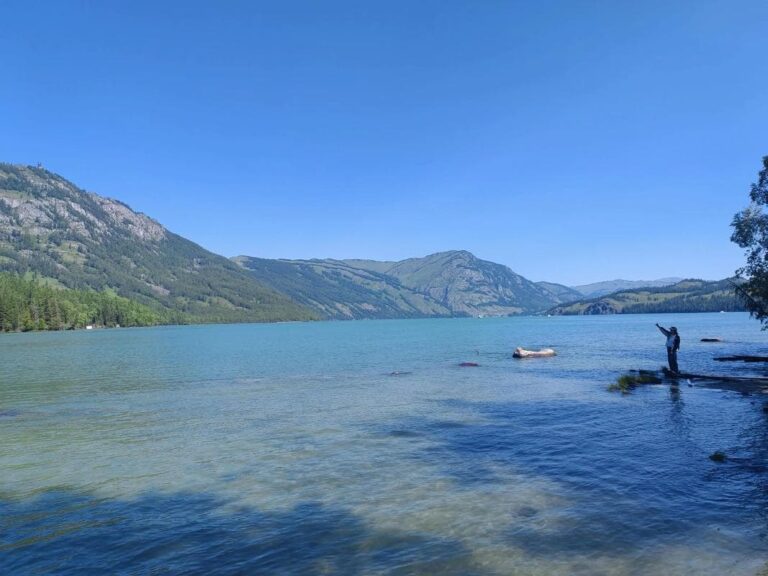
| Kanas Lake | Open; ticketed park | Standard park entry + shuttle | Active glacial lake |
These are different, accessible lakes: Sayram Lake and Kanas Lake are both open to ordinary visitors and should not be confused with the closed Lop Nur basin. The honest takeaway is that Lop Nur is best experienced through museums and authorized research rather than as a paid tourist stop.
5. Best Time to Visit
For those on authorized trips, researchers note that spring (April–May) and autumn (September–October) offer the most tolerable conditions, with milder temperatures and somewhat lower wind frequency. Summer brings extreme heat across the Tarim Basin, with surface temperatures on the salt flats becoming dangerous and daytime travel physically risky. Winter is harsh and cold, with limited daylight and the possibility of ice on access roads.
Sandstorms are a recurring hazard, especially in the windy seasons, and can close desert roads without warning. Travelers report that even short exposure to the basin’s climate demands careful planning, ample water, and reliable communication. For regional seasonal context, see the best time to visit Xinjiang guide, though Lop Nur’s restrictions mean the timing advice applies mainly to the Ruoqiang staging area rather than to the basin interior. If your authorized window is fixed, build flexibility around weather rather than against it.
6. Day-by-Day Itinerary
The following is a sample framework for an authorized, Ruoqiang-based trip and is not a promise of access. Authorized itineraries vary by permit and purpose, and some groups spend far more time in the field. Clock times are illustrative and assume a cleared, guided convoy.
| Day | Time | Activity |
|---|---|---|
| Day 1 | 08:00 | Arrive Ruoqiang; briefing on restricted-zone rules |
| Day 1 | 14:00 | Visit Ruoqiang Museum; Loulan relics exhibit |
| Day 1 | 19:00 | Equipment and water check with authorized guide |
| Day 2 | 07:00 | Depart with authorized convoy toward basin edge |
| Day 2 | 12:00 | Salt-flat observation (permit-bound area) |
| Day 2 | 18:00 | Return to Ruoqiang before nightfall |
| Day 3 | 09:00 | Documentary screening / museum follow-up |
| Day 3 | 15:00 | Depart Ruoqiang for Korla or onward route |
This outline keeps the focus on what is realistically reachable: the museum and town on Day 1, a guided basin-edge excursion on Day 2, and wrap-up on Day 3. Travelers report that even authorized groups rarely penetrate deep into the salt pan, and the sample reflects that constraint rather than implying open exploration.

7. Where to Stay
The realistic base is Ruoqiang (Charklik) town. Travelers report basic but adequate hotels there, ranging from simple guesthouses to small mid-range properties, with the occasional newer business hotel near the town center. There are no stays inside Lop Nur — the basin offers no accommodation, and authorized trips typically return to Ruoqiang each night or use temporary field camps under permit. Do not plan to “sleep under the stars” in the salt pan without explicit authorization; the environment is hazardous and the rules are strict.
Bookings should be made in advance, as Ruoqiang is a small town and rooms are limited during peak travel months. Visitors coming from the north often pass through Korla, which has a wider range of hotels and connects onward by road. Official sources state that accommodation standards near restricted zones are functional rather than luxurious, so travelers should set expectations accordingly and treat Ruoqiang as a logistics base, not a resort.
8. Food (What & Where to Eat Nearby)
In Ruoqiang, travelers report Uyghur cuisine dominates: hand-pulled laghman noodles, polo (pilaf with lamb and carrot), samsa (baked pastries), and fresh nang bread. Small family restaurants and night-market stalls serve these dishes at modest prices, and the town’s size means options are concentrated along a few main streets. Vegetarians may find choices limited but can usually rely on noodle and bread dishes.
Because the Lop Nur basin itself has no services, all meals are taken in Ruoqiang or en route, and authorized groups typically carry provisions for any time spent outside town. For a fuller picture of regional dishes and where to find them, consult the Xinjiang food guide. Those combining a Ruoqiang trip with a northern route may also explore the oasis cuisine described in the Turpan guide, where grape-based dishes and cold noodles add variety to the standard Silk Road menu.
9. Practical Tips
- Permits: Official sources state that entering the restricted zone requires advance authorization; never attempt independent entry, as penalties and danger are both real.
- GPS & navigation: Researchers note that the flat white salt pan erases landmarks; carry satellite navigation and inform others of your route before any movement.
- Water: The desert is unforgiving — carry far more water than seems necessary, even on short excursions from Ruoqiang, and monitor intake in heat.
- Guides: Use only authorized, permit-holding guides familiar with the restricted area; informal local offers are not a substitute for clearance.
- Respect: Loulan relics are protected; removing artifacts is illegal and damages irreplaceable history that belongs to the public record.
- Photography: Some zones limit photography for security or preservation reasons — follow guide instructions and do not push past posted boundaries.
- Communications: Travelers report that phone coverage disappears away from town; a satellite messenger is prudent for any authorized field movement.
10. Original FAQ
Q: Can ordinary tourists visit Lop Nur freely?
A: No. Official sources state the area is restricted; only authorized scientific or official trips with permits are allowed.
Q: Why did Lop Nur dry up?
A: Researchers note a combination of reduced river inflow from upstream diversion and long-term climate drying in the Tarim Basin.
Q: What happened to the Kingdom of Loulan?
A: Official sources state it was abandoned as the rivers shifted and the desert expanded, ending its role as a Silk Road oasis.
Q: Is Lop Nur the same as Kanas or Sayram Lake?
A: No.