12 Xinjiang Travel Mistakes to Avoid (And What to Do Instead)
I have driven, flown and train-hopped across Xinjiang more times than I can count, and the pattern is depressingly consistent: the trips that go sideways almost never fail because of the region itself. They fail because of a handful of planning assumptions that travelers import from somewhere else. Xinjiang is the size of Iran. It runs on two clocks. Its shoulder seasons swing forty degrees in a single afternoon. None of that is hidden information, and yet I meet people in Urumqi lobbies every season who are quietly rearranging a broken itinerary.
What follows is not a list of scary warnings. It is the twelve mistakes I actually watch people make, with the fix for each one.
Mistake 1: Treating Xinjiang Like a Single Destination
This is the original sin, and every other scheduling problem descends from it. People book ten days, list Kashgar, Kanas, Turpan and the Pamirs, and assume the gaps between them are a couple of hours. They are not. Kanas sits in the far north near the Altai; Tashkurgan sits on the Pamir Plateau in the far southwest. Putting both in one ten-day trip means you spend most of it in transit.
| Route | Approx. distance | Realistic travel time |
|---|---|---|
| Urumqi to Kanas Lake | ~700 km | 2 days by road, or fly to Kanas/Burqin |
| Urumqi to Kashgar | ~1,500 km | ~2 hr flight, or 17-24 hr by train |
| Kashgar to Tashkurgan | ~290 km | 5-6 hr each way on the Karakoram Highway |
| Urumqi to Turpan | ~190 km | 1 hr by high-speed rail |
| Urumqi to Sayram Lake | ~550 km | 7-8 hr by road |
The fix: pick a half. North (Urumqi, Tianchi, Sayram, Ili Valley, Kanas) or south (Kashgar, Karakoram Highway, Hotan, Turpan). Ten days does one half well. Fourteen days can attempt both if you fly the long leg.
Mistake 2: Ignoring the Two-Clock Problem
Officially the whole region runs on Beijing time. In practice, much of southern Xinjiang and a lot of daily Uyghur life runs on unofficial local time, two hours behind. So “we’ll meet at nine” is a genuinely ambiguous sentence. Trains, flights and formal ticket offices use Beijing time; a guesthouse breakfast or a market stall opening may not.
The fix: when anyone gives you a time, add three words: “Beijing or local?” I have never once had someone find the question rude. And remember what the offset does to daylight — in Kashgar in June the sun can still be up past 10 p.m. Beijing time, which is glorious for photography and terrible for anyone who assumed dinner meant sunset.
Mistake 3: Packing for One Climate
People pack for the photo they saw. Desert photo, so shorts. Grassland photo, so a fleece. Xinjiang does not respect either choice, because a single day can include a 38°C Turpan afternoon and a 6°C night at altitude. In the same week I have wanted sunscreen, a down jacket and gloves.
The fix: layers over volume. A merino base, a light insulated mid-layer, a windproof shell, a brimmed hat and real sunglasses will cover almost every scenario except deep winter. Skip the second pair of jeans. Our full seasonal packing list for Xinjiang breaks this down region by region if you want the checklist version.
Mistake 4: Assuming You Can Sort the Paperwork on Arrival
Most of Xinjiang needs nothing beyond your normal China visa. But specific border-zone areas — Tashkurgan and the Pamir corridor being the obvious one — sit inside controlled zones where a separate border permit applies, and the rules are administered locally rather than uniformly. Travelers who show up in Kashgar on a Saturday hoping to be in Tashkurgan on Sunday sometimes lose two days.
The fix: decide before you fly whether your route touches a border zone. If it does, arrange it through a local agency or your Kashgar guesthouse a few days ahead, and carry your passport at all times — not a photo of it. Bring more passport photocopies than feels reasonable.
Mistake 5: Relying on Foreign Cards and Foreign Apps
This is the single most common practical failure I see, and it is entirely avoidable. Foreign credit cards are accepted in a thin slice of hotels and almost nowhere else. Daily life runs on mobile payment. Meanwhile some of the apps you rely on for maps, mail and messaging will not behave as expected.
What actually works
Link an international card to Alipay or WeChat Pay before you arrive and test it on a small purchase in your first city. Download offline maps for every region you will enter. Keep a paper note of your hotel names in Chinese characters, because handing a taxi driver a screenshot beats spelling a transliteration.
Still carry cash
A few hundred yuan in small notes covers the moments mobile payment fails — a rural pasture entry gate, a village shop with an offline scanner, a shared taxi driver who wants notes. Small notes, not a single large one.
Mistake 6: Over-Scheduling the Days
Xinjiang punishes tight itineraries. Security checkpoints on some roads add unpredictable minutes. Mountain weather closes passes. A scenic-area shuttle bus queue can eat an hour you did not budget. Travelers who plan three sights a day arrive at the third one in the dark, exhausted, having enjoyed none of them.
The fix: one anchor sight per day, plus one flexible option. Build a spare half-day into any week-long route. The days people remember here are the unplanned ones — the roadside melon stall, the hour drinking tea because it started hailing.
Mistake 7: Booking the Wrong Season for What You Want
July and August are peak for good reason — the grasslands are green and the passes are open — but they are also the most expensive, most crowded and hottest weeks of the year. Turpan in July is genuinely punishing. Meanwhile a lot of what people picture from Xinjiang photography is September, not summer.
The fix: match season to intent. Grassland and lakes: June to early September. Autumn colour and comfortable temperatures: mid-September to mid-October. Desert ruins and Turpan: April-May or October. Deep winter is beautiful and cheap, but many mountain roads and scenic areas partially close.
Mistake 8: Photographing People Without Asking
A camera pointed at a stranger’s face is a social act everywhere, and here it carries more weight. I have watched a wonderful market morning curdle because someone shoved a lens into a bread baker’s workspace. Also be conscious of what you point a camera at more broadly: checkpoints, military installations and some official buildings are not photo subjects.
The fix: gesture at the camera, make eye contact, wait for the nod. Buy the bread first. Show people the photo afterwards. My best portraits from Kashgar all came after a purchase and a short conversation, never before.
Mistake 9: Eating Only Where It Is Easy
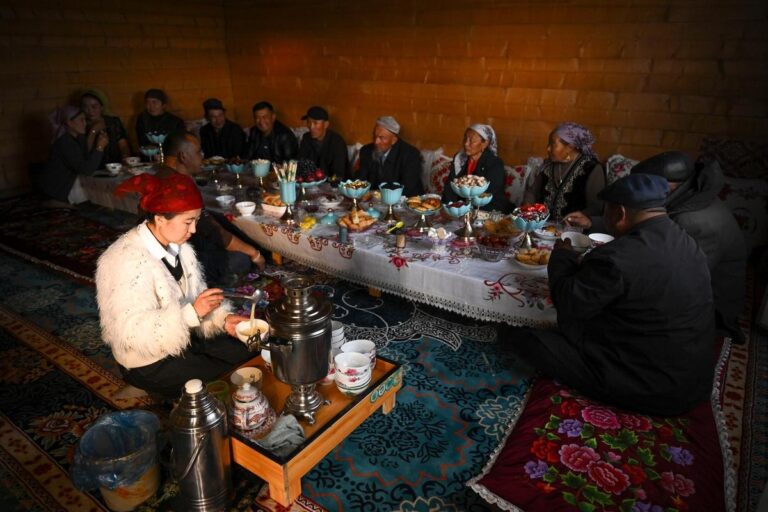
Hotel buffets and mall food courts in Urumqi will feed you competently and teach you nothing. The regional food here is one of the genuine reasons to come — hand-pulled noodles, tandoor bread, slow-cooked lamb, melons that ruin melons elsewhere.
The fix: eat one meal a day somewhere you cannot fully read the menu. Point at what the next table has. Learn three food words. Night markets are the low-risk entry point because you can see everything before you commit.
Mistake 10: Underestimating Altitude
The Karakoram Highway climbs past 4,000 m, and Karakul Lake sits around 3,600 m. People treat this as a scenic drive, which it is, and forget it is also an altitude gain of several thousand metres in a single morning. Headache, nausea and a terrible night’s sleep are the usual result.
The fix: sleep low, climb slowly, drink far more water than you want, skip alcohol on the ascent day, and do not plan anything strenuous on your first day above 3,000 m. If symptoms worsen rather than settle, descending is the treatment.
Mistake 11: Trusting You Will Have Signal
Coverage is better than expected in towns and patchy the moment you are in a gorge, on a pass, or thirty minutes off a main road. Navigate purely by live mobile data and you will eventually be guessing at a fork.
The fix: download offline maps, screenshot your bookings, save your driver’s number in two places, and keep a power bank charged. On self-drive days, note where the next fuel stop is before you leave the last one.
Mistake 12: Skipping Insurance Because It Feels Unnecessary
The specific risk profile here justifies it: long distances from major hospitals, high-altitude sections, horse riding, and weather that rearranges flights. Get a policy covering altitude activity and medical evacuation.
A Pre-Trip Fix-It Checklist
| Before you fly | Why it matters |
|---|---|
| Pick north OR south | Removes 80% of scheduling pain |
| Link a card to mobile payment and test it | Cards fail almost everywhere else |
| Download offline maps by region | Signal drops in gorges and passes |
| Confirm whether your route needs a border permit | Can cost two days if left late |
| Buy insurance covering altitude and evacuation | Long distances to major hospitals |
| Print hotel names in Chinese characters | Taxi communication without data |
| Pack layers, sunscreen, real sunglasses | Desert heat and mountain cold in one day |

Common traps at this stop
The trap here: Single biggest mistake first-timers make
Geographic overreach. Trying to combine the far north and the far southwest in one short trip. Almost every other complaint — exhaustion, missed sights, blown budget — traces back to that one decision.
Where people slip: Needing a guide to travel in xinjiang
For most mainstream routes, no. Independent travel by train, flight and shared car works well. A local driver or guide becomes genuinely valuable for remote grassland loops, border-zone areas and anywhere language friction would cost you hours per day.
The usual error: Cost
Seven days for one half of the region done calmly. Ten days is comfortable. Fourteen days lets you attempt both halves with a flight in the middle. Under five days, stay around Urumqi and Turpan and enjoy it properly.
Easy to get this wrong: Mistake to visit in winter
Not at all, as long as you go for winter things — snow landscapes, ski areas, empty sights, low prices, heavy comfort food. It is a mistake only if you arrive expecting green grassland and open mountain passes.
The trap here: Never do
Photograph checkpoints or security personnel, wander into a border zone without checking permit requirements, or assume your foreign bank card will work. For a broader run through the practical questions, see our Xinjiang travel FAQ.
Where people slip: Bargaining expected in the bazaars
In tourist-facing craft and souvenir stalls, yes, and it is friendly rather than adversarial. In food stalls, bakeries and fixed-price shops, no. If a price is displayed on a sign, treat it as the price.