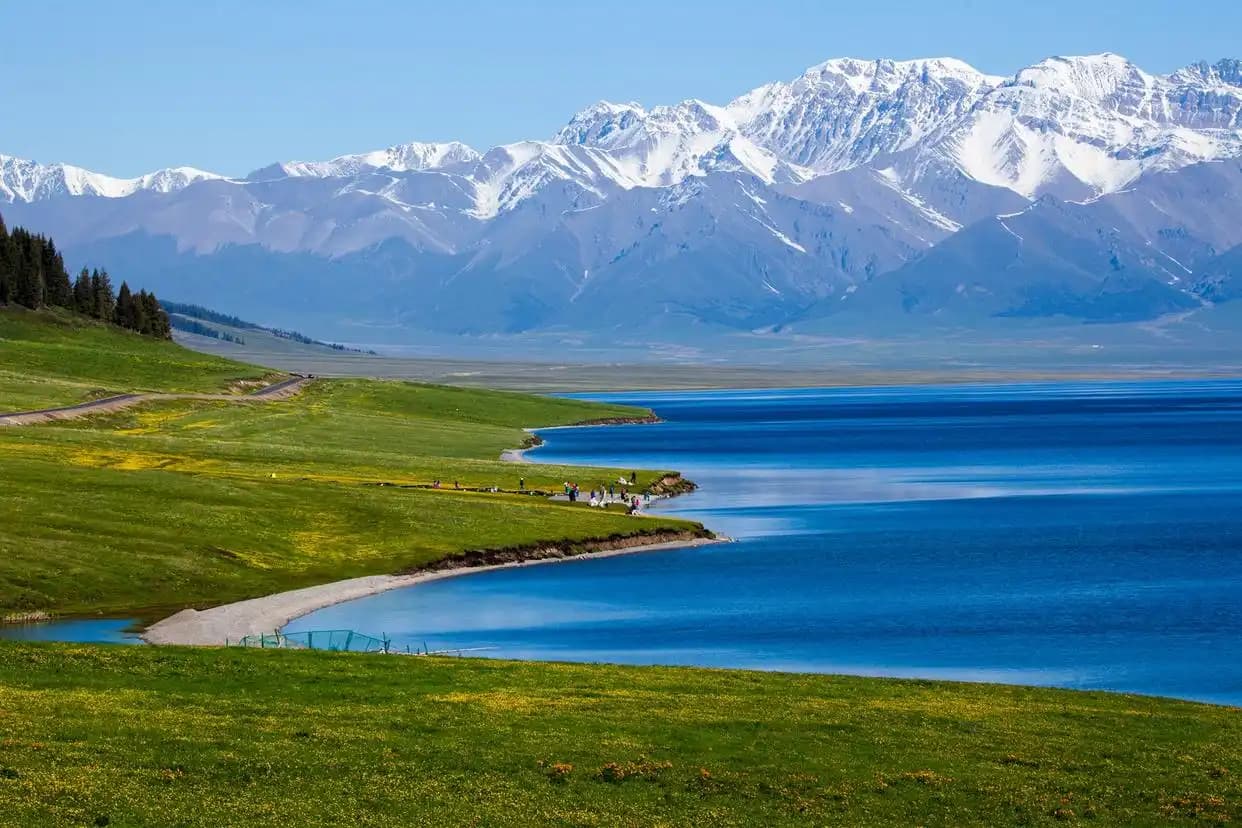
Bayinbuluke Grassland & Swan Lake: Xinjiang’s Alpine Wetland
Most visitors to the Ili grasslands stop at Nalati and call it a day. They are missing the better story. A few hours deeper into the Tianshan lies Bayinbuluke (巴音布鲁克), Xinjiang‘s largest alpine wetland and one of the only places in China where wild whooper swans breed. It is a place of impossible scale: a green ocean of meadow, a river that bends nine times to catch the sunset, and flocks of swans drifting on a high mountain lake. This is the practical guide I wish I had before my first trip.
Why Bayinbuluke is special
At about 2,500 meters above sea level, Bayinbuluke is cold, wet, and gloriously empty compared with the busier grasslands. It is a protected wetland, home to the Bayinbuluke Swan Lake Nature Reserve, and the source area of the Kaidu River (开都河), the “river of a thousand bends.” The combination of altitude, water, and open sky makes it one of the most photographic landscapes in all of Xinjiang.
The nine turns of the Kaidu River
The signature image of Bayinbuluke is the Kaidu River snaking across the meadow in a series of perfect curves. At sunset the still water reflects the sky so evenly that locals call it the “nine suns” effect — if the light is right you can see multiple suns mirrored at once.
| Viewpoint | Best light | Tip |
|---|---|---|
| Main boardwalk bend | One hour before sunset | Arrive early; tour groups fill the rail |
| Upper ridge overlook | Late afternoon | Bring a long lens for compression |
| Swan Lake causeway | Morning, low sun | Calm water = best reflections |
Swan Lake: wild whooper swans
The reserve protects a population of wild whooper swans that nest here in summer. You will not get close — the birds are shy and the boardwalks keep visitors at a respectful distance — but with binoculars the sight of dozens of swans on a mountain lake at 2,500 meters is worth the trip alone.
| Season | What you’ll see | Access |
|---|---|---|
| April–May | Swans arrive, mating display | Boardwalk open, cold |
| June–August | Cygnets, lush meadows, peak | Best weather, most crowds |
| September–October | Swans fatten before migration | Quiet, golden grass |
| November–March | Frozen, swans gone | Usually closed by snow |
The roads you are actually on
Bayinbuluke sits in Hejing County, Bayingolin Prefecture. Most travelers approach from one of two directions. From the north, the Duku Highway drops you spectacularly into the Tianshan and within reach of the east gate. From the west, the road from Yining and Nalati winds over the mountains. Either way, budget half a day of driving on slow, curvy mountain roads.
From Hejing (south approach)
Buses and private cars run Hejing → Bayinbuluke. The road climbs steadily; expect the temperature to drop 10–15°C from the valley floor. This is the easier logistics option if you are not driving the Duku.
From the Duku Highway (north approach)
If you are already on the Duku Highway, Bayinbuluke is a natural detour. The descent off the Tianshan crest into the wetland is one of the trip’s great reveals. Note that the Duku is open only roughly June–September and closes in bad weather.
When to go
| Month | Conditions | Crowd |
|---|---|---|
| May | Cold, swans returning, few flowers | Low |
| June–July | Green, wildflowers, mild days | Medium |
| August | Warmest, cygnets, peak season | High |
| September | Golden grass, crisp air | Medium |
Tickets, permits, and the shuttle
Entry is by ticket plus a mandatory scenic-area shuttle bus; private cars cannot freely roam the wetland. Buy tickets at the visitor center. Foreign travelers should carry their passport and, if coming via the southern route near any border-sensitive area, confirm the current border-permit situation in advance — rules change. The shuttle runs set loops to the river bends and Swan Lake, so plan your timing around the last bus.
Accommodation notes
Inside the scenic area there is basic lodging near the entrance, but it books out in August. Most travelers sleep in Hejing or press on to stay near Nalati or Korla. Staying inside means you can catch the early-morning light before the tour buses arrive.
What to pack for the altitude
At 2,500 meters the sun is brutal and the nights are near-freezing even in July. Pack a warm layer, a windproof shell, high-SPF sunscreen, sunglasses, and more water than you think you need. The thin air makes a short boardwalk walk feel like a workout.
Photography tips
The nine-bend river is a sunset shot; Swan Lake favors morning calm. A polarizer cuts glare on the water, and a telephoto lens brings the shy swans close. Drones are restricted in the reserve — check signage and respect no-fly zones. Patience beats gear: the “nine suns” reflection appears only on still, clear evenings.
Wildlife beyond the swans
Swans get the headlines, but Bayinbuluke is alive with other creatures. Scan the meadows for marmots standing sentinel at their burrows, and the wetlands for ruddy shelducks, bar-headed geese, and the occasional black-necked crane. Above the grass line, blue sheep pick across the scree. Bring binoculars — the animals are wild and the distances vast, so a zoom lens or spotting scope turns a pleasant walk into a real sighting. Move slowly and keep your distance; the reserve’s whole point is that the wildlife stays wild, not habituated to crowds.
Birds and the best viewing times
Early morning is quietly the best: the boardwalk is empty, the light is soft, and the birds are feeding. Late afternoon favors the river bends for that sunset reflection. Plan a full loop so you catch both, and dress for cold even if the noon sun feels warm.
Nearby detours worth the drive
If you have a spare day, the southern Tianshan around Bayinbuluke rewards exploration. The road toward the Duku’s higher passes threads past glacier views and high meadows where herders still move with the seasons. Combined with a stop at a grassland homestay for butter tea and kaymak, it rounds out the wetland visit into a proper Tianshan experience rather than a quick photo stop.
Choosing your weeks
Spring and early summer
You need a standard scenic-area ticket and shuttle pass. A border permit is generally not required for the main tourist route, but if you loop in via sensitive southern corridors, confirm current rules with your hotel before driving.
Summer
Wild whooper swans are present roughly April through October, with chicks in summer. The wetland is typically closed by snow in deep winter.
Autumn
Half a day minimum for the shuttle loop, a full day if you want both sunset at the river bends and a calm morning at Swan Lake. An overnight inside lets you catch both light windows.
Winter
Yes. Daytime can be pleasant, but evenings drop near freezing at 2,500 meters. Bring a real warm layer regardless of the month.
4
Absolutely — it is one of the best pairings in Xinjiang. Drive the Duku Highway and detour to Bayinbuluke on the way. Just watch the Duku’s seasonal opening dates.
5
Different experiences. Nalati is lush and accessible; Bayinbuluke is vaster, wilder, and famous for swans and the nine-bend river. If you have time for only one, see Nalati Grassland for the comparison that fits your route.