Big Plate Chicken (Da Pan Ji): Xinjiang’s Iconic One-Pot Feast
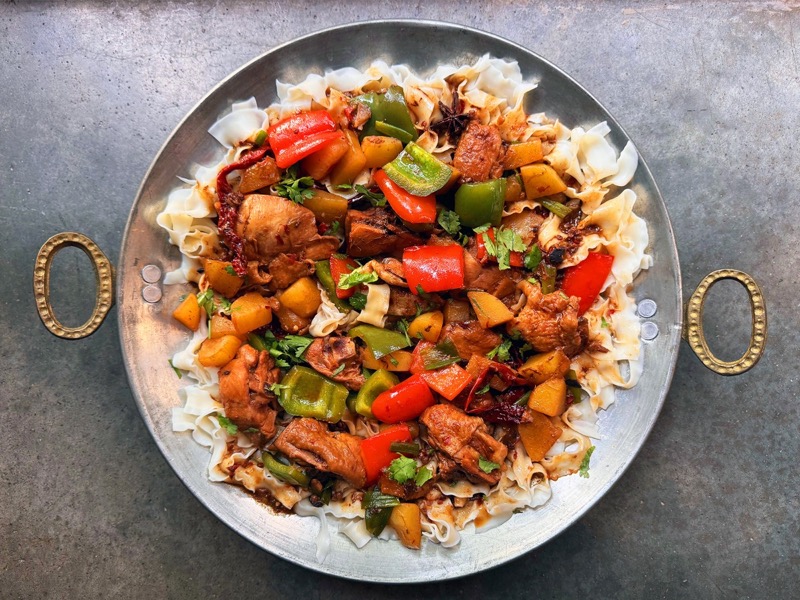
If Xinjiang had a national dish, it might well be Da Pan Ji — literally ‘big plate chicken.’ Born in the 1990s along the G30 highway corridor (the story usually credits a Sichuan-born cook in Shawan), it fuses Han-Chinese stir-fry technique with Xinjiang’s love of cumin, chili, and hand-pulled noodles into a single communal plate built for sharing.
The anatomy is simple but addictive: bone-in chicken thighs braised with potatoes, green peppers, and dried chili in a dark, smoky, mildly numbing sauce, then crowned with a tangle of belt-wide noodles (liang pi or freshly pulled mian) that soak up the gravy. The ‘big plate’ is literal — it arrives on a platter meant for three or four people.
Ordering is a small ritual. You specify the size (usually by number of diners), and at the end you almost always add ‘jia mian’ — extra noodles — because the sauce is too good to leave behind. The noodles are the point: springy, chewy, and engineered to carry chili oil. Vegetarians can find potato-heavy variations, but the canonical version is unapologetically carnivorous.
Where to eat it: nearly every mid-range restaurant across Xinjiang serves a version, from Urumqi to Kashgar. The ‘authentic’ Shawan style is prized, but the dish has happily localized everywhere. In Urumqi, the areas around the bazaars and the university district are dependable; in smaller towns, the busy roadside halal restaurants are usually the best bet. For a curated food crawl, our Xinjiang Travel Guide maps the strongest regional kitchens.
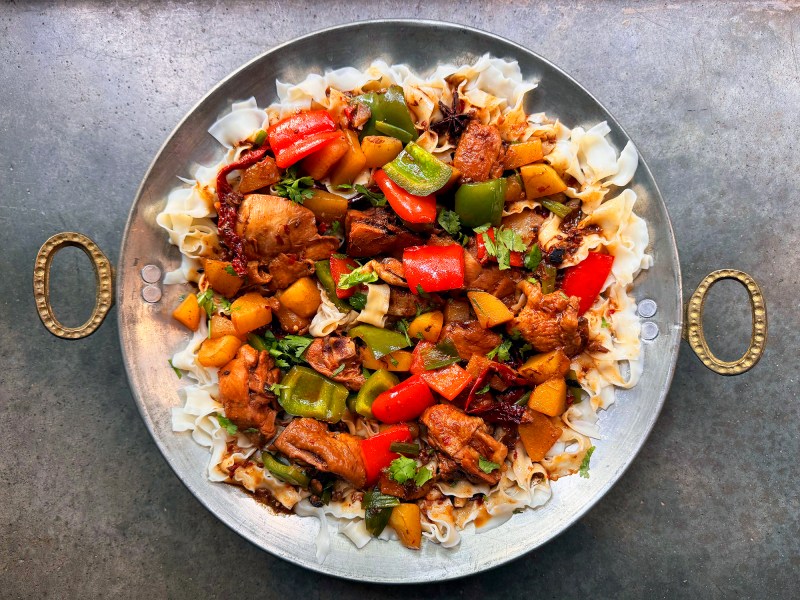
Flavor profile: expect cumin-forward warmth, a gentle heat from dried chili, the slight sweetness of slow-cooked potato, and a savory depth from the chicken bones. It is not aggressively spicy by default — ask for ‘la’ (spicy) if you want more kick. Pair it with black tea or a cold soft drink; the locals often finish with yoghurt to cool the palate.
Etiquette and pacing: Da Pan Ji is a sit-down, share-it-all dish. Don’t rush it. Tear off bits of naan to mop the sauce, summon the extra noodles when the plate thins, and linger. It is comfort food with a sense of occasion — the kind of meal that turns strangers at a table into a temporary family.
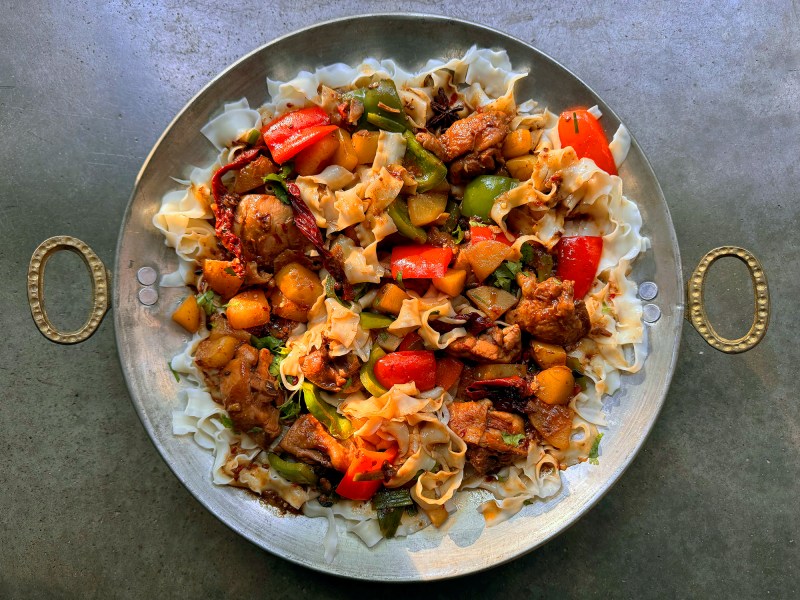
Make it at home if you dare: the backbone is a good chili-bean paste, cumin, star anise, and patience for the potatoes to break down. But honestly, the roadside version — eaten at a plastic table after a long day on the Silk Road — is hard to beat. If you travel Xinjiang for the food, put Da Pan Ji at the top of the list, then work your way through lamb skewers, laghman, and naan.
The hour I go back for
Between the two I would pick the later one, mostly because the early version costs you the rest of the day. Sunrise is the one worth an alarm for. The whole face of Big Plate Chicken Da turns a colour that does not exist at any other time, and the site is empty enough that you can stand still and hear nothing. By ten the coaches are here, and by one it is an hour of people shuffling past. I have come to like the last forty minutes before the gate shuts, when the groups have gone and the staff are sweeping, because that is when you can look up properly instead of squeezing a shoulder past strangers.
The light is only free of company on a Tuesday. Whatever the guidebook says about golden hour, go on a weekday. Midday is the hour to avoid, not the hour to schedule. Everything goes flat, the shade disappears, and the temperature on an open plateau rises in a way that stops you caring about photographs. Go early or go late and the same ground gives you two different subjects.
I wrote the driving side up in our [[xinjiang-dapanji-big-plate-chicken|Xinjiang Big Plate Chicken (Dapanji): The…]] as well.
Timing your visit to {P}
Budget the full morning. That covers the walk in, the slow look at the main feature, the side trails almost nobody does, and getting back to the car before the light goes flat. Half a day is enough to understand it. Ninety minutes is enough to tick the box. A full day is what you want when the point of coming was Big Plate Chicken Da itself rather than a stop on the way.
The first time I rushed it and spent the whole visit looking up at the same rock from one spot. The second I gave it a morning and a late-afternoon return and saw two completely different places, because the light moved across the surface and the crowds thinned to nothing. My own rule now: if I have to choose between this and an extra evening in Xinjiang, I keep the evening. Most first-timers plan two hours and then get stranded. The gates open early and the last entry tends to stop a couple of hours before closing, so the promise of coming back for sunset is not always possible.
The short version, with the numbers, is in our [[xinjiang-da-pan-ji-big-plate-chicken-guide|Da Pan Ji (Big Plate Chicken): The Dish…]].
Worth pairing with
Ask at the hotel desk the evening before what opened this week, because several of these places shift their hours with the season and the leaflet in the lobby is a year out of date. Big Plate Chicken Da sits naturally into a longer Xinjiang day. The stops most people miss are the small ones between the big names. With a car the combination that worked for us was the site in the morning, a long lunch somewhere with shade, and the other place in the late afternoon, so two half-days covered a full one.