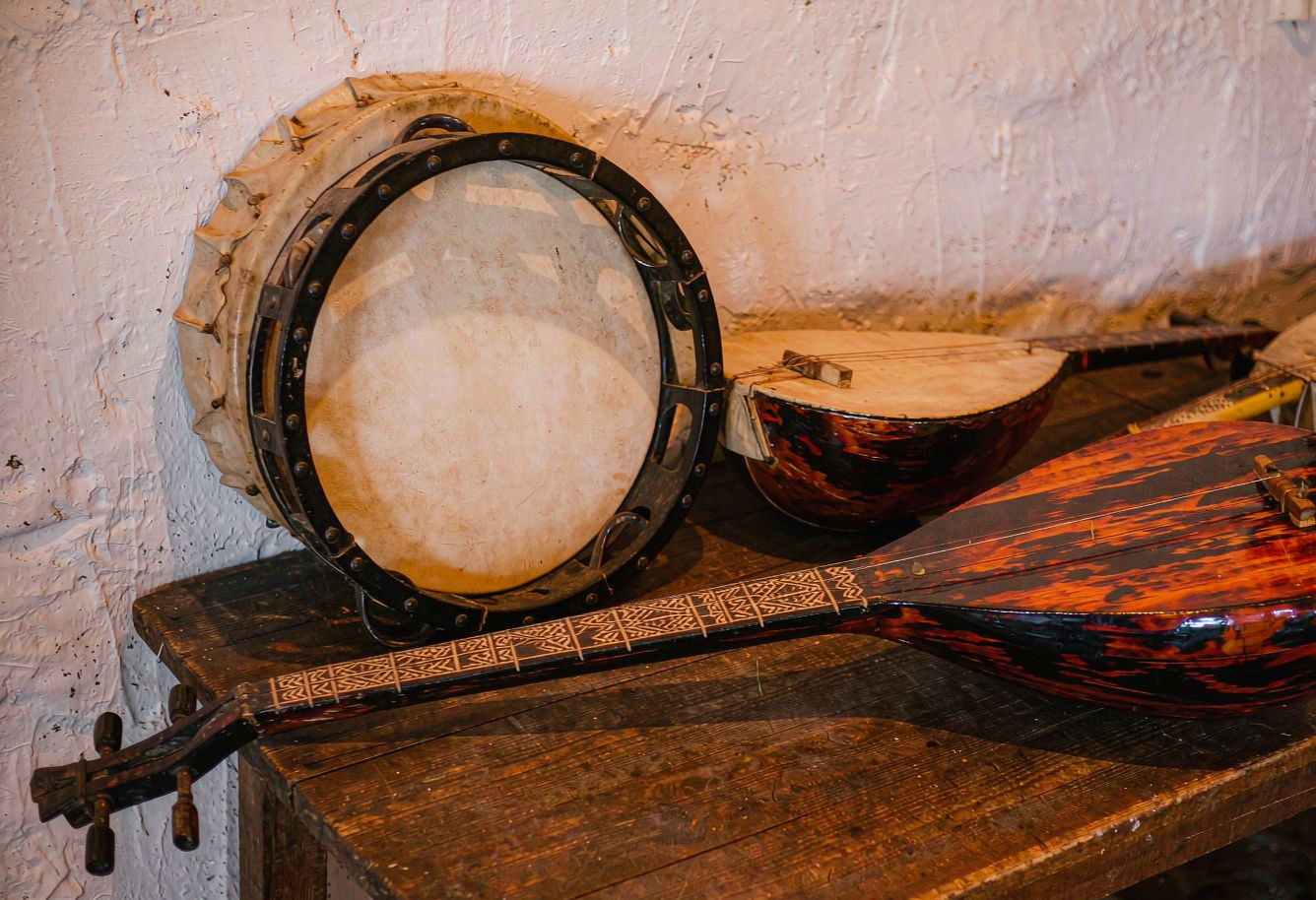
The Instruments of Xinjiang: Dutar, Rawap, and the Long-Necked Sound of the Road
I learned to tell the instruments apart only after embarrassing myself by calling a rawap a dutar in front of a musician in Kashgar. He laughed, then spent twenty minutes putting each one in my hands. That lesson stuck better than any page.
The dutar is the gentle one: two strings, a long neck, a sound like a conversation between two calm people. It backs most muqam performances and is the instrument you actually hear in homes. The rawap is louder and brighter, with a smaller body and a restless, plucked energy. The satar carries the twelve-muqam melody line and has more strings than I can count on one hand, some of them sympathetic, humming under the main tune.
What surprised me was how young the players are. I expected old men in museums. Instead I found teenagers in the old town squatting on a step, trading licks. The handicraft markets sell both the real instruments and the painted souvenir versions, and the gap is obvious once you heft one.
The culture of the region is carried as much by these instruments as by any building. If you want to buy one, go to a maker, not a stall. A real dutar is light, the wood is uneven, and the strings are real gut or steel, not nylon dressed up to look old.
I left with a student dutar I cannot play well. But on slow evenings it reminds me of that step in Kashgar, and that is worth more than a perfect one I never touched.
I tried to learn the dutar and quit, which is its own kind of respect. The teacher, a teenager in Kashgar, showed me the two-string tuning and a single phrase, then made me repeat it until my left hand cramped. The phrase was a greeting, he said, not a tune, and the point was to play it so it sounded like a question answered, not a statement. I could not. He kept smiling. What I took from those twenty minutes is that the instrument is a conversation you have to be calm enough to have, and most of the music I love is people who are calm enough. I bought the student dutar anyway, and it sits where I see it, a reminder that some things are worth trying badly in front of someone kind.
Buying one: a student dutar runs cheap and is all you need to learn on; a master-made rawap costs real money and is worth it if you will play. The handicraft markets sell both, and the old town is where you hear them before you buy. Avoid the lacquered ‘decorative’ instruments with no sound hole; they are wall art, not music. I hang mine on the wall and take it down to fail at it, which is the right use. The instruments of Xinjiang are not souvenirs with strings. They are the region’s voice, and owning one is a quiet promise to listen, even if you never learn the greeting phrase the teenager tried to teach me.
Who should think twice about {P}
The honest version: take half a day if that is all the arithmetic allows, and save the full day for the thing that is genuinely once in a lifetime. I am not going to pretend this is gentle. There is a lot of unshaded ground, the altitude is real if you came from a low-altitude city, and the swing between the car and the viewpoints is enough to give you a headache on an empty stomach. Who it does suit: someone wanting one strong memory, someone driving the Xinjiang loop anyway, someone willing to be out before breakfast.
Who it does not: anyone whose main goal is a relaxed few days, and anyone who has already done this same thing twice here. It suits people who like landscape and can walk a few kilometres at their own pace. If you are short on days, this is the thing to cut, and no guidebook will tell you that. Xinjiang Music Instruments is superb, but it is also an hour or more in each direction from everything else you planned, and the drives are what eat the schedule. It does not suit a family with a small child who needs a shade stop every forty minutes, and it does not suit anyone in week two of a high-altitude trip still feeling it.
It suits a traveller with a car and a flexible morning.
The hour I go back for
I have come to like the last forty minutes before the gate shuts, when the groups have gone and the staff are sweeping, because that is when you can look up properly instead of squeezing a shoulder past strangers. By ten the coaches are here, and by one it is an hour of people shuffling past. Whatever the guidebook says about golden hour, go on a weekday. The light is only free of company on a Tuesday. Midday is the hour to avoid, not the hour to schedule.
Everything goes flat, the shade disappears, and the temperature on an open plateau rises in a way that stops you caring about photographs. Go early or go late and the same ground gives you two different subjects. Between the two I would pick the later one, mostly because the early version costs you the rest of the day. The whole face of Xinjiang Music Instruments turns a colour that does not exist at any other time, and the site is empty enough that you can stand still and hear nothing. Sunrise is the one worth an alarm for.