Atlas Silk and Ikat: How Xinjiang’s Most Famous Cloth Is Actually Made
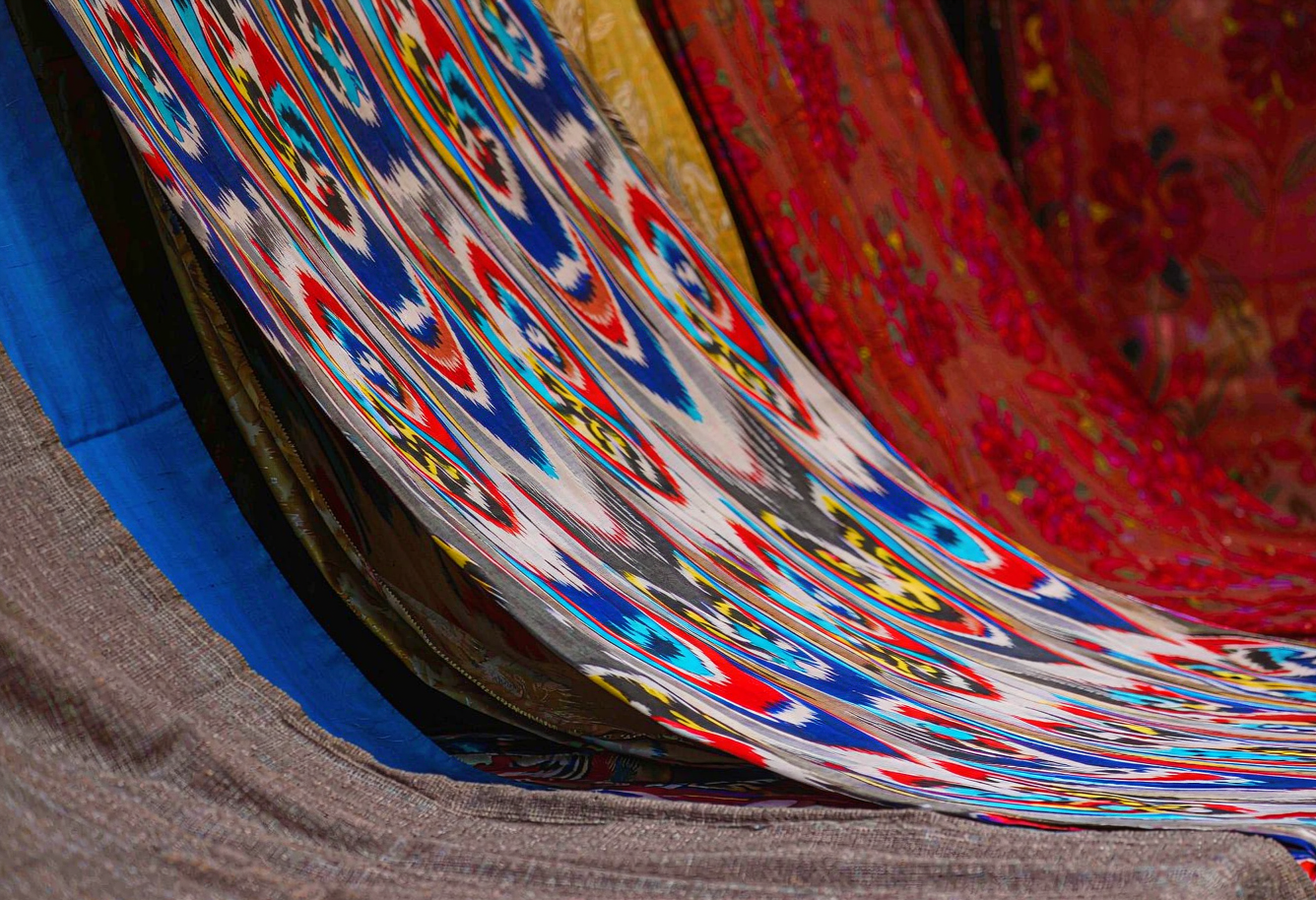
The first time I saw atlas silk up close was in a Hotan workshop in 2021, not a shop. A woman was tying bundles of silk thread with plastic strips before dyeing, and the pattern on the finished cloth was already decided by those knots. That is the whole trick of ikat: the design is tied into the thread before it is ever woven, so the lines come out slightly blurred, like a painting seen through rain.
People call it atlas, people call it ikat, and both are right. Atlas is the local name for the silky, slightly shiny version; ikat is the technique. The broader handicraft scene in Xinjiang runs from this cloth to copper to carpets, but atlas is the one that ends up in every tourist photo.
What surprised me was the blur. Machine-printed atlas has crisp lines because the pattern is just inked on top. Hand-tied ikat has soft, wandering edges, because no two bundles of thread knot identically. Once you see the difference side by side, the printed stuff looks dead. I now check the back of the cloth: a real atlas shows the pattern reversed and slightly off, the way a resist dye always does.
Color carries meaning people do not tell you in the bazaar. Yellow and red atlas is what brides wear in parts of the south; the cooler indigos and greens show up at ordinary markets. I learned this from an embroiderer in Yining, not from a guidebook, and it changed how I look at what people are actually wearing versus what they sell to visitors.
If you want to go deeper, Uyghur embroidery uses the same dye sense on cotton, and this shopping guide lays out where the honest sellers are. For pieces I trust, this where-to-buy list and the Kashgar Sunday bazaar are my two stops.
A warning I wish someone had given me: a meter of real atlas costs what a meter of real atlas costs. If a vendor hands you a bolt for ten dollars, it is printed. Buy it because you like it, not because you think it is handmade.
The workshop visit that changed how I buy cloth was in Hotan, where I watched the same woman tie, dye, unbind, and re-tie a single hank of silk through four color baths. Each binding hid the part that would stay the earlier color. By the end the thread held four bands, and only then was it woven. I asked how long a good atlas took start to finish and she held up both hands, twice. Two tendays. That number lives in my head every time a stall offers me a ‘handmade’ bolt for the price of a shirt. Real atlas carries the time in its price, and once you have watched the knots go in, you stop bargaining the maker down out of principle.
If you want to see the tying done rather than just buy the cloth, ask at the Hotan guide stops about a workshop visit, and be ready to pay the woman for her time, not just the cloth. The embroidery page covers the cousin craft, and the two are often done by the same hands. A good atlas will cost what a good atlas costs; the cheap bolts are printed and fine if you say so out loud. I wash mine cold, flat, never in the machine, and the color has held for years. The blur in the lines is the signature, not a flaw, and once you stop expecting crisp you start seeing the hand that tied the thread before the loom ever turned.
What goes in the day pack
The light here is serious and the shade is intermittent, so the sunscreen goes on before you leave the hotel, not at the gate. Sunscreen and a brim. A wind shell. The temperature drops fast once you stop moving and the drop is not hypothetical on an exposed pass.
A fleece covers most of the year, a real jacket covers shoulder season. Water, more than you think, a power bank and some cash. Cards work at the gate and in the shops, but the stalls on the approach road and the drivers waiting at the turnoff want cash, and coming up short at the moment you want a lift is the classic way to lose an hour. The short version, with the numbers, is in our [[xinjiang-atlas-silk-embroidery-guide|Xinjiang Atlas Silk & Embroidery: What They…]].
The mistake I made the first time
It was, in the sense that I saw everything, and it was ruined in the sense that I saw everything at the same hour with the same crowd, and I spent the drive home meaning to come back and never did. I assumed two hours would be plenty. What I would tell the version of me who planned it: put the slow hours in, not the fast ones. The whole point of coming this far is to have the place to yourself for a while, and that only happens if you are willing to be there when it opens or when it is nearly shut. I did come back the following trip, at seven in the morning, and it was a different site.
The other mistake is about distance on the map. The gate is not the site. So: work out how far it is from where the vehicle drops you to the feature, then double it. There is a shuttle, a walk, sometimes another shuttle, and the stretch everybody underestimates is between the second gate and the thing you crossed the country to see. That is the number of hours the visit needs.
More on the other end of that day is in our [[xinjiang-silk-road-history-guide|The Silk Road in Xinjiang: A Traveler’s…]].