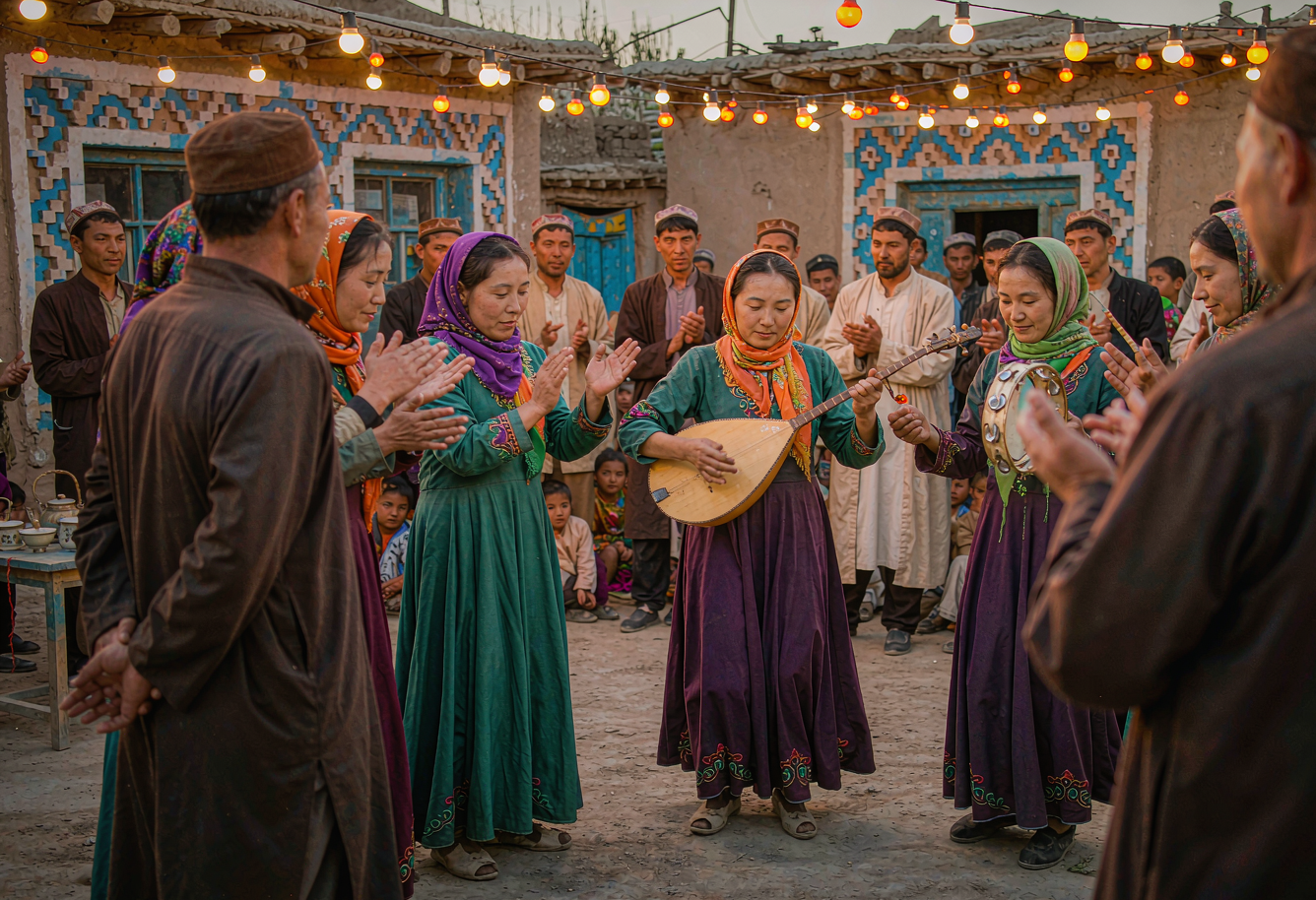
Meshrep: The Uyghur Gathering That Is Part Concert, Part Court, and All Community
I stumbled into my first meshrep by accident in a village outside Kashgar, invited by a family I had met an hour earlier. I expected a performance. It was not a performance. It was a neighborhood doing its business in public: someone sang, someone was gently scolded for drinking too much, someone else’s argument got talked through by the older men, and all of it rode on the same twelve-muqam beat.
The word gets translated as ‘gathering’ and that is technically true but useless. A meshrep is where muqam music lives as something people do rather than something people watch. There is a leader, called the yigit, who keeps order and sets the tone. In the one I saw, he steered a young man who had shouted at his cousin into actually apologizing, with the dutar playing the whole time. I have been to town-hall meetings less functional.
This is why the culture of the region is hard to pin down from a museum. The living parts happen in circles on the floor. The festivals are the big scheduled versions, but a small meshrep can happen any week a community feels like it.
If you want to witness one without offending anyone, the rules are the same as any private gathering you were not exactly invited to. Read the etiquette guide first. Sit at the edge. Do not film the scolding parts. Eat what is passed to you. The Kashgar old town is the easiest place to hear about one, because the neighborhoods still run them.
The thing I took home was not a song. It was the sight of a dispute being settled without a phone call to anyone in uniform. That, more than the music, is what meshrep is for.
One detail nobody mentions: the food at a meshrep is plain on purpose. Flatbread, a few nuts, maybe a melon in season, passed around with the singing. It is not a feast; it is fuel for the circle. I was handed a wedge of melon by a child who had been told to, and the child took it back the second I paused, then pushed it at me again, laughing. That small push-and-pull told me more about the gathering’s warmth than the music did. I have since turned down ‘meshrep shows’ staged for tour buses; they have the costumes and none of the scolding, which is to say none of the point.
One more thing worth knowing: meshrep is not something you book. You hear about it from a family, or you do not go. The staged versions in some hotels are music with a name on them, and they are pleasant, but they are not the thing. If you are serious, the old town is where to ask, quietly, of people you have already spoken to, not of a desk. The festivals are the safer entry if you need a schedule. I have been to one real meshrep and declined three staged ones, and I would rather have the one. The gathering is for the neighborhood, and a stranger is welcome only as long as they remember they are a guest and not a seat in the front row.
A second look on day two
If your itinerary has a spare morning, spend it here again rather than at the bigger name on the far side of town. The second time you can skip the obligatory viewpoint and walk along the base of the ridge where the light comes in sideways, and that is the photograph you keep. I did, and the second visit was better, because the first had been spent working out where to stand. Almost nobody does Xinjiang Meshrep Gathering twice. That stretch of the trip is described in our [[xinjiang-meshrep-community-gathering-guide|The Meshrep: Inside Xinjiang’s Living…]] too.
Worth pairing with
Ask at the hotel desk the evening before what opened this week, because several of these places shift their hours with the season and the leaflet in the lobby is a year out of date. Xinjiang Meshrep Gathering sits naturally into a longer Xinjiang day. With a car the combination that worked for us was the site in the morning, a long lunch somewhere with shade, and the other place in the late afternoon, so two half-days covered a full one. The stops most people miss are the small ones between the big names.