Flaming Mountains: Why the Red Range from ‘Journey to the West’ Is Worth the Heat
The Flaming Mountains (火焰山) are the most literary landscape in Xinjiang. They are the setting where, in the classic novel Journey to the West, the monk Tang Sanzang and his companions must pass a wall of fire guarded by the Bull Demon King — and the real ridge lives up to the myth. A 100 km line of red sandstone along the northern edge of the Turpan basin, it genuinely glows at sunrise and sunset and genuinely bakes at noon, regularly recording the highest ground temperatures in China.
For travelers, it is a short, sharp stop — but a memorable one, especially if you time the light.
What You’re Looking At
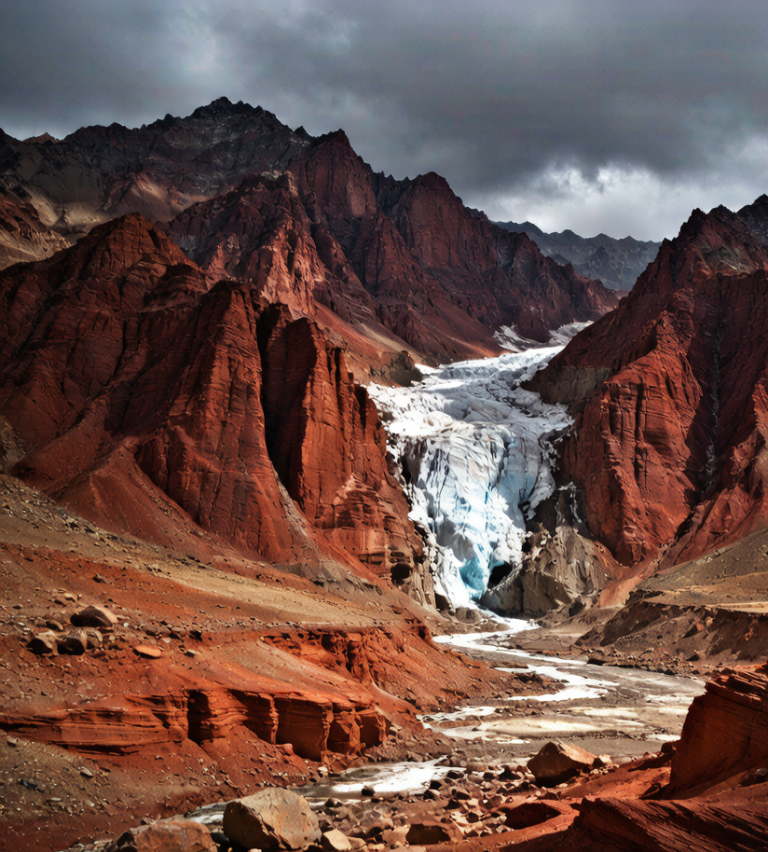
The range is made of Cretaceous red sandstone and conglomerate, eroded by wind and rare rain into gullies and folds that catch the sun like embers. The effect is strongest when the low light rakes across the folds; at midday the whole thing is a flat, shimmering oven. A giant thermometer at the tourist site dramatizes the heat (it has read over 70°C at the surface), and a statue of the Bull Demon King marks the novel’s connection.
Geologically it is the exposed edge of the Turpan depression’s uplift — the same forces that dropped the basin below sea level pushed this ridge up beside it.
The money, line by line
Parking, a printed map, and a guide are the other three places the number moves. Two of us covered the whole thing for well under what a single hotel night in Xinjiang costs, but only because we shared the car and shared the entry between us. On your own the same afternoon comes out at maybe half again as much. Prices at the gate are reasonable by European standards, which is exactly why they are easy to underestimate. The admission is cheap, the internal transport is what adds up, and a family of four in one car turns a small ticket into a real line in the budget.
Staff there are used to it, and the answer takes ten seconds. Ask once at the ticket office what the full circuit costs before you commit. The headline entrance ticket is only the first line. On top of it comes a shuttle or sightseeing bus inside the site, and if you want a far viewpoint rather than the main one that is another leg. For the part people underestimate, see our [[xinjiang-flaming-mountains-travel-guide|Flaming Mountains Photography: Golden Hour…]].
Worth pairing with
The stops most people miss are the small ones between the big names. Flaming Mountains Why The sits naturally into a longer Xinjiang day. Ask at the hotel desk the evening before what opened this week, because several of these places shift their hours with the season and the leaflet in the lobby is a year out of date. With a car the combination that worked for us was the site in the morning, a long lunch somewhere with shade, and the other place in the late afternoon, so two half-days covered a full one.
The hour I go back for
I have come to like the last forty minutes before the gate shuts, when the groups have gone and the staff are sweeping, because that is when you can look up properly instead of squeezing a shoulder past strangers. Whatever the guidebook says about golden hour, go on a weekday. Midday is the hour to avoid, not the hour to schedule. The light is only free of company on a Tuesday. Everything goes flat, the shade disappears, and the temperature on an open plateau rises in a way that stops you caring about photographs.
Go early or go late and the same ground gives you two different subjects. Between the two I would pick the later one, mostly because the early version costs you the rest of the day. Sunrise is the one worth an alarm for. The whole face of Flaming Mountains Why The turns a colour that does not exist at any other time, and the site is empty enough that you can stand still and hear nothing. By ten the coaches are here, and by one it is an hour of people shuffling past.
If the timing is the question, our [[flaming-mountains-xinjiang-travel-guide|Flaming Mountains Practical Guide: Beat the…]] goes through it properly.
When to Go
Avoid midday in summer unless you enjoy heat that warps the air. The sweet windows are sunrise and 1–2 hours before sunset, when the rock lives up to ‘flaming’ and the temperature is merely fierce. Spring and autumn are comfortable and still colorful. Winter is cold but clear — and the red against snow is a striking, uncrowded view.
Pair it with Turpan’s other sites: Jiaohe in the cool of morning, the Flaming Mountains at golden hour, and the Grape Valley for shade and raisins in between. That trio fits one long day out of Turpan town.
Logistics
The mountains are ~30 km east of Turpan city, reachable by car or tour. The main viewing area has a boardwalk and shade structures, but limited — bring water, a hat, and sun protection. There is almost no natural shade, so the heat is the real constraint, not the walking.
Photographers: a wide lens at sunset captures the glow and the fold patterns; a person in the foreground gives scale to the ridge’s height. Drones are restricted near some sites, so check locally.
The Flaming Mountains are a reminder that Xinjiang’s drama is not only in its peaks and lakes but in its extremes — the hottest, lowest, and most storied ground in the region, all within a short drive. For the Turpan chapter of our Xinjiang Travel Guide, it is the stop that turns a history lesson into a sensory one: you will feel why they called it fire.