Mulberry Paper: The Forgotten Craft of Turpan’s Oasis
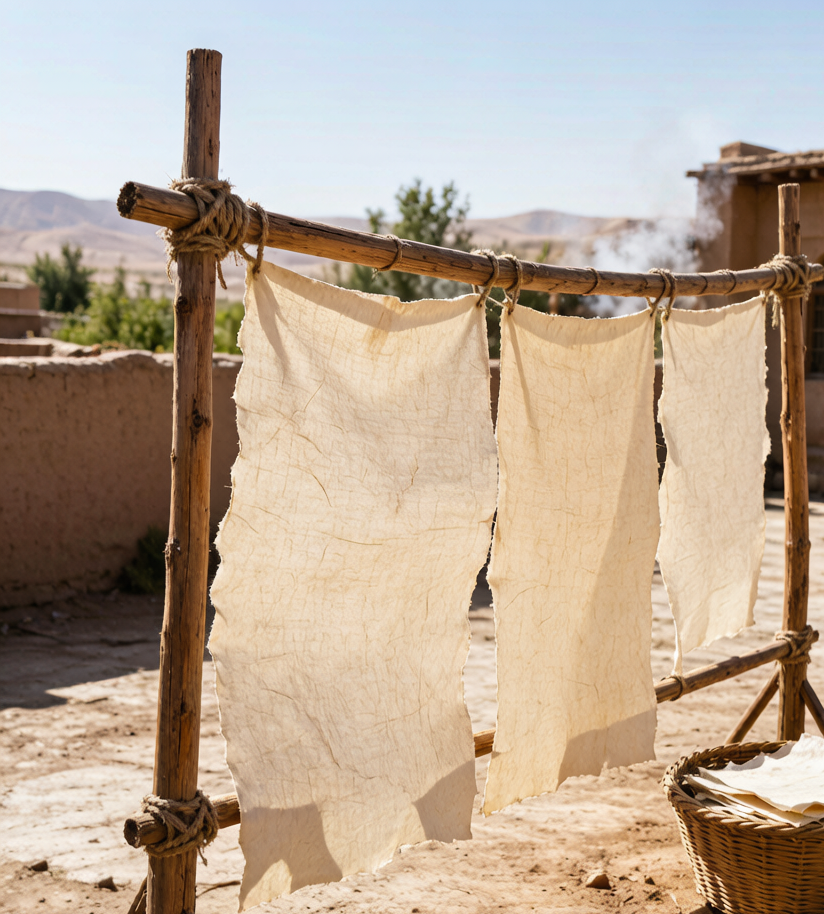
In a village outside Turpan I watched a man pull a sheet of paper from a wooden frame and lay it in the sun. It was made from mulberry bark, by hand, much as it was centuries ago. I had not known the craft still lived, and that ignorance is the craft’s real danger.
How the paper is made
The process is bark, boiled and beaten into a pulp, then lifted as a thin sheet on a screen and dried flat. No industrial shortcut survives the heat of the oasis, so the few makers left do it the slow way. The result is tough, faintly textured, and nothing like wood-pulp paper. I wrote on a scrap of it and the pen felt different, grippier, more honest.
Where to find it
The craft clusters around the Turpan oasis and its older villages, near places like Tuyoq and the Jiaohe and Gaochang ruins, where the mulberry trees and the memory both persist. The handicraft markets in the city sell the paper, but watching it made is the point. The Dolan heartland has its own paper memories too, worth asking about.
Why it is fragile
Mass paper and a younger generation with other work have shrunk the number of makers to a handful. I met one who learned from his father and worries no one will take it. The paper is not just a product, it is a line of knowledge, and when the line breaks the object becomes a museum piece instead of a living thing.
What you can do
Buy directly from a maker, not a reseller, and ask to watch. The sale keeps the workshop open, and the watching keeps the story straight. I left with a few sheets and a better sense of why Turpan mattered on the Silk Road than any ruin gave me alone.
Crafts like this do not announce their ending. You have to be looking, and you have to be early.
What the ticket and the extras actually add up to
The admission is cheap, the internal transport is what adds up, and a family of four in one car turns a small ticket into a real line in the budget. Staff there are used to it, and the answer takes ten seconds. Ask once at the ticket office what the full circuit costs before you commit. The headline entrance ticket is only the first line. On top of it comes a shuttle or sightseeing bus inside the site, and if you want a far viewpoint rather than the main one that is another leg.
Parking, a printed map, and a guide are the other three places the number moves. Two of us covered the whole thing for well under what a single hotel night in Xinjiang costs, but only because we shared the car and shared the entry between us. On your own the same afternoon comes out at maybe half again as much. Prices at the gate are reasonable by European standards, which is exactly why they are easy to underestimate. Where most people get the logistics wrong is covered in our [[xinjiang-mulberry-paper-craft|Xinjiang Mulberry Paper: The Living Silk…]].
A few minutes of background change the visit
Knowing what you are standing on turns a pleasant walk into something you actually remember. Read that the morning before rather than at the entrance, where the boards stand too far from the object to help. Locals in Xinjiang will give you the short version in about a minute if you ask, and it is usually better than the panel at the gate. The history here is layered in a way the official signage compresses into names and dates. The place only makes sense once you know its shape. Xinjiang Mulberry Paper was cut rather than built, which is why the walls are solid and the streets are the empty space between them, and why centuries of dust ended up acting as a roof. I wrote the driving side up in our [[how-to-go-to-xinjiang|How to Get to Xinjiang: Entry Requirements…]] as well.
The workshop visit
If you find a working workshop, ask to watch the whole pull, from boiled bark to wet sheet to sun. The maker I met let me try the screen lift, and the sheet tore because I rushed, which told me more about the skill than any description. The mulberry trees that feed it grow along the same oasis channels as the [[tuyoq-village-turpan|Tuyoq]] gardens, so the craft and the place are literally the same water. I use the sheets I brought back for letters and drawings, and the rough surface takes ink with a character no shop paper has. Buy a few, use one, and keep the rest; the tradition is fragile enough that owning it is a small act of keeping it alive.
What it costs and how to use it
The paper is not expensive, which is part of why the craft survives at the margins; a few sheets run cheap, and the maker is usually glad to sell direct. Sizes vary with the frame, so ask for the larger sheet if you want to write or draw on it. I use mine for letters and ink sketches, and the rough surface takes a line with character no shop paper matches. Keep it flat and dry, away from the car’s heat, because curling is permanent once it sets. Buy a few, use one, and keep the rest, because the tradition is fragile enough that owning it is a small act of keeping it alive. The paper is history you can hold, and the workshop visit is the part you remember.