Xinjiang Tianshan Shengli Tunnel: The Ultimate Self-Driving Experience Through the World’s Longest Expressway Tunnel
Last updated: July 15, 2026 · Written by Karl Huang, a Xinjiang travel specialist who has spent time across the region. Practical details are cross-checked against official tourism, transport, and border-regulation sources.
On December 26, 2025, a super project that rewrote the history of global transportation officially opened to traffic: the Xinjiang Tianshan Shengli Tunnel. Stretching 22.13 kilometers in total length, this tunnel is not only the world’s longest expressway tunnel but also a “time-space shortcut” linking northern and southern Xinjiang, slashing the travel time to cross the Tianshan Mountains from 3 hours to just 20 minutes. For international travelers chasing extraordinary engineering feats and breathtaking natural landscapes, a journey through the Xinjiang Tianshan Shengli Tunnel is a spectacular experience witnessing human ingenuity challenge the limits of nature.
As the pivotal project of the G0711 Urumqi-Yuli Expressway, the Xinjiang Tianshan Shengli Tunnel cuts straight through the central Tianshan Mountains at an average altitude of over 3,000 meters. Its completion has shortened the drive from Urumqi to Korla in southern Xinjiang from 7 hours to roughly 3.5 hours. Far more than a mere transportation corridor, it is a modern marvel integrating cutting-edge engineering technology, eco-friendly concepts, and humanistic artistic design—this is the core tourism value of the Xinjiang Tianshan Shengli Tunnel.
What Is the Xinjiang Tianshan Shengli Tunnel? A Record-Breaking Mega Project
Located in Xinjiang Uygur Autonomous Region, China, the tunnel connects Urumqi and Hejing County in the Bayingolin Mongolian Autonomous Prefecture. It is a separate twin-tube four-lane expressway tunnel with a designed speed of 100 kilometers per hour.
The project was conceived to break the geographical barrier the Tianshan Mountains posed between northern and southern Xinjiang. In the past, vehicles had to take winding mountain roads to cross the range, a 3-hour journey often blocked by heavy snow in winter. The Xinjiang Tianshan Shengli Tunnel has completely changed this scenario, enabling all-weather, safe, and efficient crossings, earning it the reputation as the “backbone” of Xinjiang’s transportation network.
Construction kicked off in April 2020 and was successfully completed in just 52 months (around 4 years and 4 months)—a feat that would have taken 10 years with traditional construction methods. Its unprecedented construction speed and extreme technical difficulty have cemented its status as a milestone in the history of global tunnel engineering.
Five Core Features: Why It Is a “World-Class” Marvel
1. Holder of Two World Records
- World’s Longest Expressway Tunnel: At 22.13 kilometers, it surpasses the previous record holder, the Qinling Zhongnanshan Highway Tunnel.
- World’s Deepest Expressway Shaft: The tunnel’s No.2 ventilation shaft reaches a depth of 706 meters—equivalent to a 250-story building, and over 100 meters taller than the Canton Tower.
2. Construction Challenges Under Extreme Harsh Conditions
The project faced extreme difficulties summarized as “one long, two deep, four high, five hard”:
- One long: Ultra-long-distance construction and ventilation.
- Two deep: A maximum tunnel overburden of 1,112.6 meters and a 706-meter ultra-deep ventilation shaft.
- Four high: High ground stress, high groundwater pressure, high seismic intensity, and stringent environmental protection requirements (adjacent to the Tianshan No.1 Glacier and water source conservation areas).
- Five hard: Difficult geological exploration, complex design, challenging construction organization, high-risk control, and complicated operation and maintenance.
Additionally, the annual average temperature in the construction area is -5.4°C, with a minimum of -41.5°C, and a maximum temperature difference of 50°C between the inside and outside of the tunnel.
3. Revolutionary “Three Tunnels + Four Shafts” Innovative Design
This is the key to solving the tunnel’s world-class engineering problems. While traditional methods would have taken 10 years, builders adopted a creative solution:
- Three tunnels: A service tunnel (middle pilot tunnel) built parallel between the two main traffic tubes.
- Four shafts: Serving as the tunnel’s “respiratory system” for ventilation.
Two custom-built giant hard rock Tunnel Boring Machines (TBMs), Tianshan and Shengli, were first used to excavate the middle pilot tunnel, creating 14 auxiliary working faces for the main tubes. This “long tunnel, short construction” approach cut the project duration to 52 months.
4. Intelligent, Green and Safe Operation System
- Intelligent temperature control & ventilation: An intelligent temperature control system was developed to cope with extreme temperature differences, while combined ventilation and intelligent control systems ensure air quality and driving safety inside the tunnel.
- 24/7 safety monitoring: The tunnel boasts full 5G coverage, with intelligent systems tracking vehicle trajectories and monitoring incidents in real time.
- Ecology-first protection: Given its proximity to glaciers and water conservation areas, the project achieved a 99% reuse rate of construction wastewater and developed high-performance ecological materials to minimize environmental impact.
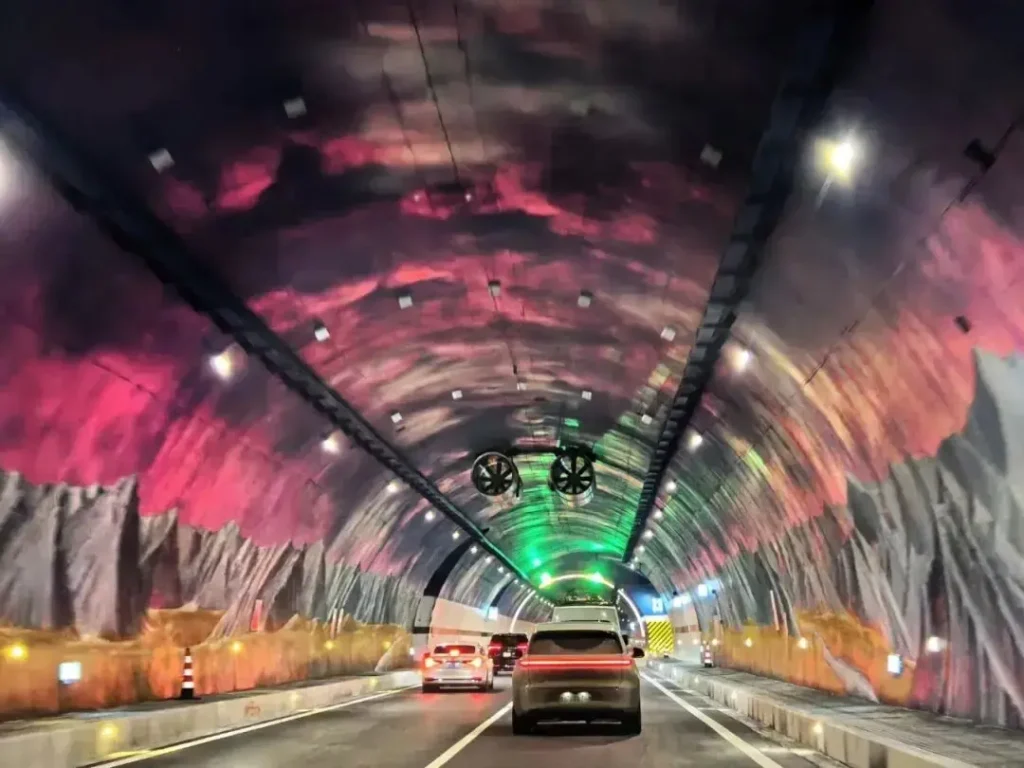
5. “Light and Shadow Gallery” Integrating Culture and Aesthetics
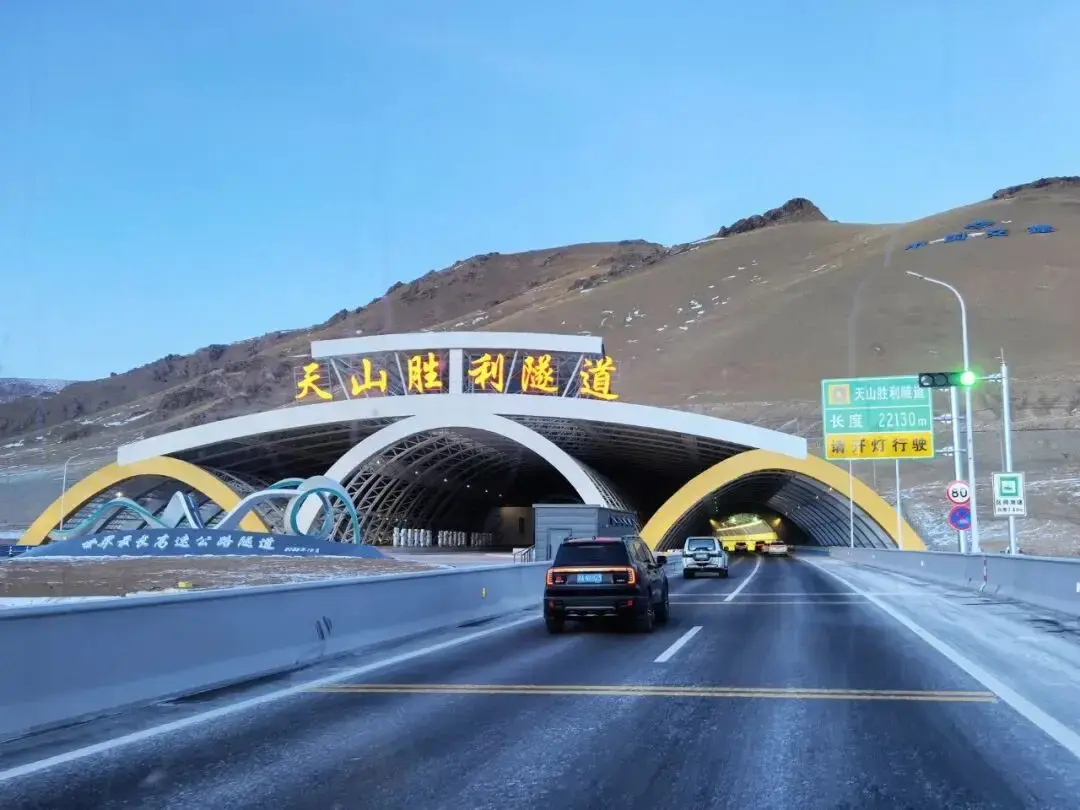
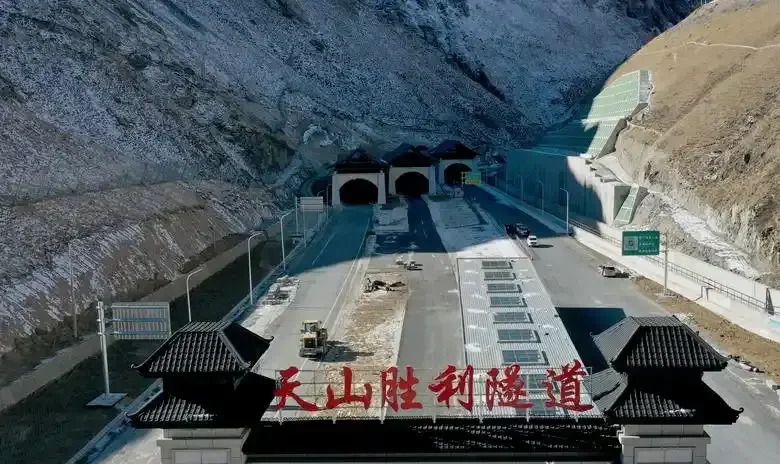
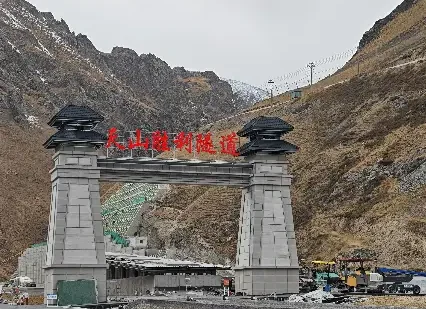
To prevent driver fatigue in the ultra-long tunnel, meticulous landscape design was implemented. Themed Xinjiang · Colors, the tunnel walls feature murals of snow-capped mountains, lakes, populus euphratica forests, and starry skies—creating a “Tianshan Light and Shadow Corridor” that balances safety and aesthetics. The tunnel entrance adopts the classic Chinese que gate style, while the exit shed draws inspiration from the oracle bone characters for Tian (Heaven) and Shan (Mountain), perfectly blending traditional Chinese culture with regional characteristics.
Tourist Highlights of the Xinjiang Tianshan Shengli Tunnel: Beyond the Thrill of Crossing
Driving or riding through the Xinjiang Tianshan Shengli Tunnel is already an extraordinary experience. In a roughly 20-minute trip, you will witness the grandeur of this mega project and enjoy the ever-changing light displays inside. Yet its tourism value extends far beyond the crossing itself—it is a key hub unlocking the finest landscapes of northern and southern Tianshan.
Core Experience 1: The Pride of Crossing a “World Record Holder”
- Thrilling drive: Glide smoothly through the 22-kilometer modern tunnel at 80 kilometers per hour, feeling the dialogue between human engineering prowess and natural barriers. The stark visual contrast between the snow-capped wilderness of northern Xinjiang and the vast vistas of southern Xinjiang upon exiting is unforgettable.
- Iconic check-in spots: Stylish landmark buildings stand at the east and west tunnel entrances. The majestic que gate at the east entrance and the artistic “Tian-Shan” shaped shed at the west exit are perfect for photo opportunities.
Core Experience 2: Exploring the Technology and Stories Behind the Engineering
- Visit the Geological Exhibition Hall: A mini geological exhibition hall (science popularization base) is located at the rescue station near the tunnel entrance. It displays drill bits used in construction, rock specimens, and uses models and interactive smart devices to showcase the tunnel’s construction history, technical challenges, and innovative solutions—a must-visit for engineering and geology enthusiasts.
- Learn about “long tunnel, short construction” technology: Through exhibition panels and multimedia displays, gain in-depth insights into world-leading construction techniques such as the “three tunnels + four shafts” and TBM middle pilot tunnel, and marvel at the ingenuity of China’s infrastructure.
Core Experience 3: A Hub Connecting Top Landscapes of Northern and Southern Tianshan
The opening of the Xinjiang Tianshan Shengli Tunnel has reshaped the spatial-temporal pattern of Xinjiang tourism, making two classic circular routes accessible:
Route 1: Northern Xinjiang Natural Wonders & Southern Xinjiang Cultural Tour (5–7 Days)
- D1–2 Urumqi & Surroundings: Visit the International Grand Bazaar and Xinjiang Museum, then drive to Heavenly Lake of Tianshan (about 28 kilometers from the east tunnel entrance) to admire snow-capped mountains and lakes.
- D3 Cross the Tunnel to Southern Xinjiang: Experience the tunnel crossing in the morning, then arrive in Korla in the afternoon. Tour Korla Museum to learn about Loulan culture and the Silk Road, and stroll along the Peacock River at dusk.
- D4–5 Bosten Lake & Tiemen Pass: Explore Bosten Lake, China’s largest inland freshwater lake, for birdwatching and reed marsh views. Visit Tiemen Pass, a strategic choke point of the Silk Road, to experience millennia-old frontier defense culture.
- D6–7 Return or Extend the Southern Xinjiang Trip: Fly from Korla to Kashgar, or drive along the desert highway into the Taklamakan Desert.
Route 2: In-Depth Natural Tour of the Tianshan Heartland (4–5 Days)
- D1 Urumqi → Shengli Tunnel → Bayanbulak: Cross the tunnel, then drive 1.5 hours to Bayanbulak Grassland. Stay at a starry homestay and experience Mongolian pastoral life.
- D2 Bayanbulak Grassland: Visit Swan Lake and wait for the spectacular “nine suns” sunset at the Nine Bends and Eighteen Turns viewing platform.
- D3 Bayanbulak → Narat Grassland: Head north along the middle section of the Duku Highway to Narat “Sky Grassland” for light hiking or horse riding.
- D4 Narat → Yining (or return to Urumqi via Duku Highway): Return to Urumqi or continue your journey to the Ili River Valley based on your schedule.
Core Experience 4: Photography & Visual Feast
- Contrast of landscapes inside and outside the tunnel: Capture stunning photos of the tunnel entrances against the towering Tianshan Mountains, and document the instant shift from the wilderness of northern Xinjiang to the vastness of southern Xinjiang.
- Interior “Light and Shadow Gallery”: (Without stopping for safety) Snap photos of the Xinjiang-themed murals inside the tunnel, which showcase unique effects under varying lighting.
- Aerial photography: From legally permitted safe areas, take aerial shots of the tunnel and the rolling Tianshan Mountains to show how this engineering feat “stitches” the earth’s folds together.
Practical Travel Guide
How to Reach & Cross the Tunnel
- Location & Navigation: The Xinjiang Tianshan Shengli Tunnel is part of the G0711 Urumqi-Yuli Expressway. From Urumqi, set your navigation to “Tianshan Shengli Tunnel” or “Urumqi-Yuli Expressway”.
- Traffic Conditions: A fully enclosed expressway tunnel open 24/7, all year round, unaffected by weather (a stark contrast to mountain roads often closed in winter).
- Toll Fees: Tolls apply as part of the Urumqi-Yuli Expressway, varying by vehicle type. The total toll for a small passenger car (Urumqi to Yuli) is approximately 100 RMB, payable via ETC or manual toll booths.
- Safety Tips: The speed limit inside the tunnel is generally 80–100 km/h; strictly follow traffic signs. Parking and U-turns are prohibited. Complete fire-fighting, emergency communication, and escape facilities are available throughout the tunnel.
Best Travel Time
Suitable for visits all year round. Summer (June–August) offers lush grasslands and blooming wildflowers, the most scenic season. Autumn (September–October) features vibrant fall colors. Winter crossings deliver a magical shift from the snowfields of northern Xinjiang to the relatively warm and dry south.
Budget Reference
The main costs of visiting the tunnel are transportation and fuel. Below is a budget for a 3-day classic circular tour starting and ending in Urumqi (in RMB, per person):
| Item | Budget Type | Comfort Type | Notes |
|---|---|---|---|
| Car Rental/Charter (3 days) | 600–900 | 1,200–1,800 | Rental of a small SUV (including insurance) or shared chartered car cost |
| Fuel & Toll Fees | 300–500 | 300–500 | Depends on travel mileage |
| Accommodation (2 nights) | 300–500 | 800–1,500 | Homestays or hotels in Bayanbulak Town |
| Meals (per day) | 150–200 | 200–350 | Local specialty cuisine |
| Scenic Spot Tickets | 200–300 | 200–300 | Tickets for Bayanbulak Grassland, Swan Lake, etc. |
| Total Estimate | 1,550–2,400 | 2,700–4,450 | Flexible based on travel preferences |
The Xinjiang Tianshan Shengli Tunnel is more than a transportation infrastructure—it is a destination, a symbol, and a new-era tourism calling card. It represents humanity’s ability to reshape geographical boundaries with wisdom and courage. A trip including the Xinjiang Tianshan Shengli Tunnel will reward you not only with stunning scenery but also with a pilgrimage to a modern engineering marvel and a deep understanding of Xinjiang’s vastness and diversity. This tunnel shortens not just spatial distances, but also the gap between you and the most magnificent core of Xinjiang.
-
When is the best time to visit?
The best time to visit Xinjiang is from May to October, with July and August being the peak season.
-
Do I need a permit to visit this area?
Most tourist areas in Xinjiang do not require special permits. Check specific destination requirements before traveling.
-
How do I get to this destination?
You can reach most destinations by flight to major cities like Urumqi, then by car, bus, or train.
-
What should I pack for my trip?
Pack layers for temperature changes, sun protection, comfortable shoes, and any personal medications.