Xinjiang Etiquette: A Respectful Traveler’s Guide

Travelers often arrive in Xinjiang unsure how to behave in a mosque, at a family dinner, or in a busy bazaar. To address that gap, this article draws on several kinds of openly available material. Cultural guides note that published etiquette handbooks from regional tourism offices describe the broad norms of Uyghur and Kazakh hospitality. Travelers report, through blogs and forum threads, what actually happened when they accepted tea, declined food, or raised a camera.
Locals generally appreciate visitors who make a visible effort, even when small mistakes occur. We have not invented personal anecdotes here. Where a claim depends on lived experience, it is framed as what travelers report or what cultural guides note. Prices and schedules change, so any figure in this article should be confirmed locally before you rely on it.
Xinjiang Etiquette: Overview & Key Facts
Xinjiang etiquette is best understood as a layered system. The Uyghur and Kazakh majority in the south and north respectively follow Muslim-influenced customs around cleanliness, prayer, and hospitality. Han communities, concentrated in larger cities, follow largely secular Chinese social norms. Across groups, a few principles stand out: offer greetings warmly, ask before photographing people, use the right hand for eating and giving, and never refuse hospitality too bluntly.
The table below summarizes the main cultural reference points you will meet as a traveler.
| Community | Core Custom | Traveler Takeaway |
|---|---|---|
| Uyghur | Right-hand eating, removing shoes at home, mosque modesty | Use right hand, dress covering shoulders and knees, ask before photos |
| Kazakh | Hospitality with tea and fermented drinks, respect for elders | Accept offered tea, greet the oldest person first |
| Han | Gift reciprocity, toasting at meals, polite bargaining | Bring a small gift if visiting, haggle good-naturedly |
| Hui | Halal dietary rules strictly observed | Do not bring pork near Hui or Uyghur meals |
Cultural guides note that the single most common traveler misstep is assuming one rule fits all. A gesture welcomed in a Urumqi restaurant may be out of place at a village mosque. Reading the room, and asking, is the safest approach.
Getting There and Meeting People
Most travelers reach Xinjiang by air into Urumqi, or by rail from Gansu and beyond. Meeting people starts at the station or airport, where a simple nod and a soft greeting open doors. Among Uyghur and Kazakh locals, the traditional greeting is a handshake, often with the right hand placed over the heart afterward. Travelers report that this small gesture is received with visible warmth.
When you are introduced to a family, greet the eldest member first. Locals generally appreciate a slight bow of the head rather than a backslap or loud hello. In mixed company, wait to see whether women offer a handshake; in more conservative areas, a verbal greeting alone is respectful. Learn a few phrases: “Salam” (peace) and “Rahmet” (thank you in Kazakh) go a long way.
If you are heading south, the Kashgar Old City is where many of these greeting customs are most visible, especially in the morning as shopkeepers open their doors.

Tickets & Costs (Cultural Sites)
Many cultural and religious sites in Xinjiang are free to enter, but a few charge modest fees. The figures below come from traveler reports and official postings and should be confirmed locally, as prices shift year to year.
| Site | Reported Fee | Year / Note |
|---|---|---|
| Id Kah Mosque, Kashgar | Free to 30 CNY | 2023; non-Muslim visitors may enter outside prayer times, confirm locally |
| Kashgar Old City maintenance fee | 0 to 15 CNY | 2024; often free, some courtyards charge |
| Apak Hoja Mausoleum | 30 to 40 CNY | 2023 to 2024; student discounts sometimes available |
| Heavenly Lake (Tianchi) cultural area | 100 to 215 CNY with shuttle | 2024; varies by season |
Travelers report that mosque entry is usually free, but donations are welcomed. Do not treat a religious site as a paid attraction; the etiquette is to enter quietly, cover appropriately, and leave a small contribution if you can.
Best Time to Practice and Observe Local Customs
Spring (April to June) and autumn (September to October) are the most comfortable seasons and the richest for observing customs. Cultural guides note that during major festivals such as Eid al-Fitr and Eid al-Adha, homes and mosques are most active, but also most private. Travelers report that being invited to a festival meal is a privilege, not an entitlement.
Friday is the main congregational prayer day at mosques. If you visit on a Friday morning, expect limited access and a solemn atmosphere. The evening bazaar scene is liveliest in summer, and that is when the Xinjiang Night Market Culture comes into its own, offering a relaxed setting to watch local manners around food and socializing.
A Day of Culturally Aware Travel
The timed plan below shows how a respectful day might flow in Kashgar. Clock times are suggestions based on traveler reports of when sites are calmest and most welcoming.
| Time | Activity | Etiquette Note |
|---|---|---|
| 08:00 | Walk the Old City as shops open | Greet shopkeepers with a nod; do not photograph until invited |
| 09:30 | Visit Id Kah Mosque (outside prayer) | Dress modestly, speak quietly, women cover head |
| 11:00 | Tea at a local cafe | Accept with right hand; see Xinjiang Tea Culture |
| 13:00 | Lunch with a family or guesthouse | Wait to be seated, use right hand, do not waste food |
| 16:00 | Bazaar browsing and polite bargaining | Smile, haggle lightly, never raise your voice |
| 19:30 | Evening stroll and people watching | Ask before photos of people; step back if refused |

Where to Stay and Neighborhood Etiquette
Choosing a guesthouse inside the Old City rather than a chain hotel puts you close to daily life, but it also means respecting residential rhythms. Locals generally appreciate guests who keep noise low after 22:00 and who do not wander into private courtyards. Remove your shoes when entering a home or a traditional guesthouse sitting room.
In Urumqi, high-rise hotels follow standard Chinese etiquette: tipping is not expected, and front-desk staff respond well to polite, indirect requests. Travelers report that learning the floor you are on and using the elevator quietly matters more than any gift. If you stay with a family, a small token such as fruit or sweets is appropriate, offered with both hands.
What & Where to Eat: Dining Manners
Dining is where Xinjiang etiquette is most rewarding to observe. Meals are communal, served on a shared plate or in a central bowl. Use your right hand or a spoon; the left hand is considered unclean for eating. When bread, especially Xinjiang Naan, is passed, handle it with care and never place it upside down.
Halal rules are strict in Uyghur and Hui settings. Do not bring pork or alcohol to such a meal. Travelers report that simply asking “Is this halal?” shows respect even when the answer is obvious. When tea is poured, the host may refill your cup repeatedly; a light tap of two fingers on the table is a quiet thank you in many Han-influenced settings.
For an overview of city dining, the Urumqi Food Scene covers where to eat and how locals share tables. At any meal, wait for the eldest or the host to begin before you eat, and leave a little food to signal you are full rather than cleaning the plate completely, which can imply the host underfed you.
Practical Tips for Respectful Travel
A short list of habits will carry you far across Xinjiang:
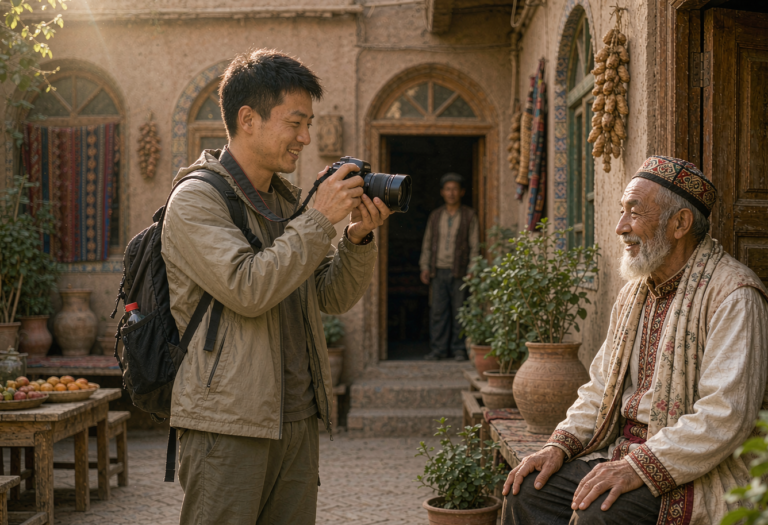
- Ask before photographing people; a smile and a gesture toward your camera usually works.
- Dress modestly at religious sites: shoulders, knees, and midriff covered; women carry a scarf.
- Use the right hand for eating, giving, and receiving.
- Bargain with good humor; it is expected at bazaars but never aggressive.
- Remove shoes at homes and mosques where indicated.
- Avoid discussing sensitive politics; keep conversation on food, family, and travel.
- Carry small change for mosque donations and tips at teahouses.
Travelers report that a patient, smiling approach resolves most awkward moments. Locals generally appreciate effort over perfection, and a botched greeting said with a smile is better than a flawless one delivered coldly.
Frequently Asked Questions About Xinjiang Etiquette
Can I take photos of people in the bazaar?
You can photograph scenes, but always ask before framing a person. Travelers report that a quick gesture toward your camera and a smile leads to yes more often than pointing and shooting. If someone declines, thank them and move on.
Is it okay to wear shorts when visiting mosques?
No. Cultural guides note that both men and women should cover knees and shoulders. Women should also carry a scarf to cover the head inside the prayer hall. Long trousers and a sleeved top are the safe default.
How should I handle bargaining without offending?
Bargaining is a social game, not a confrontation. Start at about half the asking price, smile, and walk away if the gap is too wide. Locals generally appreciate good-natured haggling far more than silent acceptance of the first price.
What gift is appropriate if I visit a family?
Fruit, sweets, or a box of tea offered with both hands works well. Avoid alcohol and pork products entirely in Uyghur and Hui homes. A small gift for the children, such as pens, is also welcomed.
Do I need to know any phrases?
A few go a long way: “Salam” for hello, “Rahmet” for thanks in Kazakh, and “Tashakkur” in Uyghur. Travelers report that even one word earns a warmer reception than flawless English.
Is tipping expected at restaurants?
Generally no. In local eateries and teahouses, rounding up or leaving small change is a kind gesture but not required. In tourist hotels, a service charge may already be included, so check the bill.
What should I do during the call to prayer?
If you are near a mosque, lower your voice and avoid crossing in front of worshippers. You do not need to pray, but stepping back and waiting shows respect. Travelers report that this small pause is noticed and appreciated.
Similar Posts
Photographing People in Xinjiang: The Etiquette That Keeps You Welcome
Xinjiang is photogenic, but pointing a camera at people needs care. The rules I follow so the shot does not cost the relationship.
Xinjiang in Winter: What’s Open, What’s Closed, and Why It’s Worth the Cold
Visiting Xinjiang in winter 2026? Learn which roads close, what stays open and shines, winter festivals, driving caveats, and why the cold means fewer crowds and lower prices.
Buying Cashmere and Pashmina in Xinjiang: A Shopper’s Guide
How to buy real cashmere and pashmina in Xinjiang: where to shop, how to spot fakes, fair prices, and caring for your purchase.
Kashgar Bazaar Bargaining Guide: How to Haggle Without Offending
Bargaining at the Kashgar Sunday Bazaar is a social art, not a fight. Learn the pacing, the phrases, and the manners that get you a fair price and a new friend.
Why Your Next Journey Should Be to Xinjiang
Last updated: July 15, 2026 · Written by Karl Huang, a Xinjiang travel specialist who has spent time across the region. Practical details are cross-checked against official tourism, transport, and border-regulation sources. Unlocking the Ultimate Xinjiang China Travel Experience If you seek a destination that simultaneously satisfies your yearning for majestic landscapes, profound history, and…
Staying in a Yurt or Kazakh Homestay in Xinjiang: What to Expect
Sleep under the stars in a felt yurt on the Tian Shan or Pamir. Guide to Kazakh and Kyrgyz homestays — etiquette, what’s provided, costs, booking.