Kazy and Chuchuk: Xinjiang’s Kazakh Horse Meat Sausage, Explained
The first time someone handed me a slice of kazy in a Kazakh household outside Zhaosu, I did not know what I was eating. It arrived on a communal plate with the boiled meat course: dark burgundy rounds, each rimmed with a pale band of fat, faintly glossy, smelling of woodsmoke and cold-weather cellars. I assumed cured beef. It was horse. Nobody announced it, because in that room announcing it would have been like announcing that bread is made of wheat.
Horse-meat sausage is the single most misunderstood item on the northern Xinjiang table. Travellers who happily eat lamb offal skewers will flinch at it, and travellers who go looking for it often order the wrong thing at the wrong season and come away unimpressed. This guide is what I wish I had known before that first plate: what kazy and chuchuk actually are, how they are made, how they are served, where to find the good stuff, and how to say no politely if you decide it is not for you.
Kazy and Chuchuk: Two Sausages, One Tradition
Both are horse-meat sausages made by Kazakh (and to a lesser extent Kyrgyz) families across the Ili Valley, the Altai, Tacheng and the Barkol grasslands. They are not interchangeable, and locals will correct you if you mix them up.
Kazy — the fatty rib sausage
Kazy (哈萨克熏马肠, sometimes written qazy) is made from the rib meat of a horse, cut in long strips with the fat layer left attached, salted, seasoned lightly, then packed into cleaned horse intestine. The point of kazy is the fat. Each slice shows a ring or crescent of white fat against dark muscle, and that fat is the reason the sausage is prized rather than merely eaten. It renders soft and clean rather than greasy, with none of the waxy aftertaste of pork fat.
Chuchuk — the leaner smoked one
Chuchuk (also shuzhyk) uses trimmed meat from elsewhere on the animal, often minced or coarsely chopped rather than left in strips, with far less fat. It hangs longer in the smoke, so it comes out firmer, darker and more concentrated — closer in texture to a dry-cured salami than to a boiled sausage. Chuchuk is the one you can pack into a bag and eat cold on a bus; kazy is the one that belongs on a table.
Why Horse Meat Sits at the Centre of the Kazakh Table
This is not novelty food. On the grasslands, a horse was capital: transport, status, and — at the end of its working life — a winter’s protein for an extended family. Autumn slaughter (Kazakh families call the whole operation sogym) happened when the animal had put on grass fat and when the temperature had dropped far enough for meat to hang safely. Everything was used, and sausage was the storage technology that carried the family through to spring.
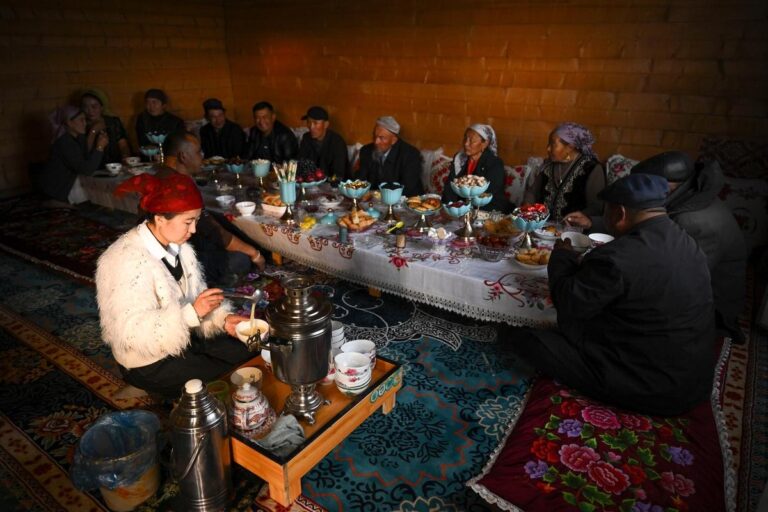
That is why horse meat still carries ceremonial weight. Serving kazy signals a household is treating you seriously. It appears at Nowruz, at weddings, at the meal that follows a long-awaited guest’s arrival — usually alongside beshbarmak, the boiled-meat-and-pasta dish that anchors any Kazakh feast. If you are offered a slice, you are being included, not tested.
How It Is Actually Made
I have watched the process twice, both times in November, both times outdoors. The rhythm is fixed:
| Stage | Typical timing | What happens |
|---|---|---|
| Slaughter (sogym) | Late Oct – early Dec | Grass-fattened animal processed in cold weather; ribs reserved for kazy |
| Salting | 1–3 days | Coarse salt, sometimes garlic, black pepper, cumin; minimal spice by design |
| Stuffing | Same week | Meat strips packed into cleaned casing, tied at both ends |
| Cold smoking | 1–3 weeks | Hung over slow spruce, birch or dung-and-hay smoke in a shed or chimney space |
| Drying / storage | Through winter | Kept cold and dry; kazy is boiled before serving, chuchuk often eaten as is |
Two things follow from that table. First, the honest season for fresh, home-made kazy is roughly December to April — buy it in August and you are buying either last winter’s stock or a factory product. Second, kazy is boiled before eating, usually 1.5 to 2 hours in plain water with an onion, then cooled slightly and sliced across the grain into thin rounds. Restaurants that serve it raw and warm have skipped a step.
How to Eat It Without Getting It Wrong
At a proper spread, kazy does not arrive alone. It comes as part of the boiled-meat course, fanned over pasta sheets or beside plain noodles, sometimes with raw onion rings and a ladle of the cooking broth poured over. The etiquette is simple and worth respecting:
- Take from the plate nearest you, with your right hand, and do not rearrange the meat to hunt for a better piece.
- Eat the fat. Trimming the white band off and leaving it on your plate reads as a rejection of the best part. If you genuinely cannot, take a smaller slice next round rather than dissecting the one you have.
- Pace yourself. This course is rarely the last one. Bread and tea have already come, and something hot usually follows.
- Drink what is offered. Kazy is often paired with hot broth or with koumiss, the fermented mare’s milk that cuts the fat surprisingly well.
If you would rather not eat horse — a completely reasonable position, and one plenty of Han Chinese visitors share — say so early and gently, before the plate reaches you. “I don’t eat horse meat, but the lamb is wonderful” lands fine. Refusing a slice already placed in front of you is the awkward version.
Where to Find It
Kazy is a northern speciality. Looking for it in Kashgar or Hotan is a waste of a meal.
| Where | What you’ll find | Rough price (RMB, 2026) |
|---|---|---|
| Yining / Ili Valley markets | Best all-round availability; vacuum-packed and loose | 90–160 per jin (500 g) |
| Zhaosu, Tekes, Nileke county towns | Home-made, sold from stalls and small butchers | 80–140 per jin |
| Altay & Burqin | Strong chuchuk tradition; drier, smokier style | 90–150 per jin |
| Tacheng / Emin | Excellent quality, very little tourist markup | 80–130 per jin |
| Urumqi supermarkets & bazaars | Factory-made, reliable but flatter in flavour | 110–200 per jin |
| Kazakh restaurants (region-wide) | Sliced plate, usually with beshbarmak | 60–120 per plate |
How to tell decent kazy from filler
Look at a cut end. Good kazy shows distinct strips of muscle with an intact fat layer — you can see it was packed, not pumped. Uniform pink paste with fat specks scattered evenly is emulsified factory sausage, which is edible but is not what anyone means by kazy. Smell matters too: clean woodsmoke, not liquid-smoke sharpness or sourness.
What It Actually Tastes Like
Honestly? Cleaner than you expect. Horse meat is lean, slightly sweet, mineral in a way that sits between beef and venison, with none of lamb’s musk. The smoke is present but restrained. The fat is the surprise — it melts at a lower temperature than mutton fat, so it coats rather than clings. If you like bresaola or cold-smoked beef, you will be fine. If you dislike the idea more than the flavour, the idea will win, and that is fair enough.
Buying It to Take Home
Vacuum-packed kazy and chuchuk travel well and are sold specifically as gifts in Yining and Urumqi — expect a printed box, a production date, and a shelf life of several months unopened. Two practical cautions from experience. Domestic Chinese flights accept vacuum-packed cooked meat in checked baggage without fuss; carry-on is riskier at security. And crossing an international border with any meat product is almost always prohibited, so if you are flying home, buy dried fruit instead and eat the sausage in Xinjiang.
The calendar decides everything
Spring and early summer
Yes, in the Hanafi tradition followed by most Kazakh Muslims in Xinjiang, horse meat is permitted when slaughtered correctly, and kazy is served in halal households and restaurants. Some other Islamic schools discourage it, which is why you will occasionally meet a Muslim traveller who declines. It is a difference of jurisprudence, not a scandal.
Summer
Rarely. Horse-meat sausage is a Kazakh and Kyrgyz speciality; Uyghur cuisine centres on lamb and beef. In Kashgar or Turpan you should be eating lamb, not hunting for horse.
December through April, when winter stock is fresh. Late summer is the weakest window for home-made product, though restaurants and supermarkets sell it year-round.
Kazy is boiled before serving, which handles the main risk. Chuchuk is cured and dried. Buy from busy stalls with visible turnover, avoid anything that smells sour or has a slimy surface, and skip loose unrefrigerated sausage sitting in summer heat.
Autumn
In a restaurant, one shared plate between two or three people is plenty — it is rich. At a home meal you will not be ordering at all; take one slice, and take a second if you want to make your hosts happy.
Winter
Almost everything. Chinese cured sausage is pork, sweetened, and usually cooked into rice or stir-fries. Kazy is horse, salted rather than sugared, boiled and sliced, and eaten as a centrepiece meat course.