Xinjiang Silver Jewelry: A Buyer’s Guide to Uyghur, Kazakh, and Tajik Silver
Walk into any old-town alley in Kashgar or Yining and the first thing that catches the light is silver. Xinjiang silver jewelry is not a souvenir afterthought — it is a living craft worn daily by Uyghur, Kazakh, Kyrgyz, and Pamiri Tajik women, and it carries 1,500 years of Silk Road metallurgy in every clasp. If you want a gift that is beautiful, portable, and genuinely local, this is one of the best things you can buy. The trick is knowing what you are looking at before a vendor names a price.
Why Xinjiang silver is different
Most “silver” sold across the region is not sterling in the Western sense. It is a high-silver alloy — typically 80–92% silver mixed with copper for strength — that has been the local standard since the caravan era. That is a feature, not a flaw: the copper gives the metal a warm tone and lets smiths chase fine detail that pure silver would not hold. What you will not find much of is mass-produced, machine-stamped “925” jewelry from coastal factories; the good pieces are still cut, chased, and set by hand in family workshops.
The main styles you will meet
Uyghur silver: bold, floral, apotropaic
Uyghur work favours heavy cuff bracelets, domed pendants, and the iconic tesmachi belt chains. Motifs are floral and pomegranate-heavy, often paired with turquoise, cornelian, or glass “aring” stones said to ward off the evil eye. Expect chunky, symmetrical, celebratory pieces.
Kazakh and Kyrgyz: zoomorphic and totemic
North of the Tianshan the silver goes animal. Rams’ heads, birds, and curved “koshkar” horns appear on earrings and chest ornaments (omirshaya). These are clan and marital markers as much as decoration — a young bride’s set can weigh half a kilo.
Tajik (Pamiri): restrained and ancient
In Tashkurgan the silver is thinner, older in feel, with granulation and staple-and-bead work reminiscent of the Hindu Kush. Pamiri women wear rows of pinned discs and a forehead band; the look is austere compared with the Uyghur exuberance.
Silver standards and what the marks mean
Reading the marks saves you from the single most common tourist mistake: paying silver prices for white-metal junk. Here is the working shorthand.
| Mark / term | Approx. silver content | What it means for you |
|---|---|---|
| S925 / “sterling” | 92.5% | Rare locally; usually imported or modern factory work. |
| “Baiyin” / 90% | ~90% | Top local handmade grade; the real deal. |
| “80 silver” / cupronickel mix | ~80% or less | Common, honest, good value — but confirm price. |
| No mark, very light, magnets stick | 0% | White metal / german silver. Walk away or pay scrap price. |
Price guide: what to expect in 2026
Prices track the global silver spot, but labour dominates the final number. Use this as a sanity check, not a target.
| Item | Typical bazaar range (RMB) | Notes |
|---|---|---|
| Pair of stamped earrings | 40–120 | Small, easy first purchase. |
| Cuff bracelet (handmade) | 150–450 | Weight and detail drive the spread. |
| Domed pendant w/ stone | 120–350 | Turquoise and cornelian add cost. |
| Bridal chest ornament set | 800–2,500+ | Heirloom pieces; negotiate hard. |
Where to buy (and where to skip)
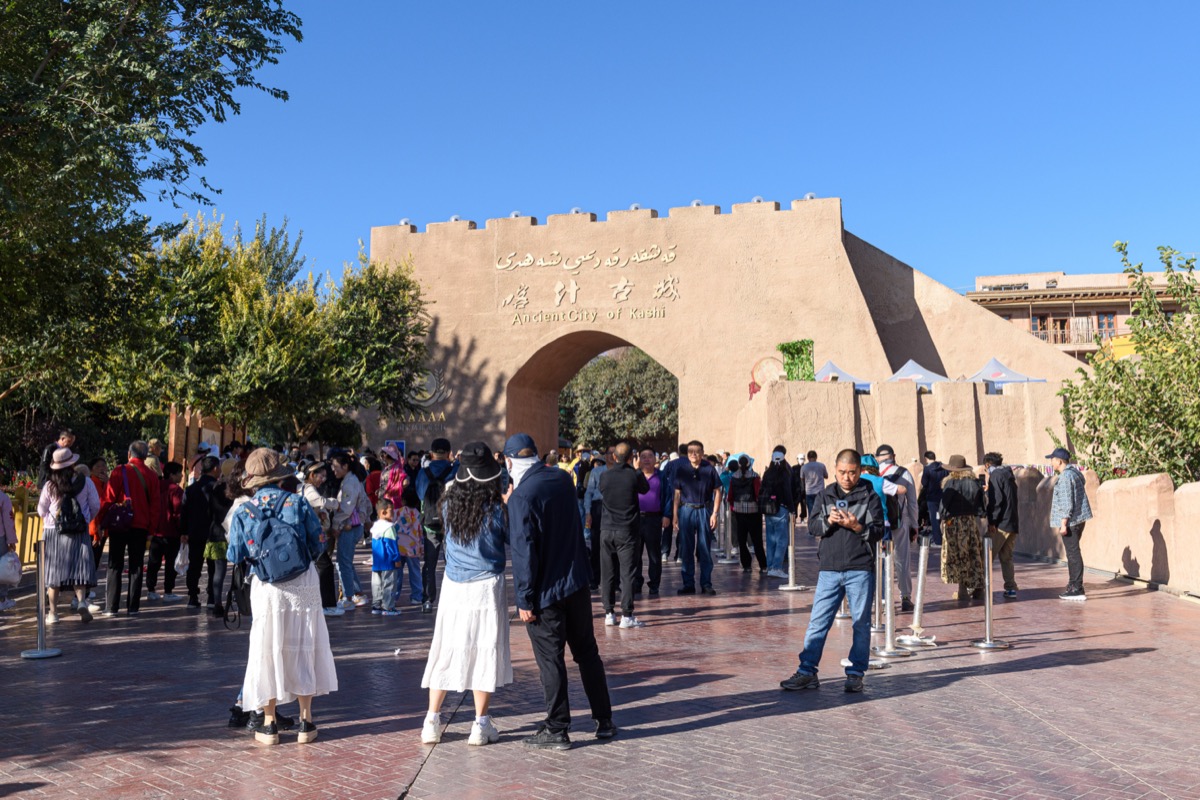
The best hunting is inside the working bazaars and souk lanes rather than the glass-fronted shops aimed at tour buses. The Kashgar Sunday Bazaar is unbeatable for volume and variety; Yining’s Liuxing Street and the jewellery rows of Hotan and Aksu are strong runners-up. Airport kiosks and the “official” counters inside scenic areas charge 2–3x and often stock factory silver. In a real workshop you can watch the smith work — ask, and most will show you.
How to spot a fake
Five field tests, no equipment needed: (1) a magnet should not stick — white metal is magnetic, silver is not; (2) real silver tarnishes to grey-black over weeks, white metal stays bright; (3) the edge of a hand-chased piece is slightly irregular, a casting is mirror-perfect; (4) genuine pieces have some marks or maker’s punch, blanks are suspicious; (5) price too good to be true on a “heavy sterling” set means it is plated. Buy from a stall you can find again the next day.
Silver as a souvenir versus an investment
Treat Xinjiang silver for what it is: a craft souvenir, not a bullion play. The metal content is real and tracks the silver price, but the resale value of a handmade Uyghur cuff outside China is close to zero — buyers abroad have no reference for the local alloy grade and no way to verify the maker. That is fine. You are not buying it to flip; you are buying a wearable object with a specific cultural fingerprint. If you do want exposure to silver as a commodity, buy weighted scrap or recognised 925 from a city jeweller and get a receipt, but understand that the premium you pay for handwork is exactly the part you will not recover on resale. The smart play is to buy the pieces you would actually wear and let the story be the dividend.
Caring for your silver at home and on the road
Silver is low-maintenance but not maintenance-free. On the road, keep pieces in a small ziplock with a silica sachet so humidity and the inevitable bazaar dust do not accelerate tarnish; remove bracelets before swimming pools and hot springs, where chlorine and sulphur blacken silver fast. At home, store in anti-tarnish cloth or a sealed bag, not loose in a jewellery box where it rubs against harder metals and picks up scratches. To clean, a few minutes in warm water with a drop of mild dish soap, a soft toothbrush for the chased detail, and a polish with a treated cloth restores the shine — skip the abrasive pastes that strip the patina collectors actually like. With that little effort a Xinjiang silver set will outlive the trip that produced it by decades.
Questions people keep asking me
Is Xinjiang silver actually silver?
Usually yes, but it is a high-silver alloy (80–92%), not always 925 sterling. That has been the local standard for centuries and is perfectly legitimate — just confirm the grade and the price before you hand over cash.
Will the silver tarnish or turn my skin green?
Real silver tarnishes dark, it does not turn skin green; a green mark means a copper-heavy or plated fake. A quick wipe with a polishing cloth restores the shine, and a zip bag slows tarnish during travel.
Can I take silver jewelry home through customs?
For personal use, small quantities are fine leaving China and entering most countries, but keep receipts and stay under your home country’s duty-free allowance. Very heavy bridal sets can attract questions, so carry them in cabin baggage with proof of purchase.
Should I bargain, and by how much?
Always bargain in the bazaar — the first price is a starting point, not an offer. A realistic landing zone is 30–50% off the opening number for a patient, friendly negotiation. In fixed-price workshops the price is the price; there respect the craft.
What is the best gift piece to take home?
A mid-weight Uyghur cuff bracelet or a pair of Kazakh ram’s-head earrings reads as “Xinjiang” instantly, packs flat, and survives luggage. Avoid anything glued — hand-soldered settings travel better than adhesive ones.