What Xinjiang Highway Service Areas Are Actually Like
I expected the worst from China’s highway service areas and got surprised, then surprised again in the opposite direction. The network is modern near the big cities and patchy where the road gets remote. Knowing the difference before you leave town is the trick.
Fuel and the foreigner question
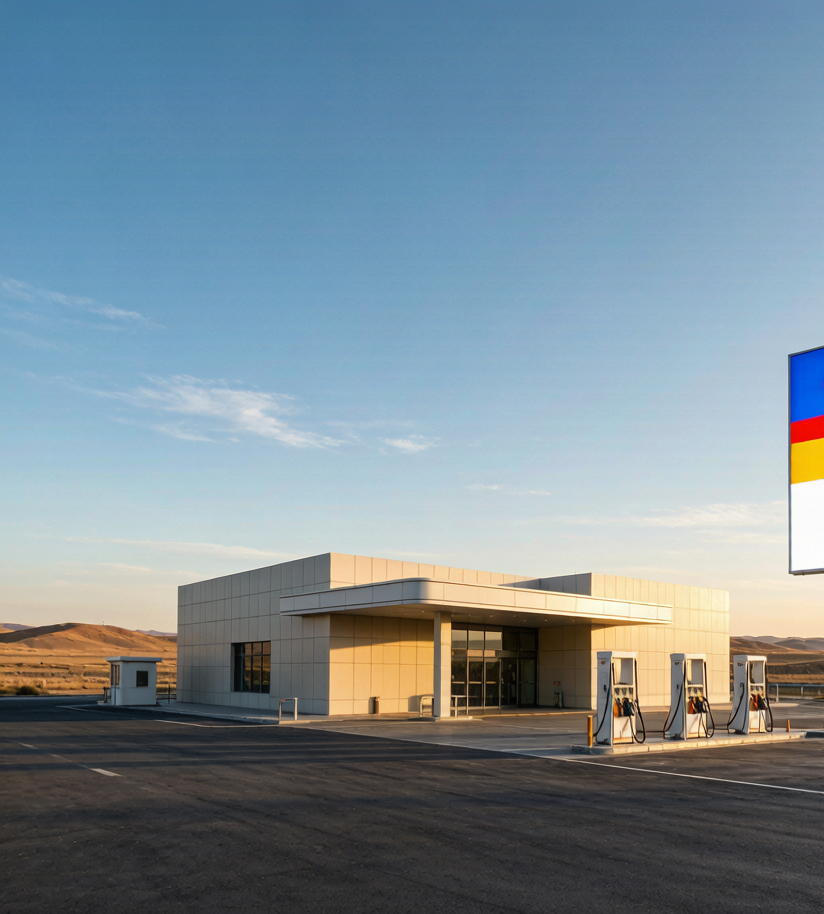
Most service areas have a petrol station, and that is your lifeline on a long haul. The catch is the payment and ID check at some stations, which ties back to the checkpoint routine you will already know. I fill up whenever I see a station with a queue, not when the gauge scares me, because the next one can be far.
Food, toilets, and the rest
Near Urumqi and on the main east-west lines, service areas have clean toilets, a small shop, and sometimes a noodle counter. Out west, expect a bare lot with a toilet and little else. The toll and fuel budget assumes you carry your own water and snacks, because the remote stops will not sell you what you forgot.
Rest without risk
A service area is the safe place to nap, not the shoulder. I have seen drivers pulled over on the hard shoulder get flagged, and it is never worth it. Twenty minutes in a lit lot beats a fine or worse. Pair the stop with the night driving rules above if you are covering distance after dark.
Plan around the gaps
My system is simple: top off fuel at every decent station, carry a day of water and food, and treat the map’s service areas as promises that sometimes break. The travel insurance is for the rare breakdown, but self-reliance is the daily insurance. A flat in the middle of nowhere is survivable if you are not starving and you have charged your phone.
Service areas are not attractions. They are the quiet infrastructure that lets the trip happen, and respecting them keeps you moving.
What goes in the day pack
A wind shell. The temperature drops fast once you stop moving and the drop is not hypothetical on an exposed pass. A fleece covers most of the year, a real jacket covers shoulder season. Water, more than you think, a power bank and some cash.
Cards work at the gate and in the shops, but the stalls on the approach road and the drivers waiting at the turnoff want cash, and coming up short at the moment you want a lift is the classic way to lose an hour. Sunscreen and a brim. The light here is serious and the shade is intermittent, so the sunscreen goes on before you leave the hotel, not at the gate. I wrote the driving side up in our [[how-to-go-to-xinjiang|How to Get to Xinjiang: Entry Requirements…]] as well.
The hour I go back for
Whatever the guidebook says about golden hour, go on a weekday. The light is only free of company on a Tuesday. Midday is the hour to avoid, not the hour to schedule. Go early or go late and the same ground gives you two different subjects. Everything goes flat, the shade disappears, and the temperature on an open plateau rises in a way that stops you caring about photographs.
Between the two I would pick the later one, mostly because the early version costs you the rest of the day. Sunrise is the one worth an alarm for. The whole face of Xinjiang Service Area turns a colour that does not exist at any other time, and the site is empty enough that you can stand still and hear nothing. By ten the coaches are here, and by one it is an hour of people shuffling past. I have come to like the last forty minutes before the gate shuts, when the groups have gone and the staff are sweeping, because that is when you can look up properly instead of squeezing a shoulder past strangers.
The evening version of that plan is in our [[xinjiang-tianshan-tianchi-scenic-area-travel-guide|Heavenly Lake (Tianchi) Practical Guide:…]].
The payment and restroom reality
Most stations take mobile pay, but the signal can drop right where you need it, so I keep a little cash and a charged phone as backup. The toilets range from clean to an experience, and the remote ones are the latter, so I carry tissue and hand sanitizer without exception. Once, north of the basin, my car threw a soft warning light at a bare lot with no shop; I had water, a charged phone, and the [[travel-insurance-xinjiang|insurance]] number saved, and what could have been a crisis was a two-hour wait for a tow I could track. Self-reliance is not paranoia here. It is the normal condition of the far west, and planning for it is what makes the trip feel easy.
What I keep in the car
My standard kit for a long haul is a day of water per person, tissue, hand sanitizer, a power bank, and a few snacks that survive heat. The remote service areas will not sell what you forgot, and the good ones close earlier than you hope. I also keep the [[travel-insurance-xinjiang|insurance]] number and a roadside assistance contact in the phone, not just in my head. Paid showers exist at some larger areas and are worth it on a multi-day drive. The trick is to treat every stop as possibly the last good one for a while, top off fuel, use the toilet, refill water, then go. Self-reliance is not paranoia here; it is the normal condition of the far west, and it is what makes the trip feel easy instead of edge-of-rough.