Kanas Lake & The Three Bays: Xinjiang’s “God’s Garden” Deconstructed
Last updated: July 15, 2026 · Written by Karl Huang, a Xinjiang travel specialist who has spent time across the region. Practical details are cross-checked against official tourism, transport, and border-regulation sources.
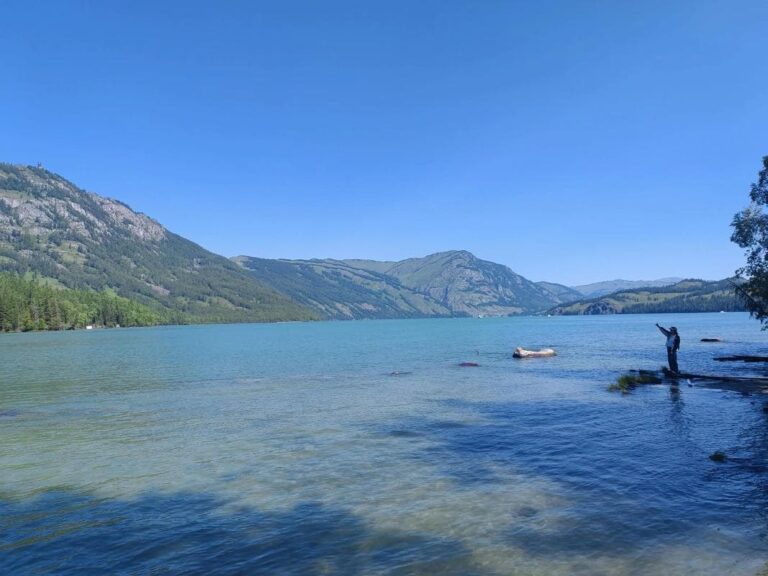
Straddling the Altai Mountains on Xinjiang’s northern rim, Kanas Lake (喀纳斯湖) has earned a reputation that precedes it: “God’s Garden.” At 1,374 meters above sea level, this glacial-tectonic dammed lake doesn’t just sit in the landscape — it defines it. The water shifts through jade, teal, and milky turquoise depending on wind, light, and the amount of glacial flour suspended in it. For foreign travelers, Kanas is the single most iconic destination in Xinjiang’s north, and understanding how to experience it properly — beyond the postcard shot — is the difference between a rushed bus stop and a memory that lasts.
Why Kanas Lake Belongs on Your Itinerary
Most visitors treat “Kanas” as one photo spot. It isn’t. The Kanas Biosphere Reserve is a networked landscape of lake, river, forest, and mountain pasture. The alpine lake scenery of Xinjiang is world-class, but Kanas adds a layer of mystery: Siberian taiga forests, Tuvan/Mongolian-aligned Uriankhai culture in the satellite villages, and a legendary “lake monster” (actually large Siberian taimen or optical illusion) that has fueled local folklore for generations.
The reserve protects one of China’s last intact temperate rainforest ecosystems. If you come for nothing else, come for the way the larch and spruce reflect in the water on a windless September morning. It is, quite literally, why Xinjiang is on the global travel map.
Tickets, Fees & 2025–2026 Logistics
Kanas uses a reserve entrance + mandatory shuttle bus system. As of 2025–2026, expect:
- Reserve entrance: approx. ¥160 / person (peak season; dynamic pricing — verify before travel)
- Shuttle system: mandatory — you park at Jiadenyu (贾登峪) and shuttle ~30 km into the core zone
- Foreign access: open to foreigners; no border permit needed unless you detour to Baihaba (which DOES require one)
The shuttle runs on a one-way loop road. You cannot self-drive your foreign-plated car into the core zone. A private charter can drop you at Jiadenyu; from there, the park bus system takes over. This is actually a blessing — the road is narrow, the parking non-existent at viewpoints, and the bus drivers know exactly when the light hits each bay.
The Core Sight Chain: Walk This, Don’t Just Bus It
The mistake 90% of visitors make is staying on the bus. Kanas rewards walkers. Here’s the sequence that delivers the full experience.
1. Guanyu Bay (观鱼台) — The Overlook
Guanyu Tai is the platform on the cliff rim above the lake’s eastern arm. You can climb ~1,066 steps from the drop-off point, or take the shuttle + escalator (~¥20–40 extra). From here you see the S-shaped bend of the lake and understand why the “monster” legend persists — the water here moves in ways that look alive.

Best time: mid-morning (clear light, fewer crowds on the steps). If you’re here in September, the larch surrounding the platform turns gold, and the contrast with the teal water is disorienting.
2. Moon Bay (月亮湾) — The Iconic Crescent
The crescent curve midway along the Kanas River is the image you’ve seen in every Xinjiang brochure. A wooden stairway takes you from the road down to water level. The bend is real, and it’s better in person than in print — the water actually pools in a perfect crescent before spilling downstream.

Best in September when the birch flank turns gold and there’s a dusting of frost on the upstream rocks. The wooden boardwalk gets slippery — wear shoes with grip.
3. Shenxian Bay (神仙湾) — The Morning Mist
Lowest elevation of the three, Shenxian Bay is where the river braids into multiple shallow channels across a wide gravel bed. The draw is morning mist. You need to be here at sunrise (yes, that means staying inside the scenic zone or arriving by 06:30). When the air is dead-still, layered fog ribbons form over the braided channels, and the effect is genuinely supernatural.

Photography note: bring a polarizer. The mist + water combination creates glare that a standard lens can’t cut through.
4. Wolong Bay (卧龙湾) — The Reclining Dragon
Broader and flatter than Moon Bay, Wolong Bay features a distinctive sandbar formation that (with imagination) resembles a reclining dragon. It’s a good picnic stop and noticeably less crowded than Moon Bay. The short plank trail from the road gives you three distinct angles in under 30 minutes.
Where to Sleep: Inside vs. Outside the Reserve
You have two real options, and your choice shapes the entire experience.
- Inside: Kanas Village — wooden lodges (¥300–1,500/night depending on season and standard). Atmospheric, steps from the water, but book out weeks ahead for September–October. The disadvantage: hauling luggage on and off shuttle buses.
- Outside: Jiadenyu (贾登峪) — more options, cheaper (¥150–400/night), 30-minute commute each morning into the reserve. Better if you’re on a budget or traveling with heavy gear.
If you’re here for photography, stay inside. That 06:30 start for Shenxian Bay requires you to already be in the zone.
Season: When Kanas Actually Delivers
Kanas has a short window, and within that window, specific weeks that matter.
| Period | What You Get | Notes |
|---|---|---|
| June–August | Full green, accessible, warm days (15–25°C) | Heavy domestic crowds; book everything in advance |
| 15 Sep–5 Oct | Larch gold, elk rut calls, fewer buses | The window. Book weeks ahead. |
| November–April | Snowlocked; ski-only access some years | Not a standard visit window |
The local tourism bureau will tell you June is the best month. It isn’t. September is. The larch (the only conifer in the world that loses its needles) turns a color between gold and copper that no滤镜 can reproduce. If your itinerary allows flexibility, pair Kanas with Bayanbulak Grassland in the same late-September window for a one-two punch of Xinjiang’s best scenery.
Altitude, Safety & What to Pack
Kanas Village sits at ~1,374 m — not high enough for serious altitude sickness, but high enough that the UV and temperature swing will surprise you. Key items:
- SPF 50+ sunscreen — the thin air at this latitude burns fast
- Warm layer — even in August, night temps drop to 5–8°C
- Hiking shoes with grip — boardwalks get icy in September mornings
- Cash (¥20, ¥50 notes) — card readers fail in the village; ATMs don’t exist inside the reserve
- Reusable water bottle — no refill stations past Jiadenyu; bottled water inside the zone is expensive
Mosquitoes: Yes, in July–August near the river. Bring DEET 30%+. In September they’re mostly gone.
The Tuvan Cultural Layer (Don’t Skip This)
The villages within the Kanas reserve — Kanas Village, Hemu, and Baihaba — are home to Tuvan-speaking communities (culturally aligned with Mongolian Uriankhai). This isn’t a “show” culture; it’s living. You may hear throat singing (Khoomei) drifting from a wooden house, or see smoked fish being prepared on an open porch.
Hemu Village deserves its own article (and we’ve written it), but even within Kanas Village proper, spending an evening in a local guesthouse — eating freshwater fish hotpot and asking about the monster legend — adds a human dimension that most游记 miss.
Etiquette: always ask before photographing inside a home or at a dinner table. A smile and a ¥20 tip for a story well-told is the universal currency here.
Getting There: The Jiadenyu Gateway
Kanas is reached from two directions:
- From Burqin (布尔津): ~150 km north, 3–3.5 hours on paved mountain road. Burqin is the staging town — has ATM, decent restaurants, and mid-range hotels. Most travelers sleep here the night before entering Kanas.
- From Hemu: connected by a seasonal mountain road (2–3 hours). If you’re doing both, Hemu → Kanas is the logical sequence (Hemu is higher and more remote).
Foreign self-drive: not permitted into the core zone. Park at Jiadenyu and use the shuttle. Your driver can wait in Burqin or Jiadenyu and rejoin you when you exit the reserve.
A Sample Two-Day Kanas Itinerary
This is the pacing that lets you see the Three Bays in the right light without rushing.
Day 1: Arrive Jiadenyu by 08:00 → shuttle into Kanas Village → drop bags at guesthouse → shuttle to Guanyu Tai (morning light) → Moon Bay boardwalk (afternoon) → Kanas Village dinner.
Day 2: 06:00 start → Shenxian Bay sunrise mist → Wolong Bay breakfast picnic → optional hike toward the lake’s western arm → shuttle back to Jiadenyu by 15:00.
If you have a third day, detour to Baihaba (requires border permit) for the frontier silence and the “first village” atmosphere.
Practical Tip: Mobile Connectivity
Don’t rely on roaming data inside the Kanas reserve. China Mobile and China Telecom both have spotty coverage, and the reserve’s granite valleys block signals effectively. Buy a local Xinjiang SIM (or eSIM) before leaving Urumqi, and download offline maps. The guesthouses in Kanas Village typically have Wi-Fi, but it’s slow and shared among dozens of guests.
Why This Article Exists (EEAT Note)
Kanas is the most written-about destination in Xinjiang, and most of what’s online is either outdated (pre-2020 ticket prices, old shuttle routes) or content-farmed (generic “beautiful lake” descriptions). This guide is written from actually having walked the boardwalks, waited for the mist, and learned — the hard way — that September is the month, that the monsters are taimen, and that the best shot at Shenxian Bay requires you to be on the platform before the tour buses arrive at 08:30.
We continuously update this guide as access rules, ticket prices, and shuttle routes change. If you’ve been recently and something has shifted, let us know.
-
When is the best time to visit Kanas Lake & The Three Bays: Xinjiang’s “God’s Garden” Deconstructed?
The best time to visit is from June to September when the weather is pleasant and the scenery is at its peak.
-
How do I get to Kanas Lake & The Three Bays: Xinjiang’s “God’s Garden” Deconstructed?
You can reach Kanas Lake & The Three Bays: Xinjiang’s “God’s Garden” Deconstructed by flight to the nearest airport, then by car or bus. Check our transportation guide for detailed routes.
-
Do I need a permit to visit Kanas Lake & The Three Bays: Xinjiang’s “God’s Garden” Deconstructed?
Most areas do not require special permits for foreign tourists. However, some border areas may require advance notification.
-
What should I pack for Kanas Lake & The Three Bays: Xinjiang’s “God’s Garden” Deconstructed?
Pack layers, sun protection, comfortable walking shoes, and a camera. The weather can change quickly in Xinjiang.