Xinjiang’s Weekly Bazaars: The Market-Day Calendar That Shapes Town Life
I once rearranged a whole Xinjiang loop around a single day of the week. The reason was the Sunday bazaar in Kashgar – the kind of market that folds a whole region’s economy into one loud, dusty, glorious morning. In Xinjiang, bazaars do not run every day the way a supermarket does. They run on a weekly rhythm, and knowing that rhythm is the difference between walking into a ghost town and walking into the best thing your trip has to offer.
Why market day matters more here
In a region where towns can be hours apart, the weekly bazaar is the original social network. It is where farmers, herders, and traders meet, where news travels, and where you can buy everything from a live sheep to a welded iron stove. For travellers, a market day is the most concentrated dose of local life you will find – food stalls, handicrafts, and faces from every ethnic community in one square.
The rhythm of the week
Once you notice the pattern, the whole region starts to make sense. A town that felt asleep on Tuesday is roaring on its market day; the same streets that were empty fill with trucks, horses, and grandmothers in full dress. Time your stay to land on that day and you see the place at full volume. Miss it and you have seen the rehearsal, not the show.
The market-day calendar
Most bazaars anchor to a weekday, and Sunday is the heavyweight. But the pattern varies by town, and some places run on a set lunar or “every fifth day” cycle, so always confirm locally. Below is the common pattern for the headline markets – treat it as a planning starting point, not gospel.
| Town / City | Typical market day | Best known for |
|---|---|---|
| Kashgar | Sunday | Livestock, carpets, spices, the famous Kashgar Sunday Bazaar |
| Yarkand (Shache) | Sunday / set days | Agricultural produce, textiles |
| Hotan | Sunday & weekly cycles | Jade, silk, dried fruit |
| Yining (Ghulja) | Weekends | Kazakh & Hui foods, dairy |
| Turpan oasis towns | Varies by village | Grapes, raisins, melons |
| Small county seats | One fixed weekday | Livestock, tools, clothing |
What you will actually find
Expect layers. The outer ring is often livestock – sheep, cows, donkeys, the occasional horse – with a noise and smell that tells you this is the real economy, not a show. Move inward and you hit produce, nuts, and the spice mountains of chilli and cumin that Xinjiang cooking is built on. The inner core is crafts:Atlas silk, embroidery, knives (sold, but shipping rules apply), and copperware. And woven through all of it are the food stalls – kebabs, naan hot from the tandir, and bowls of laghman that cost pocket change.
Food you should eat at the bazaar
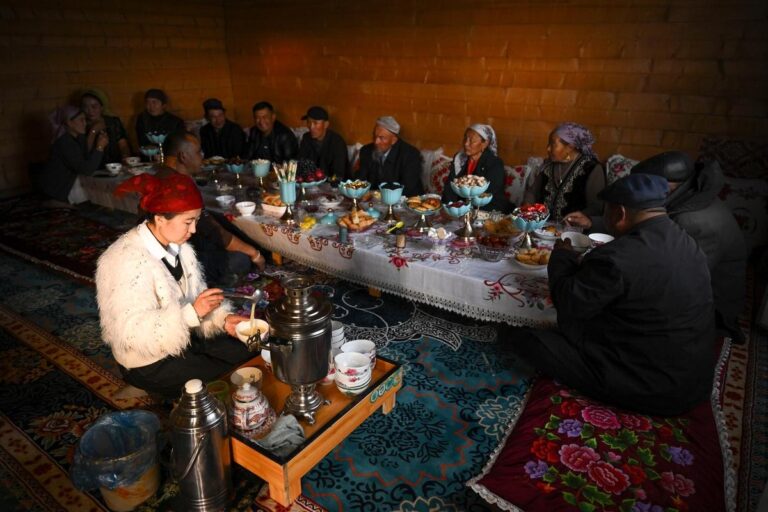
The bazaar is the best cheap lunch in town. Look for naan pulled from a tandir seconds earlier, skewers cooked over coals, bowls of hand-pulled laghman, and cups of milky tea. Prices are local, not tourist – a full plate rarely costs more than a few yuan. Follow the longest queue of locals; it is the most reliable review system in Xinjiang.
Handicraft buying pointers
For Atlas silk, hold it to the light to see the ikat blur that machines struggle to copy. For knives and copper, weight and finish tell the story. Buy from a stall the owner clearly runs, not a middleman near the exit, and keep the receipt – some items need it for shipping later.
Etiquette that earns you a smile
Bargaining is expected but warm, not adversarial. Start at roughly half to two-thirds of the asking price for crafts, smile, and be ready to walk away – then come back. Ask before photographing people, especially in the livestock section. And buy a snack from a stall you photograph; it is the polite exchange.
Stay alert in the crowd
Bazaars get crowded, and crowds attract the usual pickpockets. Wear a cross-body bag worn to the front, keep your phone on a short lanyard, and count your change at the stall rather than after you walk away. None of this is unique to Xinjiang – it is standard market sense anywhere – but the big Sunday bazaars pack in thousands, so a little caution goes far. The livestock section in particular is a working market, not a stage, and being jostled is part of it; keep your footing and your wallet, and you will enjoy it far more.
How to time your trip around the bazaar
If a Sunday market is your priority, build the week so you reach that town on Saturday night. Markets typically peak early – think 08:00 to noon – and thin out by mid-afternoon as traders pack up. Arriving at opening means the best produce, the fullest pens, and the most energy. Sleeping in costs you the best hour.
Bazaars vs the everyday bazaar
Do not confuse the weekly bazaar with the permanent covered bazaars and the modern shopping and souvenir streets in big cities. Those are open daily and are great for gifts; the weekly bazaar is the living version, where almost nothing is priced for tourists and almost everything is the real thing. Both are worth your time, but they are different experiences.
A sample bazaar-day plan
Arrive the night before and stay within walking distance of the market. Be at the gate when it opens; the first hour is calm enough to photograph and talk. Do your serious shopping by late morning, eat at a stall, then drift the outer livestock ring before it thins. By early afternoon most traders have gone – leave with them, or you will be photographing empty tarps.
What not to buy: a quick customs reminder
Most bazaar goods are fine to take home, but a few need care. Antique-looking items may actually be protected artefacts – buy only from licensed sellers who provide paperwork. Certain knives and some animal products face shipping and import limits, so if unsure, ask before you pay. The joy of a bazaar is the everyday stuff: spices, cloth, dried fruit, and the stories.
Photography without being a nuisance
The bazaar is photogenic to a fault, but restraint reads as respect. Shoot the stalls and the light, ask before portraits, and offer to send a photo if you take one of a person – many will happily agree once you have asked. The best bazaar images come from the trust you build in the first ten minutes, not the longest lens.
Questions people keep asking me
Which Xinjiang bazaar is the most famous?
The Kashgar Sunday Bazaar is the headline act – enormous, historic, and easy to reach. But smaller town bazaars are often more intimate and less performative.
Do all bazaars happen on Sunday?
No. Sunday is common for the big ones, but many county and village bazaars use a different fixed weekday or a multi-day cycle. Ask at your hotel to confirm.
Is bargaining required?
For crafts and souvenirs, yes – it is part of the ritual. Keep it friendly. Food and produce often have firmer prices.
Can I photograph the livestock market?
With permission. Ask the owner before pointing a camera at animals or people; a small purchase smooths the interaction.
What should I bring to a weekly bazaar?
Cash in small notes, a reusable bag, comfortable shoes, and an empty stomach for the food stalls. Arrive early for the best selection.