Xinjiang 21-Day Itinerary: The Complete North + South + Pamir Route
Where details change with short notice — Pamir road closures, the annual Duku Highway opening date and park shuttle prices — the guide names who can confirm them.
How This Guide Was Researched
Overview & Key Facts for a Xinjiang 21-Day Itinerary
Xinjiang is roughly the size of Iran.
Key facts travelers and official sources consistently confirm:
- Distances: Urumqi to Kashgar is about 1,470 km by road, roughly 24 hours by conventional train, and about 2 hours by air.
- Time zone: the region officially runs on Beijing time (UTC+8), but local life in the south often runs two hours later. Always ask which clock a schedule uses.
- Checkpoints: ID checks are routine on highways, at stations and bazaars, with 10–40 minute delays at busy southern posts. Keep your passport on you.
- Permits: foreign nationals need a border permit beyond Tashkurgan and for some valleys, arranged via a licensed agency or the PSB in Kashgar; confirm 2–4 weeks ahead.
- Altitude: Karakul Lake sits around 3,600 m and Tashkurgan around 3,100 m, the route’s main physiological challenge.

The plan below assumes 4–6 hours moving and 4–6 hours sightseeing per day, with three deliberate rest days. Cutting those rest days is the most common mistake in the trip reports reviewed.
Getting there and the distances
Almost every three-week route starts and ends at Urumqi Diwopu International Airport (URC). Timetables show daily connections to Beijing, Shanghai, Guangzhou, Xi’an, Chengdu and Chongqing, with flights of roughly 3.5–5 hours from the eastern seaboard.
By rail, the Lanzhou–Urumqi high-speed line puts Xi’an around 12–14 hours away. Inside Xinjiang, the useful high-speed segment is Urumqi–Turpan North (about 1 hour 10 minutes) and Urumqi–Hami.
| Long jump | Fastest option | Typical duration | Indicative 2025 cost |
|---|---|---|---|
| Urumqi → Turpan | High-speed rail (D/G) | 1 h 10 m | 90–110 RMB 2nd class |
| Urumqi → Kashgar | Flight | 2 h | 600–1,300 RMB |
| Urumqi → Kashgar | Sleeper train | 22–25 h | 230–420 RMB hard sleeper |
| Kashgar → Yining (Ili) | Flight (often via URC) | 1 h direct / 4–6 h via URC | 700–1,500 RMB |
| Yining → Urumqi | Flight or overnight train | 1 h / 11–13 h | 500–900 RMB / 180–330 RMB |
Rental cars are available in Urumqi, Kashgar and Yining, but foreign licences need a temporary Chinese permit, so most visitors hire a car with a driver. Operator quotes from 2024–2025 cluster around 800–1,400 RMB per day including fuel, more for 4WD on the Pamir or Kanas legs.
What tickets cost
These are published 2025 reference prices. Scenic areas usually charge separately for the gate ticket and the compulsory internal shuttle, the biggest source of budget surprises.
| Site | Gate ticket (2025) | Shuttle / extras | Notes |
|---|---|---|---|
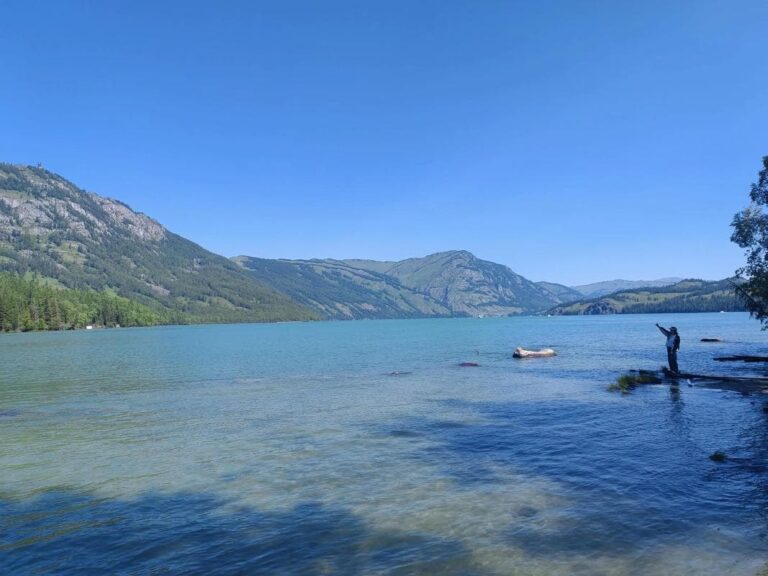
| Kanas Lake Scenic Area | 195 RMB | Shuttle ~120 RMB; Guanyu Pavilion ~120 RMB | Multi-day passes available; confirm locally |
| Hemu Village | ~62 RMB | Shuttle ~52 RMB | Often bundled with Kanas |
| Jiaohe Ruins, Turpan | 70 RMB | Buggy ~20 RMB | Little shade; go early |
| Emin Minaret | 45 RMB | to | Interior access varies |
| Karez Museum | 40 RMB | to | Good on a hot afternoon |
| Id Kah Mosque, Kashgar | 45 RMB | to | Closed to visitors at prayer times |
| Kashgar Old City | Free | to | Some courtyard houses charge small fees |
| Karakul Lake | ~50–100 RMB area fee | Camel/horse ~100 RMB | Permit checks en route |
| Sayram Lake | 70 RMB | Shuttle ~75 RMB | Peak-season queues at the gate |
| Nalati Grassland | 95 RMB | Shuttle 60–100 RMB | Two separate valley routes |
| Duku Highway | Free road | Fuel only | Seasonal closure, typically Oct–Jun |
Realistic all-in daily budgets from 2025 traveler reports, excluding international flights:
- Budget (dorms, buses, street food): 300–450 RMB per person per day.
- Mid-range (3-star hotels, occasional car hire, restaurant meals): 600–900 RMB.
- Comfortable (4-star, private car and driver split two ways): 1,200–1,800 RMB.
For 21 days, the mid-range total is around 13,000–19,000 RMB per person including domestic flights and tickets. Alipay and WeChat Pay now accept many foreign cards; set both up before arrival and carry 1,000–2,000 RMB cash as backup.
What each season brings
No single window is ideal for all three regions, which is the central compromise of a three-week trip. Our detailed best time to visit Xinjiang breakdown goes month by month; the short version for this route:
- Late June to early July: the Duku Highway has usually reopened, Ili grasslands and lavender peak, and the Pamirs are accessible. Turpan is already 40 °C plus.
- Mid-September to early October: the strongest compromise. Kanas turns gold, Turpan drops to 25–30 °C, grape harvest is on. Downside: National Day (1–7 October) brings heavy crowds and inflated rates.
- August: everything open, everything busy, southern desert heat punishing.
- November–March: Kanas becomes a snow destination, Duku closes, some Pamir services suspend. Not recommended for a first circuit.
If you build around one date, mid-September is what most reviewed reports recommend for this north-plus-south-plus-Pamir combination.
The itinerary I would follow
Three weeks, three phases: Week 1 covers Urumqi, Turpan and the flight south to Kashgar; Week 2 is the Pamir Highway and southern rim; Week 3 returns north for Ili, the Duku Highway and Kanas before exiting via Urumqi.
Week 1: Urumqi – Turpan – Kashgar
| Day | Time | Plan |
|---|---|---|
| 1 | 09:00 / 14:00 / 19:00 | Arrive Urumqi; Xinjiang Regional Museum (free, timed entry, book via WeChat mini-program); Grand Bazaar and dinner |
| 2 | 08:00 / 11:00 / 16:00 | Drive to Tianchi (Heavenly Lake); lakeside walk and shuttle loop; return to Urumqi by evening |
| 3 | 08:30 / 10:30 / 17:00 | High-speed rail to Turpan North; Jiaohe Ruins before the heat; Karez Museum and Emin Minaret at golden hour |
| 4 | 07:30 / 12:00 / 18:00 | Flaming Mountains and Bezeklik Caves early; Grape Valley lunch and shade; night train or drive back to Urumqi |
| 5 | 10:00 / 13:00 / 20:00 | Flight Urumqi–Kashgar; hotel check-in and slow afternoon to reset; Id Kah square at dusk |
| 6 | 08:00 / 12:00 / 17:00 | Kashgar Old City on foot; coppersmiths’ and hat lanes; rooftop tea house |
| 7 | 07:00 / 12:00 / 15:00 | Sunday Livestock Market (Sundays only); Kashgar Grand Bazaar; rest day, arrange Pamir permit paperwork |
The Xinjiang Regional Museum needs advance reservation and closes Mondays; the livestock market runs Sundays only, and the Kashgar Old City deserves two unhurried days.
Week 2: Pamir Highway and the Southern Loop
| Day | Time | Plan |
|---|---|---|
| 8 | 08:00 / 12:30 / 16:00 | Karakoram Highway south; Baishahu (White Sand Lake) stop; overnight Karakul Lake or continue to Tashkurgan |
| 9 | 09:00 / 14:00 / 18:00 | Muztagh Ata viewpoints; Tashkurgan Stone Fort and wetland boardwalk; acclimatise, early night |
| 10 | 08:30 / 13:00 / 19:00 | Optional Khunjerab Pass viewpoint (permit-dependent, closed in winter); return drive to Kashgar |
| 11 | 08:00 / 13:00 / 18:00 | Kashgar to Yarkand and Karghilik; Yarkand royal tombs and old quarter; overnight Karghilik or Hotan |
| 12 | 09:00 / 12:00 / 16:00 | Hotan silk and carpet workshops; jade market on the riverbank; Hotan night market |
| 13 | 08:00 / 14:00 / 19:00 | Taklamakan Desert Highway northbound or flight Hotan–Urumqi; long transit day |
| 14 | 10:00 / 15:00 / 20:00 | Rest and laundry day in Urumqi or Korla; repack for the cooler north |
Day 13 is the weak point: the Taklamakan crossing is 500 km of near-featureless road with checkpoints, so flying Hotan to Urumqi buys back most of a day.

Week 3: Northern Xinjiang – Ili – Kanas – Exit
| Day | Time | Plan |
|---|---|---|
| 15 | 09:00 / 13:00 / 18:00 | Fly or train to Yining; Kazanqi folk quarter; Uyghur and Hui dinner street |
| 16 | 08:00 / 12:00 / 17:00 | Drive to Sayram Lake; shoreline loop and Guozigou Bridge viewpoint; overnight lakeside yurt or Qingshuihe town |
| 17 | 08:30 / 13:00 / 18:30 | Nalati Grassland; horse ride or valley shuttle; overnight Nalati |
| 18 | 07:30 / 12:00 / 19:00 | Duku Highway northbound: Nalati to Dushanzi via mountain passes; frequent photo stops; long day, start early |
| 19 | 08:00 / 15:00 / 20:00 | Transfer north to Burqin; Wucaitan (Colourful Beach) at sunset |
| 20 | 08:00 / 12:00 / 17:00 | Kanas Lake shuttle and Guanyu Pavilion; Moon Bay and Fairy Bay boardwalks; overnight Hemu or Jiadengyu |
| 21 | 07:00 / 13:00 / 19:00 | Hemu village morning mist viewpoint; drive or fly Kanas–Urumqi; departure |
Day 18 is the driving highlight and biggest risk: the Duku Highway opens in June and closes in October, with mid-season suspensions, so confirm the day before. Sayram Lake pairs with the Guozigou viaduct, and Kanas Lake justifies two nights here.
Where I stayed
Quality varies more by region than by price; Urumqi and the north have reliable chain hotels, while southern towns rely on family guesthouses where hot water and heating can be intermittent.
- Urumqi: near the Grand Bazaar or Hongshan for transport; chains 300–700 RMB. Airport hotels help for the early Kashgar flight.
- Turpan: 200–400 RMB. Functioning air conditioning is non-negotiable in summer; verify before paying.
- Kashgar: old-town courtyard guesthouses 200–450 RMB put you inside the neighbourhood you came to see. New-city hotels are cheaper but a 20-minute taxi away.
- Karakul / Tashkurgan: yurts and guesthouses 150–350 RMB. Yurts are often unheated; travelers recommend Tashkurgan for sleeping and Karakul for daytime.
- Hotan: business hotels 200–350 RMB, limited English.
- Yining and Sayram: town hotels 250–500 RMB; lakeside yurts 200–400 RMB, shared facilities.
- Kanas area: the most expensive beds on the route. Jiadengyu and Hemu guesthouses hit 500–1,200 RMB in peak autumn and sell out weeks ahead.
Food: What & Where to Eat
The food follows the same regional lines: lamb, wheat noodles, cumin and naan everywhere, with regional variations that keep three weeks from feeling repetitive.

- Laghman: hand-pulled noodles with stir-fried lamb, peppers and tomato, 20–35 RMB. Best where they pull to order.
- Polo (pilaf): rice with lamb and shredded carrot from bazaar cauldrons, 25–40 RMB.
- Kawap (kebab): 5–10 RMB per skewer; Turpan and Kashgar night markets are reliable.
- Nan: 2–5 RMB from tandoor bakeries; Kashgar’s sesame and onion variants are worth seeking out.
- Samsa: baked lamb pastries off the oven wall, 5–8 RMB.
- Turpan fruit: seedless grapes and Hami melon in season, sold by weight roadside.
- Hotan: walnut and rose-jam snacks plus heavily spiced whole-lamb dishes.
- Ili: Kazakh and Russian influence shows in horse-meat sausage, kumis, and bread with sour cream in Kazanqi.
- Kanas: Tuvan and Kazakh milk tea and dried curd. Food inside the park is expensive and mediocre, so carry snacks.
Practical local notes
- Carry your passport at all times. Checkpoints, stations and bazaars scan it; a photocopy is not accepted.
- Build in buffer. Security queues can add 30–60 minutes to southern days, so avoid tight flight connections.
- Connectivity. Many foreign apps are blocked; download offline maps, translation packs and booking confirmations, and get a local SIM or eSIM for payments and check-in.
- Altitude. Sleep low, ascend gradually, skip alcohol at Karakul, and if headache plus vomiting appears, descend to Kashgar.
- The two-hour clock gap. When a time is quoted, ask Beijing or local; it resolves most missed-bus stories.
- Photography. Never photograph checkpoints, police or military sites; ask before photographing people, especially in mosques and bazaars.
- Packing. Layers for the 40 °C to near-freezing swing, strong sun protection, a dust buff and a power bank.
- Agencies. A licensed agency handles border permits, foreigner-approved hotels and drivers; confirm whether a quote includes gate tickets and shuttles.
Before you go: the things that matter
- 21 days genuinely enough — Yes, but only with two or three domestic flights.
- Xinjiang 21-day itinerary as an independent tr — The Urumqi, Turpan, Ili and Kanas portions are straightforward independently.
- Single week should i cut — Cut the southern loop to days 11 to 14 to Yarkand, Hotan and the Taklamakan crossing, which has the longest transit and least variety.
- Duku highway definitely be open in september — Usually, but not guaranteed.
- Bad is the altitude on the karakul — Karakul is around 3,600 m and Tashkurgan around 3,100 m.
- Foreigners really turned away from some hotels — It happens in smaller southern towns because properties need specific registration for foreign passports.
- Realistic total budget for three weeks — 2025 mid-range reports cluster at 13,000–19,000 RMB per person including domestic flights, hotels, tickets, food and a shared car for the Pamir and Duku segments.
- Sunday livestock market worth planning dates a — If you have flexibility, yes to it is a genuinely working market, not a restored attraction, and runs Sundays only.
- The author — Karl Huang writes long-form route research for xinjiangtraveltips.com.
Work through that list a few days before departure, not on the morning you fly. Most of the grief I have seen on this route comes from leaving it until the last minute.