7-Day Northern Xinjiang Itinerary: The Perfect Route for First-Time Visitors
7-Day Northern Xinjiang Itinerary: The Perfect Route for First-Time Visitors
Last updated: July 15, 2026 · Written by Karl Huang, a Xinjiang travel specialist who has spent time across the region. Practical details are cross-checked against official tourism, transport, and border-regulation sources.
| Best time | June–October; September–October is best for colors. |
|---|---|
| How long | 7 days, drive-heavy loop. |
| Difficulty | Moderate — long daily drives between sites. |
| Cost level | ≈¥3,500–6,000 per person all-in. |
| Route | Urumqi → Sayram → Yining → Nalati → Kuerdening → Kanas → Hemu → Urumqi. |
| Don’t miss | Sayram Lake, Nalati grassland, Kanas Lake & Three Bays, Hemu Village. |
Northern Xinjiang (北疆) is where China’s most spectacular alpine scenery converges with some of its richest cultural diversity. Unlike the stark desert landscapes and profound historical sites that define the south, the north is a realm of emerald lakes set like jewels in high mountain valleys, of vast grasslands where Kazakh nomads still migrate with the seasons, of birch forests that turn liquid gold in September, and of snow-capped peaks that rival anything in the Alps or the Rockies. This 7-day itinerary is designed for travelers who want to experience the very best of Northern Xinjiang without the exhaustion of constant long-distance driving. The route forms a logical loop starting and ending in Urumqi, taking in the heavenly alpine lake of Sayram, the grassland paradises of Nalati and the less-visited but equally stunning Kuerdening, the storybook timber village of Hemu, and the mystical, lake-dotted forests of Kanas — a region that has been called “China’s Switzerland” and “the last untouched piece of Central Asia.” Along the way, you’ll stay in a mix of comfortable hotels and, if you’re adventurous, a traditional yurt or timber guesthouse, eat food that ranges from high-end Uyghur cuisine to simple nomad fare, and encounter cultures — Kazakh, Mongolian, Tuvan, and Uyghur — that have shaped this landscape for centuries. Whether you’re traveling independently with a rental car, joining a small-group tour, or hiring a private driver, this itinerary provides everything you need to plan a trip that balances iconic sights with off-the-beaten-path experiences.
Contents:
- Route Overview & Map
- Best Time to Do This Route
- Day 1: Urumqi to Sayram Lake
- Day 2: Sayram Lake & Guozigou Bridge
- Day 3: Sayram to Nalati Grassland
- Day 4: Nalati to Kuerdening (or Kucha alternative)
- Day 5: Kuerdening to Kanas via Beitun
- Day 6: Kanas Lake & the Three Bays
- Day 7: Hemu Village & Return to Urumqi
- Transportation Options
- Where to Stay
- Budget & Costs
- What to Pack
- Final Tips & Conclusion
Route Overview: The Classic Northern Loop
This 7-day itinerary covers approximately 1,800 kilometers by road, forming a loop through some of China’s most spectacular scenery. The route is designed to minimize backtracking while ensuring that you spend your time experiencing places rather than sitting in a car. Here’s the day-by-day breakdown:
Day 1: Urumqi → Sayram Lake (550 km, 6-7 hours)
Day 2: Sayram Lake (full day) → Guozigou Bridge → Yining (overnight)
Day 3: Yining → Nalati Grassland (250 km, 4 hours)
Day 4: Nalati Grassland (full day) → Kuerdening (180 km, 3-4 hours)
Day 5: Kuerdening → Beitun (550 km, 7-8 hours) — OR fly from Yining to Kanas (seasonal)
Day 6: Kanas Lake, Three Bays hike, and lakeside villages
Day 7: Hemu Village → return to Urumqi (by air or long drive)
This route can be done in either direction (clockwise or counter-clockwise), but the suggested order above has you gaining elevation gradually and saving the most spectacular destination — Kanas and Hemu — for the second half of the trip, when you’ll be fully acclimated to the rhythm of travel in this region.
A note on logistics: Northern Xinjiang is vast, and distances between destinations are significant. The recommended approach is to hire a private driver with an SUV (approximately 800-1,200 yuan per day including driver’s fee, fuel, and the driver’s accommodation), which gives you flexibility and local knowledge without the stress of navigating unfamiliar roads. Alternatively, self-drive with a rented SUV is increasingly popular, but be prepared for variable road conditions and the need for a Chinese driver’s license. Flying between Urumqi and the regional airports (Kanas Airport, Yining Airport) can save time but reduces your flexibility for sightseeing en route.
Best Time to Do This Route
Northern Xinjiang’s climate varies dramatically by season, and the timing of your visit will fundamentally shape your experience. Here’s a season-by-season breakdown:
June to early July: This is wildflower season on the grasslands. Nalati, Kuerdening, and the high pastures around Kanas are carpeted with poppies, irises, gentians, and countless other species. The weather is pleasantly warm (15-25°C in the day, 5-15°C at night) and the mosquitoes haven’t yet reached their August peak. The downside: this is peak domestic tourist season and accommodation prices are at their highest. Sayram Lake may still be partially frozen in early June.
Mid-July to August: The warmest period, with daytime temperatures reaching 25-30°C in the valleys. The grasslands are lush and green, the lakes are at their most vivid blue, and all facilities are fully open. The downsides: mosquitoes can be ferocious (bring serious repellent), and domestic tourist numbers are at their peak, especially during Chinese school holidays (mid-July to late August). If you must travel in August, try to visit Kanas mid-week to avoid the worst crowds.
September (especially mid-to-late): Widely considered the best time to visit Northern Xinjiang. The birch and poplar forests turn brilliant gold, the crowds have thinned dramatically, the mosquitoes are gone, and the light has a crystalline quality that photographers dream about. Daytime temperatures are comfortable (10-20°C) but nights get cold (below 0°C at Kanas). This is also the time when the local Kazakh and Mongolian nomads are bringing their herds down from the high summer pastures — a spectacular sight if you’re lucky enough to witness it.
October: The golden season extends into early October, but by mid-month snow is likely and many facilities begin to close for the winter. The Kanas area can be magical in early October if you don’t mind cold temperatures and the possibility of road closures due to snow.
November to May: Not recommended for this itinerary. Many roads are closed, facilities are shut, and the weather is brutally cold. The one exception is for winter sports enthusiasts — the Altay region (near Kanas) is the birthplace of human skiing and offers exceptional powder snow from December to March.
Day 1: Urumqi to Sayram Lake
Distance: ~550 km | Driving time: 6-7 hours | Overnight: Sayram Lake area or Wenquan County
Your journey begins in Urumqi, Xinjiang’s sprawling capital. If you haven’t already arrived a day early, use the morning to pick up a rental car or meet your driver, stock up on snacks and water, and load offline maps (Gaode Maps works well in Xinjiang). The drive from Urumqi to Sayram Lake takes you west across the northern rim of the Tarim Basin before climbing into the Tianshan Mountains. The road (G30 Expressway for most of the way) is in excellent condition and offers progressively more dramatic scenery as you approach the mountain passes.
Your first major sight is the Tianshan Tianchi (Heavenly Lake) — a detour of about 1.5 hours round-trip from the main route. If you have time, the short hike around the lake and the view of the 5,445-meter Bogda Peak reflected in the water are well worth it. If you’re on a tight schedule, save it for another trip and press on toward Sayram.
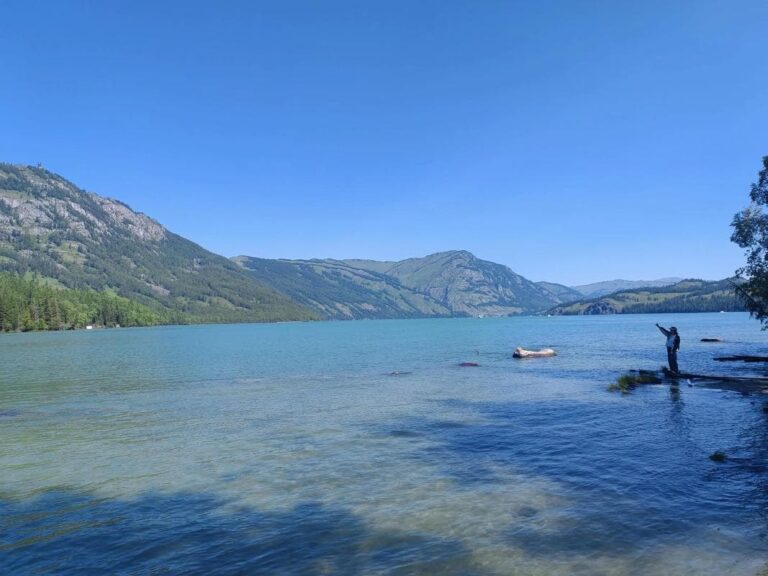
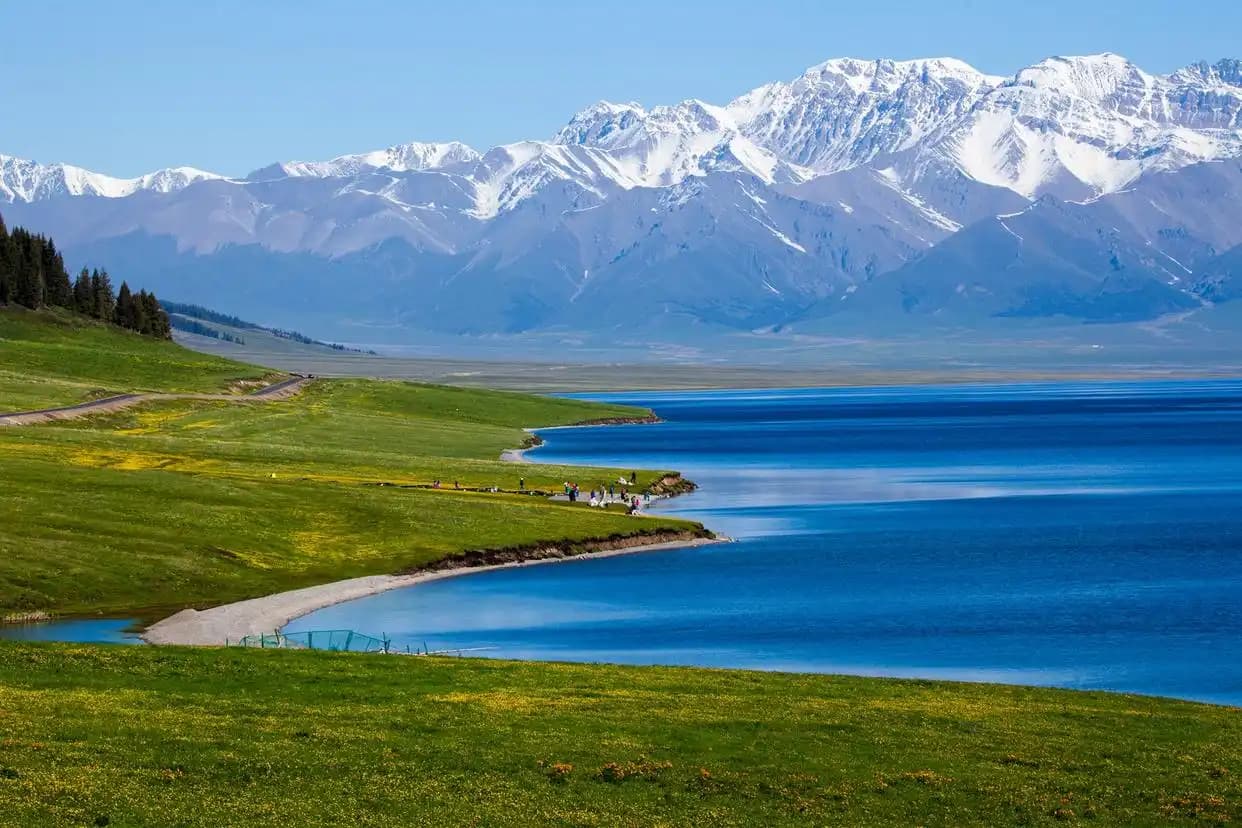
As you approach Sayram Lake in the late afternoon, the landscape suddenly opens up to reveal one of China’s most breathtaking sights: a massive alpine lake of an almost impossible blue, ringed by snow-capped mountains and, in summer, surrounded by meadows of wildflowers. Sayram is the largest alpine lake in Xinjiang, sitting at an elevation of 2,073 meters. The lake’s color changes dramatically with the light — steely blue-grey under clouds, electric turquoise in full sun, and a deep, velvety blue at dusk.
Where to stay: There are several options around Sayram Lake. The most atmospheric is to stay in a yurt camp right by the lakeshore (150-300 yuan per person including dinner and breakfast), but these are basic and can be cold at night. More comfortable options include the Sayram Lake Hotel (within the scenic area, expensive but convenient) or hotels in Wenquan County (40 km away, cheaper but requires driving).
What to do in the evening: If you’re staying by the lake, take a walk along the shore as the sun sets. The silence at Sayram is profound — broken only by the wind and the occasional call of a waterbird. On a clear night, the stargazing is exceptional due to the high elevation and minimal light pollution.
Day 2: Sayram Lake & Guozigou Bridge
Spend the full morning exploring Sayram Lake. The scenic area has a ring road (approximately 60 km) that circles the lake, with multiple viewpoints and short hiking trails. Key stops include:
Eastern Shore: The most accessible area, with boardwalks and the best facilities. Good for a gentle lakeside walk.
Southwestern Shore: Less developed and much quieter. This is where you’re most likely to spot the lake’s small population of swans and other waterbirds.
Dianjiangtai (点将台): A historical site where, according to legend, Genghis Khan reviewed his troops before heading west on campaign. The views from here are panoramic.
In the afternoon, drive south over the Guozigou (Fruit Valley) Pass. The Guozigou Bridge is an engineering marvel — a cable-stayed bridge that seems to float above a deep, forested valley. There’s a dedicated viewpoint where you can photograph the bridge framed by mountains. The drive through Guozigou is spectacular in its own right, with waterfalls, dense spruce forests, and frequent glimpses of snow peaks.
Continue to Yining (Ghulja), the main city of the Ili Valley and one of Xinjiang’s most appealing urban centers. Yining has a distinctly different feel from other Xinjiang cities — greener, more relaxed, and with a visible Kazakh and Uzbek influence. Spend the evening exploring the city’s tree-lined streets, visit the local bazaar, and enjoy a good meal. Recommended restaurants in Yining include those serving Kazakh specialties (try the horse meat sausage, called “kazy,” if you’re feeling adventurous) and Uyghur standards done exceptionally well.
Where to stay: Yining has a full range of accommodation. The Yining International Hotel and similar mid-range options (200-500 yuan/night) offer good value. For something more atmospheric, ask about guesthouses in the old district (book in advance during peak season).
Day 3: Yining to Nalati Grassland
Distance: ~250 km | Driving time: 4 hours | Overnight: Nalati town or inside the scenic area
The drive from Yining to Nalati takes you deeper into the Ili Valley, passing through rolling hills, poplar groves, and small Kazkah yurt encampments. Nalati is one of China’s most famous grasslands — a vast, undulating alpine meadow set at an elevation of 1,800-2,700 meters, ringed by snow peaks, and carpeted with wildflowers from May to August.
Exploring Nalati: The scenic area is large and best explored by a combination of driving and hiking. There are three main valleys to explore:
Aerial Grassland (Kongzhong Caoyuan): The most famous section, accessible by a steep road that climbs to a high plateau with 360-degree mountain views. There’s a cable car if you don’t want to drive the steep road. The views here are genuinely sublime — endless green rolling hills, distant peaks, and, if you visit in the right season, a profusion of wildflowers.
Valley Grassland (Guöyuan Caoyuan): A gentler landscape of river valleys, small forests, and Kazakh yurt encampments. This area is more accessible and gives you a better sense of how the grasslands are actually used by local people.
Yusun Historic Site: An archaeological site related to the ancient Wusun people who inhabited these valleys over 2,000 years ago. The setting is beautiful even if you’re not a history buff.
What to do: Hiking is the best way to experience Nalati. There are marked trails of varying difficulty. Horseback riding is also available (100-200 yuan/hour) and is a great way to explore areas that are inaccessible by car. If you’re visiting in the evening, stay for sunset — the way the light hits the grass and the distant peaks is unforgettable.
Where to stay: You have two main options. Staying inside the scenic area (in a yurt or the Nalati reputable resort hotel) lets you experience the grassland at sunrise and sunset when the day-trippers have left, but it’s more expensive (yurts: 200-400 yuan; hotel: 600-1,200 yuan). Staying in Nalati town (just outside the scenic area gate) is cheaper (150-300 yuan for decent hotels) but requires entering the scenic area each day (entrance fee: 95 yuan, valid for 48 hours).
Day 4: Nalati to Kuerdening
Distance: ~180 km | Driving time: 3-4 hours | Overnight: Kuerdening area
Kuerdening (also called Kurdenin) is the lesser-known stops of this itinerary — far less visited than Nalati but, many would argue, even more beautiful. Part of the same mountain system as Nalati, Kuerdening is a vast scenic area characterized by deep spruce forests, alpine meadows, rushing rivers, and a remarkable diversity of plant life (over 1,500 species have been recorded here).
The drive from Nalati to Kuerdening takes you over mountain passes with spectacular views. Kuerdening means “Horizontal Valley” in the local language, referring to its east-west orientation that creates a unique microclimate — it’s noticeably more humid and lush than the surrounding areas.
What to do in Kuerdening: Hiking is the main activity. The scenic area has several well-marked trails ranging from easy riverside walks to challenging mountain hikes. The “Seven-Dragon Girl Lake” trail is particularly beautiful — a moderate hike that takes you past a series of small alpine lakes, each with its own character. Birdwatching is excellent here; Kuerdening is home to golden eagles, lammergeiers, and numerous songbird species.
If you’re interested in botany or simply enjoy flowers, Kuerdening is exceptional. Depending on the season, you may see wild tulips (yes, tulips originated in Central Asia), saxifrages, delphiniums, and many species of orchid.
Where to stay: Accommodation in Kuerdening is more limited than at Nalati. There are basic guesthouses and yurt stays within the scenic area, and slightly more comfortable options in the nearby town of Gongliu. Book ahead during peak season.
Day 5: Kuerdening to Beitun (or fly to Kanas)
This is the most challenging logistics day of the itinerary. The direct drive from Kuerdening to the Kanas area is very long (700+ km, 9-10 hours). You have two realistic options:
Option A: The Long Drive. Drive from Kuerdening to Beitun (a transport hub near the northern tip of Xinjiang), then on to the Kanas area the following morning. This is tiring but lets you keep your rental car and see more of the countryside. Break the drive in Beitun for the night — it’s not scenic but has decent hotels and restaurants.
Option B: Fly (recommended if budget allows). Drive from Kuerdening back toward Yining (3-4 hours), then take a flight from Yining to Kanas Airport (seasonal, typically June-September only). Alternatively, drive to Urumqi (6-7 hours from Kuerdening) and fly from Urumqi to Kanas. This saves a full day of driving and gets you to Kanas fresher.
If you choose Option A, use the driving time to observe the changing landscape as you move from the lush Ili Valley to the drier, more dramatic terrain of northern Xinjiang’s border regions. The road passes through some fascinating small towns where you can stop for meals and glimpse local life.
Day 6: Kanas Lake & the Three Bays
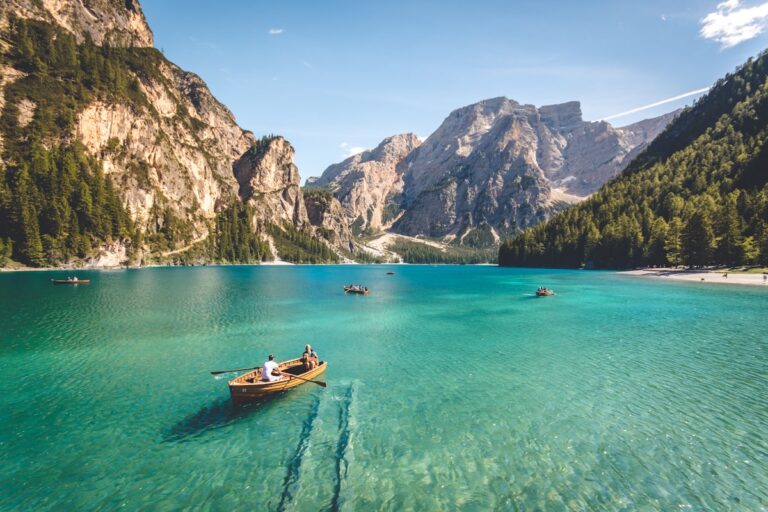
Kanas is the crown jewel of Northern Xinjiang — a place so beautiful it has spawned legends (including the persistent myth of a “Kanas Lake monster,” probably a large species of sturgeon or taimen). The lake itself is a staggering 1,374 meters long, up to 1,745 meters deep, and set in a steep U-shaped glacial valley. The water is an otherworldly blue-green, and the surrounding forest of spruce, pine, birch, and poplar creates a palette of greens and golds that changes with every shift of light.
The Three Bays (Sanwan): These are the three most famous viewpoints along the Kanas River as it flows out of the lake: Moon Bay, Wolong Bay, and Shenxian Bay. Each has a distinctive character. Moon Bay is the most photographed — a perfect crescent of turquoise water embraced by a forested bend. Wolong Bay features a small island in the middle of the river that resembles a sleeping dragon (wolong). Shenxian Bay is the quietest and, some say, the most beautiful, with shallow water that reflects the surrounding forest like a mirror.
The best way to experience the Three Bays is to take the early morning shuttle from the village to the top bay (Moon Bay), then hike downstream through all three. The full hike is about 6 kilometers and takes 2-3 hours at a leisurely pace. The trail is well-maintained and mostly downhill, making it accessible to most fitness levels.
Kanas Village: The main settlement in the area is a mix of wooden cabins (in the traditional Tuvan style), tourist facilities, and the homes of the local Tuvan people (a small Turkic-speaking group with a distinct culture). The village has a small museum dedicated to Tuvan culture, and several families offer homestay accommodation with home-cooked meals.
What to do in the afternoon: Take a boat ride on Kanas Lake (80-120 yuan) for a different perspective on the surrounding peaks. Or, if you’re energetic, hike up to the Guanyu Taiga (observatory platform) for a panoramic view of the lake and valley. The hike takes about 2 hours round-trip and involves some steep sections, but the view from the top is one of the finest in China.
Where to stay: Kanas Village has a range of options from basic guesthouses (150-300 yuan) to comfortable timber resorts (600-1,500 yuan). Staying inside the scenic area (i.e., in Kanas Village or nearby Hemu) is strongly recommended because it allows you to experience the area at sunrise and sunset when the tour groups have left. Note: accommodation inside the scenic area must be booked well in advance for July-September visits.
Day 7: Hemu Village & Return to Urumqi
Hemu is the most beautiful village in the Kanas area — a cluster of 50-60 traditional Tuvan timber cabins set in a river valley surrounded by birch forests and snow peaks. Unlike Kanas Village, which has become quite developed, Hemu retains a more authentic, timeless quality (though it too is discovering tourism). The village is especially magical in the early morning, when the rising sun backlights the birch trees and wood smoke from the cabins drifts across the valley.
Morning in Hemu: Get up before sunrise and hike up to the Hemu Viewing Platform (a 30-40 minute walk from the village) for the iconic view over the village and valley. After sunrise, explore the village on foot. The Tuvan people are known for their skill with horses and their distinctive music (played on instruments like the morin khuur, or horsehead fiddle). If you’re interested, ask about homestay opportunities or cultural performances.
Return to Urumqi: You have two options for the journey back:
Option A: Fly. Kanas Airport (actually closer to Hemu than to Kanas Lake) has flights to Urumqi (1.5 hours). This is by far the most time-efficient option and allows you to maximize your time in Hemu.
Option B: Drive. The drive from Hemu back to Urumqi is very long (700+ km, 9-11 hours) and not recommended unless you have extra days to break up the journey. If you must drive, consider stopping overnight in Beitun or Karamay.
Alternative: If you have an extra day (making this an 8-day trip), spend a second night in Hemu and use the additional day for a longer hike — the trail to the “Beauty Peak” (Meili Feng) offers spectacular high-mountain scenery, or you can hike further up the Hemu River valley toward the Chinese-Mongolian border (you won’t reach the border, but the scenery is magnificent).
Transportation Options: How to Get Around
Self-Drive: Renting a car gives you maximum flexibility but requires a Chinese driver’s license and confidence driving on mountain roads. An SUV is strongly recommended — the roads are mostly paved but some sections (especially to Hemu) involve gravel or dirt. Expect to pay 300-600 yuan/day for a decent SUV. Note: Foreigners may face restrictions renting cars in Xinjiang; check current regulations before traveling.
Private Driver: This is the most popular option for international visitors. A private driver with an SUV costs approximately 800-1,200 yuan per day (including the driver’s fee, fuel, and the driver’s accommodation and meals). The driver handles navigation and can offer local insights, but make sure to agree on the itinerary and costs clearly in advance.
Small Group Tours: Several companies offer 7-day Northern Xinjiang tours with groups of 6-15 people. These typically cost 3,000-6,000 yuan per person (depending on accommodation level) and include transportation, guides, and some meals. This is the most social option and good for solo travelers.
Public Transportation: Possible but challenging. Buses connect the major towns (Urumqi-Yining, Yining-Nalati, Beitun-Kanas), but you’ll miss out on the flexibility to stop at viewpoints and smaller attractions. This option is best for budget travelers with plenty of time.
Where to Stay: Accommodation Guide
Northern Xinjiang’s accommodation ranges from basic to surprisingly luxurious. Here’s what to expect:
Urumqi: Full range available. Recommended: Mid-range business hotels (200-500 yuan/night) in the city center, or upscale options like the Hyatt Regency (800-1,500 yuan/night).
Sayram Lake: Yurt stays (150-300 yuan, very basic) or the Sayram Lake Hotel (600-1,200 yuan, the only hotel actually by the lake). Alternative: stay in Wenquan County (40 km away, 150-300 yuan for decent hotels).
Yining: Good mid-range options (200-500 yuan/night). The Yining International Hotel is reliable.
Nalati: Yurt stays inside the scenic area (200-400 yuan, atmospheric but basic), the Nalati resort hotel (600-1,200 yuan), or hotels in Nalati town (150-300 yuan).
Kuerdening: Basic guesthouses and yurts (150-300 yuan). Book ahead.
Kanas/Hemu: Timber cabins and guesthouses (200-800 yuan/night depending on season and standard). The most atmospheric places book out months in advance for peak season. Luxury options (1,500+ yuan/night) are available but limited.
Budget & Costs: How Much to Budget
Here’s a realistic budget breakdown for this 7-day itinerary (per person, assuming two people sharing costs):
Budget Option (hostels, public transport, simple meals): 3,500-5,000 yuan per person
Mid-Range (3-star hotels, private driver, mix of local and tourist restaurants): 6,000-9,000 yuan per person
Luxury (4-5 star hotels, private driver with good vehicle, high-end dining): 12,000-20,000 yuan per person
Key cost components:
– Transportation (private driver 7 days): 5,600-8,400 yuan total (split between travelers)
– Accommodation (6 nights): 900-6,000+ yuan per person depending on standard
– Entrance fees (all scenic areas): ~800-1,200 yuan per person
– Meals: 100-300 yuan per day per person
– Activities (horse riding, boat rides, etc.): 200-800 yuan per person
What to Pack: Northern Xinjiang Packing List
Northern Xinjiang’s weather can change rapidly, even in summer. Here are the essentials:
Clothing: Layers are key. Pack a moisture-wicking base layer, a fleece or down jacket for evenings, a waterproof outer shell, quick-dry pants, and comfortable hiking boots. Even in July, bring a warm hat and gloves for early morning hikes. A sun hat and sunglasses are essential year-round.
Other Essentials: High-SPF sunscreen (the high-altitude sun is intense), insect repellent (critical in June-August), a reusable water bottle, a power bank (some areas have unreliable electricity), and any prescription medications (pharmacies are limited in remote areas).
Optional but Useful: Binoculars for wildlife and scenery, a lightweight tripod for photography, a small first-aid kit, and offline map downloads (Gaode Maps or Maps.me).
Final Tips & Conclusion
This 7-day Northern Xinjiang itinerary offers a carefully balanced introduction to one of Asia’s most spectacular regions. You’ll experience world-class natural beauty, encounter cultures that have thrived in these landscapes for centuries, and, if you travel with an open mind and a spirit of adventure, come away with memories that will last a lifetime. A few final tips:
First, be prepared for variable connectivity. Mobile phone signal and internet access can be spotty in remote areas. Download offline maps, translation apps, and entertainment before you go. Second, respect local customs. When visiting villages or staying in homestays, dress modestly and ask before photographing people. A simple “hello” in the local language (even just a smile and a gesture) goes a long way. Third, be flexible. Weather, road conditions, or unexpected festivals may require changes to your plan — and some of the best travel experiences come from unplanned detours.
Finally, give yourself time. Northern Xinjiang is not a place to rush. The magic happens when you slow down — when you sit by a mountain lake for an hour and watch the light change, when you accept an invitation to share tea with a nomad family, when you take a wrong turn and discover a valley that isn’t in any guidebook. This itinerary provides a framework, but the real journey is yours to shape.
Note: Road conditions, entrance fees, and accommodation availability can change. Always check the latest information before your trip, and consider consulting with a local travel agency for the most up-to-date advice on logistics.