Visiting Mosques in Xinjiang: Etiquette, Dress, and What Travelers Should Know
Xinjiang is home to some of the most beautiful Islamic architecture in China, from the Id Kah Mosque in Kashgar’s old city to the quiet neighborhood mosques of Turpan and Urumqi. Visiting one is a highlight — but these are working houses of worship, not museums. A little etiquette turns a photo stop into a genuine, welcomed encounter. I’ve visited dozens; the warm ones all followed the same quiet rules.
Dress: cover more than you think
For both men and women, the safe baseline is shoulders, knees, and midriff covered. Women should carry a scarf to cover the hair inside the prayer hall (you can often borrow one at the entrance). Avoid tight or sheer clothing. This isn’t about assimilation — it’s about not being the person whose outfit pulls focus from the worship. I keep a lightweight long-sleeve shirt and a scarf in my daypack all summer for exactly this.
Footwear matters too: you will remove shoes to enter the carpeted hall, so wear ones you can slip off and on without a struggle, and bring clean socks (going barefoot across a cold communal carpet is unpleasant and a little disrespectful). If you arrive in tourist shorts and a tank top, most mosques will still let you in the courtyard but may ask you to cover before entering the hall — a wrapped scarf around the waist and a borrowed shawl over the shoulders usually solves it. The effort to cover is read as respect, and that reading opens doors, literally and socially.
Timing: work around the five prayers
Mosques observe five daily prayers, and the congregation periods are not for tours. The door may close to visitors for 20–40 minutes around each call to prayer (especially the Friday noon congregational prayer, which is the largest). Plan your visit for mid-morning or mid-afternoon, and if you arrive during a prayer, wait outside quietly or return later. Never walk in front of someone mid-prostration to get a better angle.
Photo etiquette: ask, then ask again
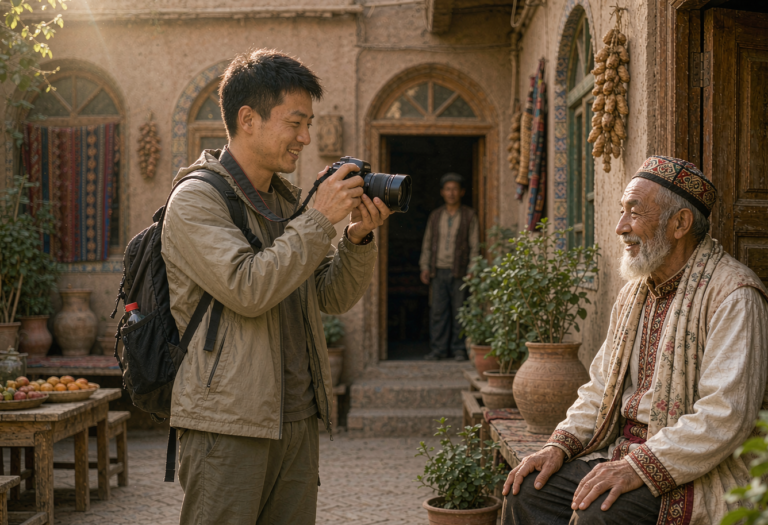
The courtyard and exterior are usually fair game for photos outside prayer times. The prayer hall is different: many mosques prohibit photography inside, and you should always ask a caretaker first. When people are present, point your camera at architecture, not faces, unless you have explicit permission. A raised eyebrow and a smile from the guard is your cue to lower the lens.
A practical tip: photograph the exterior and the call-to-prayer tower (where present) generously, and treat the interior as a place to look rather than capture. If a caretaker waves you in during a quiet hour and seems happy for you to shoot the empty hall, still avoid anyone at prayer and skip the Imam mid-sermon. The reward for restraint is that you’ll often be invited to the rooftop or the minaret — angles no tourist photo ever gets — precisely because you behaved like a guest instead of a shooter.

The do-and-don’t field card
| Do | Don’t |
|---|---|
| Remove shoes before the hall | Wear shoes into the carpet |
| Enter right-foot first, quietly | Talk loudly or take calls |
| Ask before any photo | Photograph people at prayer |
| Dress modestly, scarf for women | Wear shorts or sleeveless tops |
| Visit outside prayer times | Enter during Friday congregational prayer |
Behavior inside: simple respect
Move slowly. Keep your voice low. If you sit, do so along the side rather than in the center of the carpet. Women may be directed to a separate section — follow the cue without fuss. You are not required to pray, and nobody will pressure you to; simply being present respectfully is welcome. When you leave, a quiet “rahmet” (thank you) to the caretaker is remembered. Avoid pointing the soles of your feet toward the mihrab (the niche marking the direction of Mecca) or toward another person; in a floor-seated culture this small habit reads as considerate. Children are welcome and rarely an issue, but keep them from running across the prayer carpet during worship.
A few landmark mosques worth the visit
Xinjiang has hundreds of working mosques; three are especially rewarding for a first-time visitor who wants both architecture and living worship.
Id Kah Mosque, Kashgar
The largest mosque in Xinjiang and one of the largest in Central Asia, Id Kah sits on the edge of the old city and can hold tens of thousands for the Friday prayer. The yellow-tiled facade and tree-shaded courtyard are stunning, and the tourist visiting window (usually mid-morning) lets you see the space without disturbing worship. Arrive early, dress fully modest, and keep to the outer courtyard.
The mosques of Turpan and Urumqi
Turpan’s Emin Minaret complex pairs a mosque with a striking brick tower and is quieter than Kashgar’s giant. In Urumqi, the Tatar Mosque and the smaller neighborhood mosques near the bazaars show the city’s layered communities. These smaller sites are where you are most likely to be waved in warmly by a regular — accept, and you’ll learn more in ten minutes than from any plaque.
Visiting during Ramadan and festivals
During Ramadan the daytime atmosphere shifts: many Muslims fast from dawn to dusk, so restaurants may open later and the pre-dawn and post-sunset hours are the lively ones. As a visitor, you are not expected to fast, but eating, drinking, or smoking openly on the street during daylight is poor form — step into a hotel or a tourist restaurant instead. The nights of Eid al-Fitr and Eid al-Adha are communal celebrations; mosques fill, streets decorate, and a respectful visitor is welcome to watch from the edges. Never photograph the prayer itself without explicit permission.
What to do if you are unsure
When in doubt, mirror the locals and ask the caretaker. A simple gesture — hand on heart, a smile, a mime of “may I look?” — communicates across any language barrier. Most mosque keepers in tourist areas have seen hesitant foreigners and will either nod you in or gently redirect you to the right time. The one thing that reads badly is barging in with a camera at hip height during a prayer; if you catch yourself doing it, lower the lens and step back. Curiosity delivered with humility is almost always met with warmth.

Budgets in figures
| Item | What it costs | Note |
|---|---|---|
| there an entrance fee | ¥15 | Some major mosques charge a small fee (¥15–¥30) for tourists; local worship is free. Fees fund maintenance. |
The numbers above are what I paid on my own trips; add roughly a fifth for a private car and driver if you are travelling with someone else. Anything marked roughly is a bazaar price in high season, and it moves with demand.