Driving in Xinjiang: Road Rules, Checkpoints, and What Visitors Need to Know
I drove my first stretch of Xinjiang highway with a Chinese friend in the passenger seat and a knot in my stomach. The roads were excellent, the scenery was absurd, and the rules were a mix of the familiar and the surprising. If you are thinking about renting a car or joining a self-drive trip here, the good news is that the basics are learnable in an afternoon. The better news is that most of what travellers fear – checkpoints, remote roads, long distances – is manageable once you know the rhythm.
Can a foreign visitor actually drive in Xinjiang?
The short answer: not easily on a foreign license alone. China does not recognise International Driving Permits, and renting a car on a tourist visa usually means you need a Chinese license, which requires a residence permit and a test. In practice, almost every foreign visitor who “drives” in Xinjiang does so as a passenger in a car with a local driver, or as part of a registered self-drive tour where the vehicle and paperwork are handled by the operator. If you are set on holding the wheel, sort the license question before you book anything, not on arrival.
License and documents you need
For a registered self-drive or hired-driver trip, the paperwork sits with the company, but you should still carry your own ID at all times. Here is what gets checked.
| Document | Needed? | Note |
|---|---|---|
| Passport | Yes | Carry it; you will show it at checkpoints |
| Valid visa / residence permit | Yes | Must match your registered route |
| Chinese driving license | For self-drive only | Not issued to tourist visa holders in practice |
| Border permit (for Pamir / border zones) | Sometimes | Get it in Kashgar before heading south |

Police checkpoints: what to expect
Checkpoints are normal in Xinjiang, especially on the approach to border areas, major city entrances, and scenic roads like the Duku Highway. They are routine, not personal, and the fastest move is to have your passport ready and to stay calm. Most take a minute. Drivers hand over documents, passengers may be asked to step down and walk through a scan, and then you are waved on. Argue and you will lose time; smile and cooperate and you will be through quickly.
| Checkpoint type | What they check | Practical tip |
|---|---|---|
| City entrance | Passport scan, vehicle check | Have ID in hand before you stop |
| Scenic road (e.g. Duku) | Documents, sometimes vehicle contents | Go early; queues build by midday |
| Border zone (Pamir) | Border permit + passport | Get the permit in Kashgar first |
Speed limits and cameras
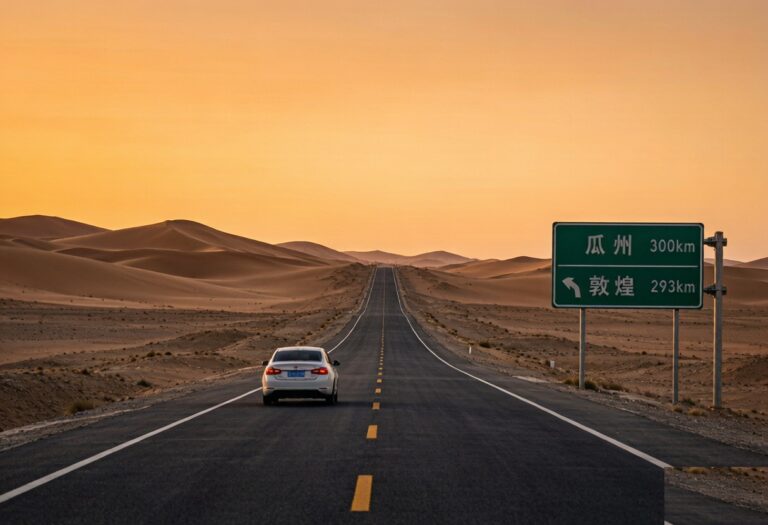
Open desert highways invite speed, and the cameras are real. Limits are posted and enforced by section-control radar that averages your speed between points, so slowing for the camera and then speeding up does not help. In towns the limit drops sharply and is policed tightly. The rule I followed: treat every camera as live, and on the open road keep to the posted limit even when locals appear to ignore it – the fines and the stop are not worth it.
Road etiquette and real hazards
The written rules are close to Europe’s, but the road culture has its own logic. Trucks run the highways hard and will occupy the overtaking lane; pass on the right with care. Livestock – sheep, cattle, camels – wander onto rural roads, especially at dawn and dusk, and they win every collision. Glare off pale desert and snow is fierce, so sunglasses are not optional. And in remote stretches, fuel and signal both run out, so you top up the tank whenever you can rather than when you must.

Fuel, tolls, and night driving
Petrol stations require an ID scan at the pump, which is why a registered driver smooths the stop. Tolls are collected electronically on the big highways and are modest for the distances covered. Night driving is legal but I avoid it: wildlife, unlit trucks, and fatigue on multi-hour empty roads turn a pretty dusk into a long dark slog. Plan to be off the remote roads by full dark, and build your day around the region’s real transport geography rather than against it.
Renting a car versus hiring a local driver
For most foreign visitors the real decision is not “can I drive” but “who holds the wheel.” Renting a car and self-driving is open to residents who hold a Chinese license, and it is the only option that gives total freedom on routes like the Duku Highway or the southern Tarim loop, where you may want to stop wherever the light is good. Hiring a local driver is the common choice for foreign travellers: it costs more per day but removes the license question, smooths every checkpoint, and handles the fuel-pump ID scan, and a good driver usually knows which scenic pull-offs are actually worth the stop. A third route is a registered self-drive tour, where you ride in a caravan and get the road experience without the paperwork. Pick the option that matches your tolerance for logistics rather than your pride – the scenery is the same either way.
Reading the road signs and planning your day
The distances are the part first-time visitors consistently underestimate. Xinjiang is larger than many countries you could name, so a “short” 400 km hop is a solid five-hour drive once you add a checkpoint or two, slow truck traffic, and a fuel stop. Road signs are in Chinese and usually Uyghur, with distances in kilometres; learn to read the blue highway shields and the town names before you depend on them. Build each day around one or two real targets instead of a long list, start early so you clear checkpoints before the midday queues, and treat the GPS as a hint rather than gospel, because signal dies in the gorges and out on the desert highways. The travellers who end up enjoying the driving are the ones who planned for the emptiness instead of fighting it.
A few things worth answering
Is an International Driving Permit valid in Xinjiang?
No. China does not recognise the IDP, and tourist-visa holders generally cannot get a local license. Plan to ride with a registered driver or tour.
Will checkpoints slow my trip down?
A little, but rarely more than a few minutes each. Build them into your timing and treat them as routine; they are not a reason to avoid self-drive routes.
Do I need snow tires in winter?
On mountain passes like Duku, yes when open, and many such roads close entirely from late autumn to late spring. Check the season before you plan a winter drive.
Can I drive the Duku Highway myself?
Only with a qualifying license and a suitable vehicle; most foreign visitors do it as passengers in a registered self-drive tour. The road is spectacular and the rules are strict.
Can I pay for fuel with a foreign card?
Not reliably. Stations often prefer mobile pay or cash, which is another reason a local driver or operator saves headaches at the pump.
Is it safe to drive long distances here?
The roads are good and the main corridors are busy by day. The main risks are fatigue, weather on passes, and running the tank low in remote areas – all manageable with planning.